


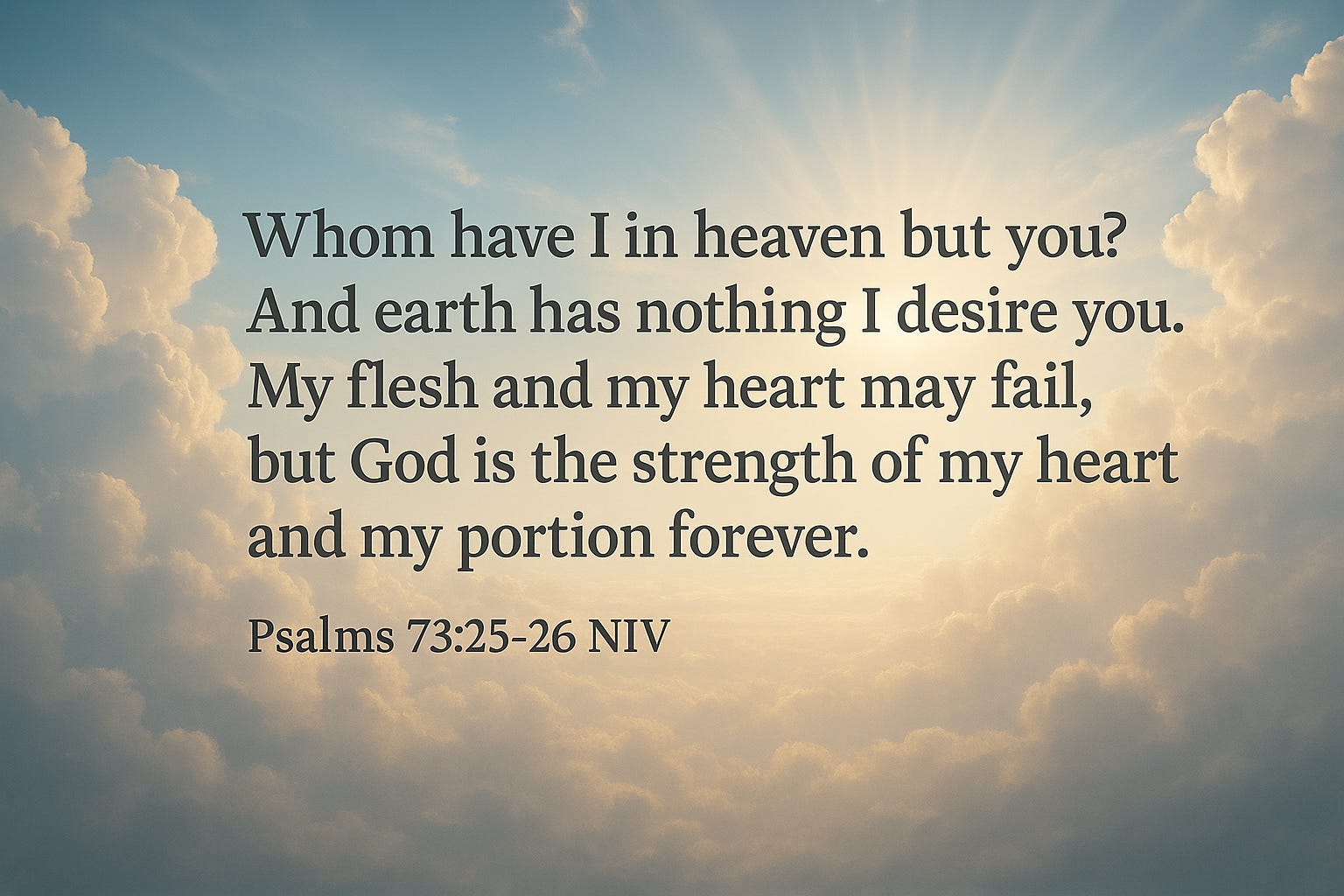
Image generated by ChatGPT (OpenAI) using the DALL·E model.
“Whom have I in heaven but you? And earth has nothing I desire besides you. My flesh and my heart may fail, but God is the strength of my heart and my portion forever.”
Psalms 73:25-26 NIV
While King David is familiar to most Christians as the composer of many of the psalms, others are attributed to Asaph, a Levite assigned by David to be a worship leader in the tabernacle choir. Asaph was not only a skilled musician, but a prophet as well. Psalm 50 and Psalms 73-83 are all Psalms of Asaph, all dealing with the judgement of God. Many of his psalms also involve the prayers of the people before or during momentous events.
Asaph was blessed with many gifts, and he knew that those gifts came from God. He used his music to praise God and to help communicate His Word to the world.
The psalm begins with the question “Whom have I in heaven but You?” Asaph is showing his yearning for God and eternity with Him. Like us, Asaph knew that heaven is a place to look forward to. He probably dreamed of what the eternal realm would be like in all of its glory, and looked forward to fellowship with God’s people for all eternity. But even those wondrous things were nothing compared to the thought of the presence of God!
Cited in Enduring Word, we have these fine words from American theologian James Montgomery Boice1 about this verse:
iii. Boice notes, “Verse 25 is a particularly fine expression and has been a blessing to many over the ages. Charles Wesley (1707-1788), the great Methodist hymn writer, was thinking about it on his deathbed and actually composed a hymn based on it as his final testimony. Calling his wife to him, he dictated:
‘In age and feebleness extreme,
What shall a sinful worm redeem?
Jesus, my only hope thou art,
Strength of my failing flesh and heart;
O, could I catch a smile from thee,
And drop into eternity.’”
Asaph goes on to say “And earth has nothing I desire besides you.” He not only had hope of being with God in heaven, but saw God as his only desire while still on earth.
Moving on to verse 26, Asaph sings “My flesh and my heart may fail, but God is the strength of my heart and my portion forever.” He’s aware of both his human weakness (physical and spiritual), and the enduring strength of God. You may be asking “what’s this ‘my portion forever’ all about?” It’s a portion of the inheritance that the Levites (the priests of ancient Israel) had. Willem VanGemeren2 explains in Enduring Word:
i. “In ancient Israel the priests enjoyed a privileged status of having the Lord as their ‘share’ and ‘inheritance’ (Numbers 18:20). Though they were denied the privilege of land ownership, they, along with the Levites, were taken care of by the Lord’s tithes and offerings.” (VanGemeren)
This also alludes to the division of the promised land among God’s chosen people. The Levites had no earthly inheritance, but they devoted their lives with their faith in a heavenly legacy.
The last word of verse 26 — forever — highlights the eternal covenant between God and His people. This covenant is fulfilled in our time through Jesus Christ, who offers us eternal life and a never ending relationship with God.
Heaven On Wheels Daily Prayer:
Heavenly Father, I humbly come before You with the realization in my heart that there is no one I desire more than You, my strength and my refuge. When my flesh and heart fail, I trust in You alone, Lord. You are my eternal inheritance, and I find my happiness in Your everlasting love and faithfulness. Teach me to seek Your presence daily, and may my prayers always express my longing for You. Nothing in this earthly realm compares to Your goodness. AMEN.
Scripture quotations taken from THE HOLY BIBLE, NEW INTERNATIONAL VERSION®, NIV®. Copyright © 1973, 1978, 1984, 2011 by Biblica US, Inc.®. Used by permission.
BibleHub was accessed on November 30, 2025 for commentary on Psalms 73:25-26
Commentary quotations from Enduring Word are used with the written permission of the author and reproduced here in their original format. © 1996-present The Enduring Word Bible Commentary by David Guzik – enduringword.com
Boice, James Montgomery “Psalms: An Expostional Commentary” Volume 2 (Psalms 42-106) (Grand Rapids, Michigan: Baker Books, 1996)
VanGemeren, Willem A. “Psalms: The Expositor’s Bible Commentary” Volume 5 (Psalms-Song of Songs) (Grand Rapids, Michigan: Zondervan, 1991)