


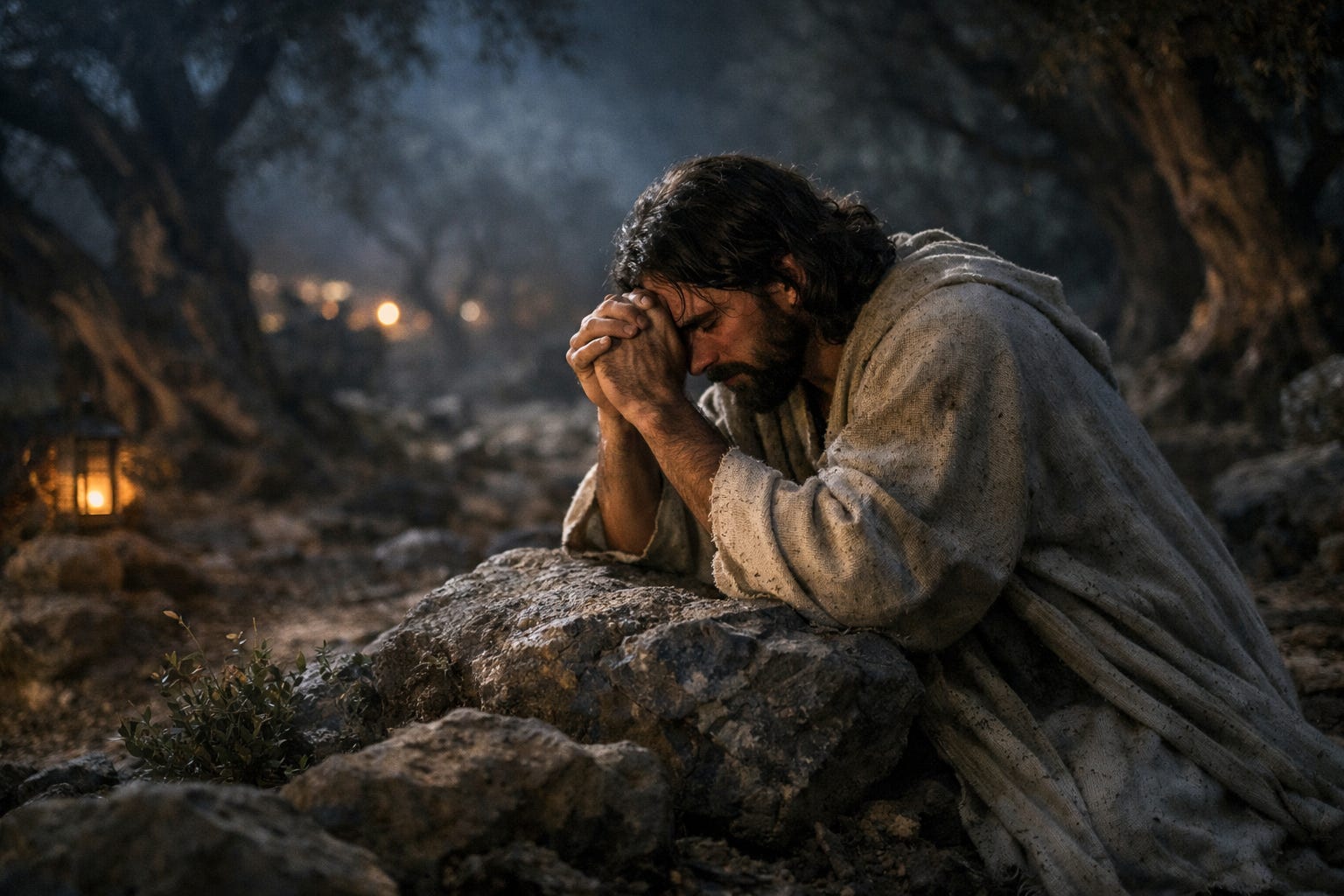
Image generated by ChatGPT (OpenAI) using the DALL·E model.
““Abba, Father,” he said, “everything is possible for you. Take this cup from me. Yet not what I will, but what you will.””
Mark 14:36 NIV
It seems like it has been a while since God chose one of the Gospels for me to study. Today’s verse should be familiar to readers of the New Testament, as it recounts the words of Jesus as He prays in the Garden of Gethsemane.
This chapter of Mark leads up to the arrest of Jesus, His trial before the Sanhedrin, and Peter’s three-time denial of Jesus; in other words, it is setting the stage for the pivotal events in human history — the crucifixion, death, and resurrection of Jesus Christ.
Earlier in this chapter we have Jesus being anointed by the woman in Bethany, Judas Iscariot betraying Him to the Sanhedrin, the Last Supper, and Jesus predicting that Peter would deny knowing Him. At this point, Jesus has gone with His disciples to Gethsemane, and takes Peter, James, and John with Him as lookouts while He goes to pray alone in the garden.
Enduring Word has this fascinating insight into Gethsemane:
This was a place just east of the temple mount area in Jerusalem, across the ravine of the Brook Kidron, and on the lower slopes of the Mount of Olives. Surrounded by ancient olive trees, Gethsemane means “olive press.” It was a place where olives from the neighborhood were crushed for their oil. So too, the Son of God would be crushed here.
The Son of God. It is fitting that Jesus cries out to God, “Abba, Father”. This is the most heart-rending moment in the life of Jesus, and He calls on His Father with the Aramaic word “Abba” — essentially a very personal name for “daddy”. Jesus felt intimately close to God in this time of crisis in His life.
Who other than the Son of God would know with crystalline clarity that “everything is possible” with God? Jesus, foreseeing the emotional and physical agony of what is to happen, reaches out to His Father with a request that He knows will not be granted: “Take this cup from me.”
Throughout the Old Testament, the “cup” is used as a metaphor for God’s wrath and judgement. We see this used in Psalms 75:8:
“In the hand of the Lord is a cup full of foaming wine mixed with spices; he pours it out, and all the wicked of the earth drink it down to its very dregs.”
and Isaiah 51:17:
“Awake, awake! Rise up, Jerusalem, you who have drunk from the hand of the Lord the cup of his wrath, you who have drained to its dregs the goblet that makes people stagger.”
In these verses (among others), the enemies of God are forced to drink the cup of His anger and wrath at them. Jesus was taking on the role of an enemy of God, judged by the Father, and forced to drink the cup of His Father’s fury. Why? So that WE would not have to drink from that cup!
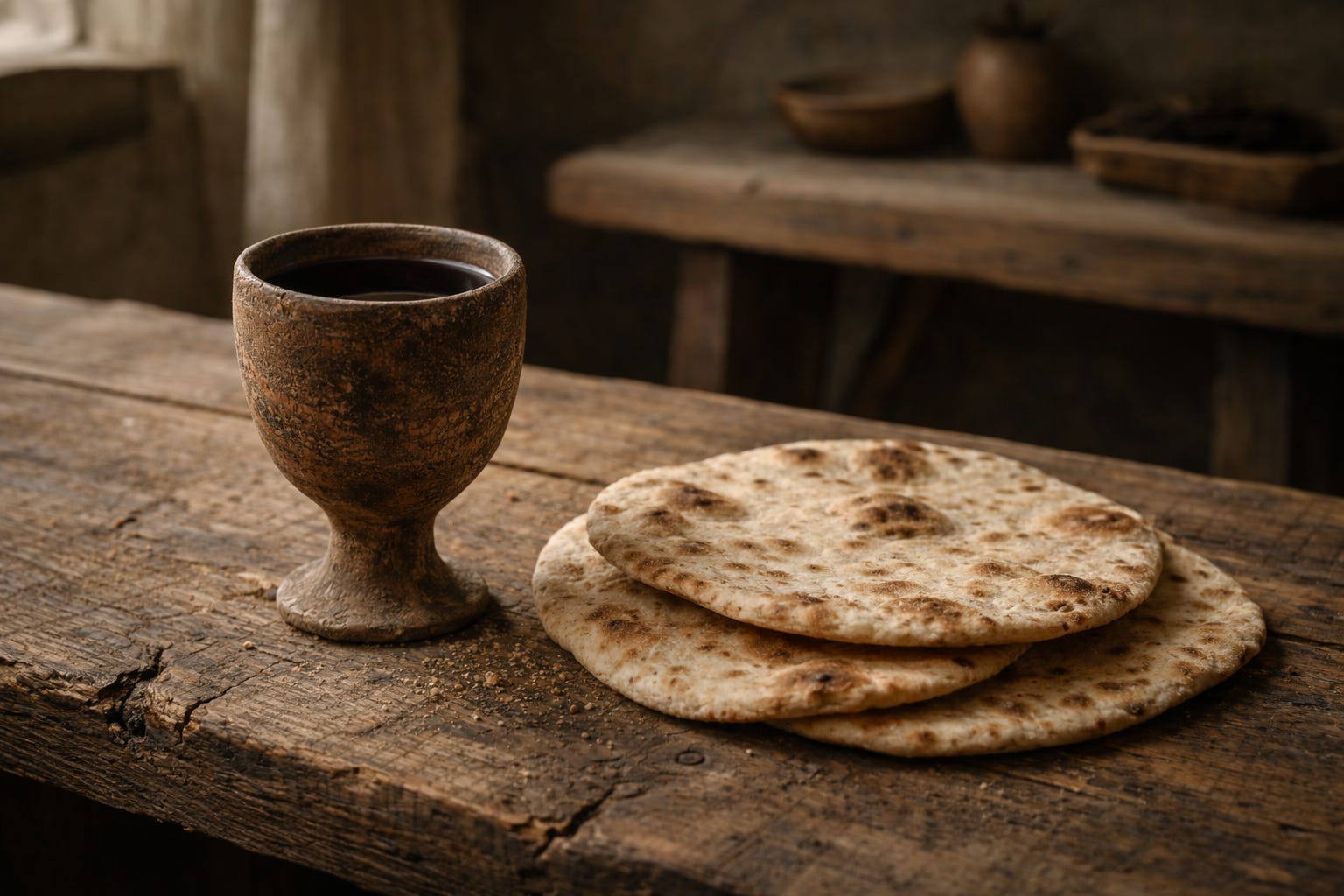
Image generated by ChatGPT (OpenAI) using the DALL·E model.
Despite the intense heartfelt prayers of His Son, God did not take the cup from Jesus. Instead, He provided Jesus with the strength to take the cup and drink it to the dregs for us. Jesus made His decision to drink the symbolic cup as He knelt in prayer at Gethsemane.
Jesus knew He had no option but to die upon the cross. The option would have been letting humanity suffer in hell for eternity. His plea to have the cup taken from Him is a request to God — if there’s any other to bring salvation to humanity other than being tortured, mocked, and crucified, let’s do it…
But there was no other way. David Guzik of Enduring Word explains that:
i. This prayer of Jesus eliminates any other way of salvation. If there is another way, His death was not necessary, and His prayer was not answered.
Jesus commits Himself to His fate with the words “Yet not what I will, but what you will.” In other words, Jesus showed the ultimate level of trust and faith in God that He knew what He was doing — and Jesus was acknowledging that salvation could only come from what He was about to endure.
The followers of Jesus were to also eventually drink from God’s cup. In Matthew 20:22-23, the mother of the disciples James and John asks Jesus if her sons will be able to sit at His left and right at His throne in the Kingdom. Jesus responds to the mother “You don’t know what you are asking,” and then asks the disciples “Can you drink the cup I am going to drink?” When they answer in the positive, Jesus says “You will indeed drink from my cup”, foreshadowing that they (with the exception of the Apostle John) will all die as martyrs for Christ.
As usual, Charles H. Spurgeon provided a summation of this verse that is both concise and eloquent. He notes that as Christians, we will all drink from the cup of tribulations at times of our lives:
“In any case, our cup can never be as deep or as bitter as was his, and there were in his cup some ingredients that never will be found in ours. The bitterness of sin was there, but he has taken that away for all who believe in him. His Father’s wrath was there, but he drank that all up, and left not a single dreg for any one of his people.” (Spurgeon)1
Thank You, Jesus, for draining the cup of God’s wrath and anger at humanity on our behalf.
Heaven On Wheels Daily Prayer:
Father in Heaven, I come to You in prayer with my burdens, and sometimes I feel overwhelmed by this world. Help me to be more like Jesus, to trust in Your plan, even when it does not seem to be in my personal best interest. Guide me to always seek Your will above my own, give me strength to face the challenges of life with faith, and may Your will be done in my life, as it is in heaven. AMEN.
Scripture quotations taken from THE HOLY BIBLE, NEW INTERNATIONAL VERSION®, NIV®. Copyright © 1973, 1978, 1984, 2011 by Biblica US, Inc.®. Used by permission.
Commentary quotations from Enduring Word are used with the written permission of the author and reproduced here in their original format. © 1996-present The Enduring Word Bible Commentary by David Guzik – enduringword.com
Spurgeon, Charles Haddon “The New Park Street Pulpit” Volumes 1-6 and “The Metropolitan Tabernacle Pulpit” Volumes 7-63 (Pasadena, Texas: Pilgrim Publications, 1990)
You are absolutely correct! I don’t know why Luke crept into that sentence, which will be fixed. Thank you for your readership and your correction!
Peter, James and John were with Jesus at the Transfiguration,not Peter,Luke and John, please.