


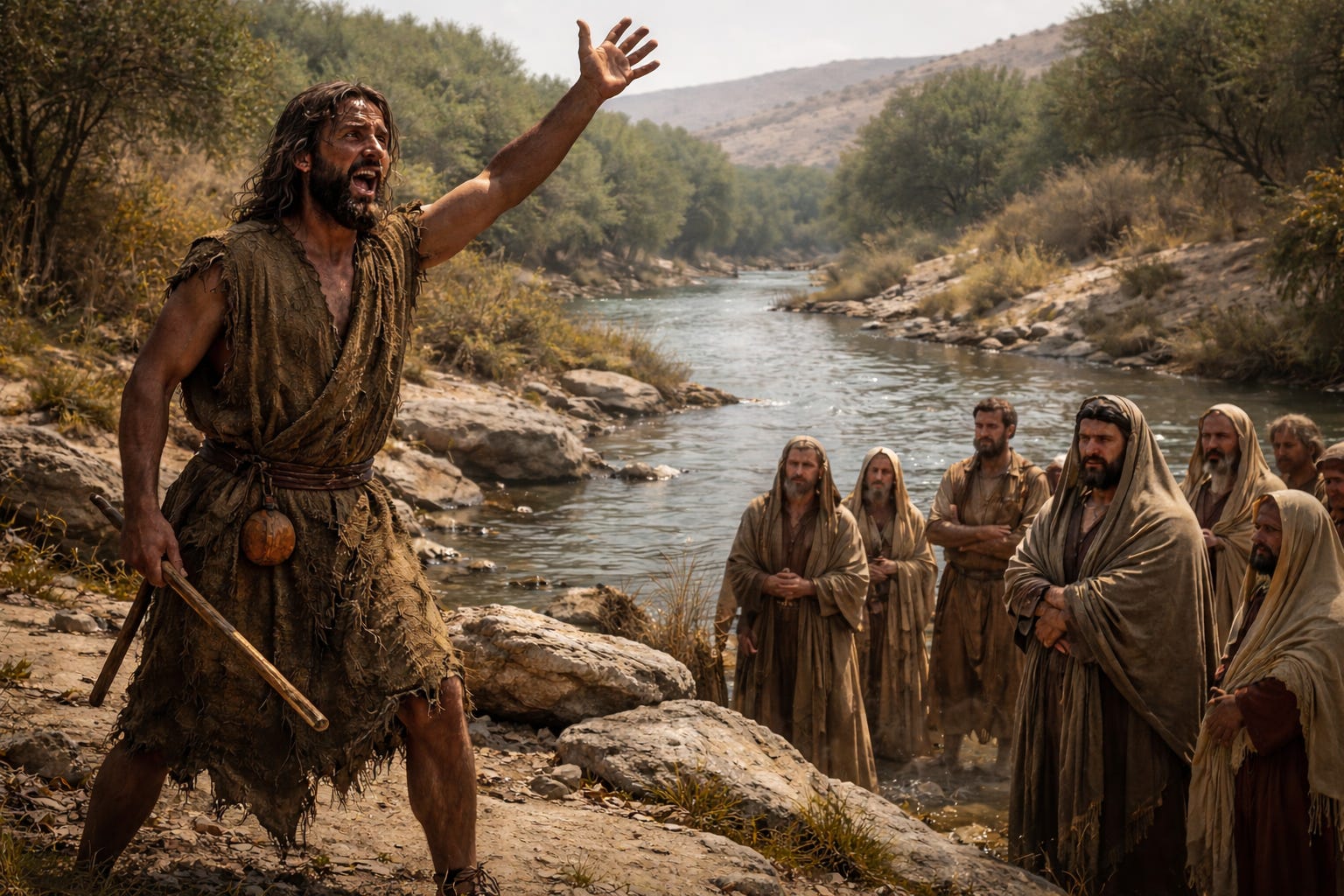
Image generated by ChatGPT (OpenAI) using the DALL·E model.
“In those days John the Baptist came, preaching in the wilderness of Judea and saying, “Repent, for the kingdom of heaven has come near.””
Matthew 3:1-2 NIV
Repentance is the one thing that many Christian churches neglect to preach about.
In the original Greek, the word was μετανοέω (metanoeō), for which Blue Letter Bible includes this one citation from Scottish evangelical scholar F.F. Bruce:
"Repentance (metanoia, 'change of mind') involves a turning with contrition from sin to God; the repentant sinner is in the proper condition to accept the divine forgiveness."1
So much of our faith is tied to this single act of transformation, yet it is rare to hear the word “repent” from many pulpits. You’re more likely to hear it shouted in the streets by those “crazy” sign-waving preachers I used to shake my head at and mock. If only I had known…
Here at the beginning of Chapter 3 of the Gospel of Matthew, we are introduced to John the Baptist. Jesus and John have known each other since before they were born; we hear that John “leaped in her womb” in Luke 1:39-45, when Mary (the mother of Jesus) greets Elizabeth (a relative who has also miraculously conceived).
In Luke 3:1 we hear when John the Baptist was preaching in the wilderness of Judea (“In the fifteenth year of the reign of Tiberius Caesar—when Pontius Pilate was governor of Judea, Herod tetrarch of Galilee, his brother Philip tetrarch of Iturea and Traconitis, and Lysanias tetrarch of Abilene—”), as well as what he is preaching — “a baptism of repentance for the forgiveness of sins.” (Luke 3:3)
All of this was foretold hundreds of years earlier by the prophet Isaiah (Isaiah 40:3-5 NIV):
“A voice of one calling: “In the wilderness prepare the way for the Lord; make straight in the desert a highway for our God. Every valley shall be raised up, every mountain and hill made low; the rough ground shall become level, the rugged places a plain. And the glory of the Lord will be revealed, and all people will see it together. For the mouth of the Lord has spoken.””
In these verses, John the Baptist is preparing the way for Jesus, preaching and performing “a baptism of repentance for the forgiveness of sins.” Later in this chapter (Matthew 3:13-16), Jesus is baptized by John, as “it is proper for us to do this to fulfill all righteousness.”. There’s a bit of history to baptism at this time (John and Jesus are both about 30 years old) — the Jews of the time baptized Gentiles who wished to convert to the faith.
What’s different and quite bold is that John was treating the Jews as Gentiles by baptizing them! But he has every right to be bold, as he is filled with the Holy Spirit. He demonstrates that boldness by scolding the Pharisees and Sadducees (the Jewish religious elite), as well as proclaiming that Jesus will soon “baptize you with the Holy Spirit and fire” (Matthew 3:11).
All of this leads to John’s proclamation to “Repent, for the kingdom of heaven has come near.” In this commentary from Precept Austin, it is explained that this isn’t a suggestion — it’s a command:
Repent is not a suggestion which is a proposal offered for acceptance or rejection. John is not giving a "multiple choice!" It reminds me of the phrase "take it or leave it!" Repent is the one side of the coin (so to speak) which is balanced by the other side which is fruit-bearing (Mt 3:8, 10), supernatural fruit serving to authenticate whether one has truly repented or just feels sorry about their sin (or sorry they got caught!) with no change of heart or mind.

And that’s what repentance is all about — a permanent change of heart or mind, turning away from sin once and for all. What makes repentance possible? Faith. Commentaries from Precept Austin by Charles Spurgeon and J.C. Ryle explain:
C H Spurgeon wrote that “Repentance and faith must go together to complete each other. I compare them to a door and its post. Repentance is the door which shuts out sin, but faith is the post on which its hinges are fixed. A door without a doorpost to hang on is not a door at all, while a doorpost without the door hanging on it is of no value whatever. What God hath joined together let no man put asunder, and these two he has made inseparable—repentance and faith.
J C Ryle wrote… There can be no true repentance without faith. You may cast away your old habits, as the serpent casts off his skin—but if you are not resting all upon the Lamb of God who takes away the sins of the world, and looking to be saved by simple faith in Him, you may be wise in your own eyes—but you are just ignorant of the root and fountain, the Alpha and the Omega, the beginning and the end, the first and the last, in all true gospel religion. You may tell us you have repented—but if you have not at the same time laid hold on Christ, you have hitherto received the grace of God in vain.
Repentance does not atone for sin. Bishop Ryle also noted that:
We must carefully bear in mind that no repentance can make atonement for sin. The blood of Christ, and nothing else, can wash away sin from man's soul. No quantity of repentance can ever justify us in the sight of God. "We are accounted righteous before God, only for the sake of our Lord Jesus Christ, by faith, and not for our own works or deservings." It is of the utmost importance to understand this clearly. The trouble that men bring upon their souls, by misunderstanding this subject, is more than can be expressed.
Why is John the Baptist calling for the people to repent? Because “the kingdom of heaven has come near.” John is aware of who Jesus is and what He represents to the sinful world. During His ministry, Jesus taught that repentance is essential for forgiveness of sins and a relationship with God, and urged people to turn away from their sins and toward Him. What is it about that message that many Christian preachers seem to have forgotten?
Heaven On Wheels Daily Prayer:
Heavenly Father, I pray that all believers recognize that repentance is more than just a one-time occurrence, but instead a constant transformation of our hears and minds towards You. Show me the areas in my life where I have still not yielded to You fully, the bad habits I retain, the relationships I ignore, the duties in Your service that I am not performing. Thank You for reminding me through your servant Matthew that the kingdom of heaven is near, a reality that blurs into our lives even now. Help me to live each day in anticipation of Your kingdom and Your glory, AMEN.
Scripture quotations taken from THE HOLY BIBLE, NEW INTERNATIONAL VERSION®, NIV®. Copyright © 1973, 1978, 1984, 2011 by Biblica US, Inc.®. Used by permission.
“Matthew 3 (NIV) - In those days John the.” Blue Letter Bible. Web. 28 Feb, 2026.
Precept Austin was accessed on February 28, 2026 for commentary on Matthew 3:1-2
F. F. Bruce. The Acts of the Apostles [Greek Text Commentary], London: Tyndale, 1952, p. 97.
This is the one thing we neglect when converting someone in our excitement over their conversion. As a result we bring about a non-conversion.
Great analogy door post and door itself both are needed and one without the other is useless
Repenting without faith or vise versa = empty