


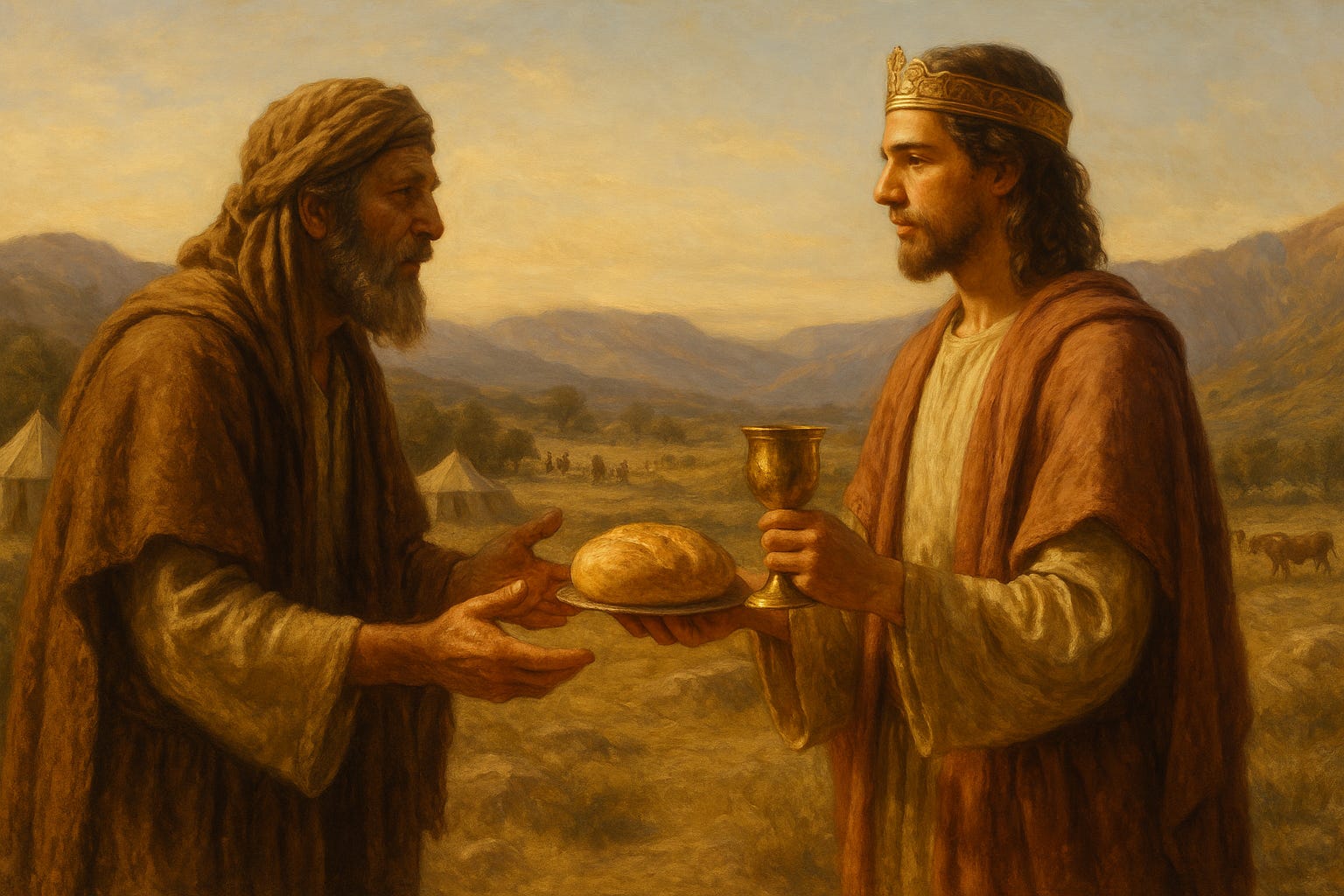
“For this Melchizedek, king of Salem, priest of the Most High God, who met Abraham as he was returning from the slaughter of the kings and blessed him, to whom also Abraham apportioned a tenth part of all the spoils, was first of all, by the translation of his name, king of righteousness, and then also king of Salem, which is king of peace. Without father, without mother, without genealogy, having neither beginning of days nor end of life, but made like the Son of God, he remains a priest perpetually.”
Hebrews 7:1-3 NASB1995
According to most commentators and scholars, Chapter 7 of Hebrews is considered a key chapter in this epistle. We now come back to the story Melchizedek, the king of Salem, who was also a priest of the Most High God. This story takes place in Genesis 14:
“Then after his return from the defeat of Chedorlaomer and the kings who were with him, the king of Sodom went out to meet him at the valley of Shaveh (that is, the King’s Valley). And Melchizedek king of Salem brought out bread and wine; now he was a priest of God Most High. He blessed him and said,
“Blessed be Abram of God Most High,
Possessor of heaven and earth;
And blessed be God Most High,
Who has delivered your enemies into your hand.”
He gave him a tenth of all.”
Genesis 14:17-20 NASB1995
Melchizedek is also mentioned again in Psalm 110, in a prophetic sense:
“The Lord says to my Lord:
“Sit at My right hand
Until I make Your enemies a footstool for Your feet.”
The Lord will stretch forth Your strong scepter from Zion, saying,
“Rule in the midst of Your enemies.”
Your people will volunteer freely in the day of Your power;
In holy array, from the womb of the dawn,
Your youth are to You as the dew.
The Lord has sworn and will not change His mind,
“You are a priest forever
According to the order of Melchizedek.”
The Lord is at Your right hand;
He will shatter kings in the day of His wrath.
He will judge among the nations,
He will fill them with corpses,
He will shatter the chief men over a broad country.
He will drink from the brook by the wayside;
Therefore He will lift up His head.”
Psalms 110:1-7 NASB1995
Enduring Word has a good introduction to Hebrews 7:
1. The writer to the Hebrews now explains a theme that he introduced back in Hebrews 2:17: Jesus as our High Priest.
a. He began to discuss the issue in Hebrews 5:10, but had to spend some time warning these discouraged Christians about the danger of not continuing and progressing in their Christian life.
b. Like the writer of a good detective story, the writer to the Hebrews draws out a character from the Old Testament that many might think insignificant, and he brings that character into real prominence.
2. These Christians from a Jewish background were interested in Jesus as their High Priest, but had a significant intellectual objection to the idea. This is because Jesus did not come from the priestly tribe (the tribe of Levi) or the priestly family in that tribe (the family of Aaron).
a. The writer to the Hebrews wanted to remove these intellectual problems the Jewish Christians had with the gospel. These intellectual hang-ups kept them from continuing on to maturity in Jesus.
b. In the same way, many Christians are hung up on intellectual issues that could be resolved, allowing them to move on with Jesus. If a Christian is hung up on issues like creation and evolution, the validity of miracles, or other such things, they should get the issues resolved so they can move on with Jesus.
3. This chapter is also important because it shows us how we should think of the Old Testament institutions of the priesthood and the Law.
This is why the Old Testament should not be read perfunctorily. There are many important issues that are brought forward again in the New Testament that might not seem so relevant at first glance. The author of Hebrews expands on the character of Melchizedek, describing him as being without father, without mother, without genealogy, having neither the beginning of days nor the end of life. He is like the son of God! Melchizedek means “king of righteousness” and Salem means “king of peace” (Salem is also an ancient name for Jerusalem). Abram (he was not yet renamed Abraham by God) gives Melchizedek ten percent of what he gained in the recent battles.
Another good point that is made in this commentary from Enduring Word is that Christians can often get hung up on issues that keep them from moving forward with Jesus. I can plead guilty to this in the past! If you have any intellectual issues that need resolving before you can leave infancy behind in your faith, work those out with the Sovereign God through prayer and understanding.

So why do we need to hear this story? The photo above shows a crowd at church listening to a sermon. I sometimes observe people around us at our church and there are varying attitudes that can be observed during the message: Some are attentively taking notes, some are listening with their Bibles open in their laps, others show half-hearted listening (looking around, drinking their coffee), while others are engaged in phone scrolling and more than a few are asleep! That’s a tough job, to be a pastor of a big church.
I thought I would share introductory excerpts from a terrific sermon by Steven Cole, found on the Precept Austin about why we need to know about Melchizedek:
Most of you would probably admit that you’re not highly motivated to learn about Melchizedek. You’ve got marriage problems, problems with your kids, financial problems, personal problems, and other practical needs. Why in the world would you be interested in learning about some obscure figure from many centuries ago named Melchizedek? “For crying out loud, Steve, it’s Mother’s Day! Give us a message that relates to mothers!” I believe that learning about Melchizedek will help you to be a better mother, father, child, or whatever role you are in. My aim is to convince you that you do need to know about this man.
To understand this, we need to put the chapter in its context. The Jewish Christians to whom this letter was addressed were tempted to abandon their Christian faith and return to Judaism under the threat of persecution. Some of them had lost their property and had suffered public reproach on account of their faith (10:32–34). They were thinking, “Hey, we didn’t have it so bad as Jews! The Jewish religion was a good system. It spelled out how we should live. The rituals were familiar and satisfying. It was the faith of our forefathers for many centuries. Maybe we should just go back to the way things were.”
To understand the pull of the past, we need to realize that religious traditions die hard! For over 20 years, Marla and I have read and prayed along with The Global Prayer Digest (published by the U.S. Center for World Mission) (ED from Bruce Hurt at Precept Austin - Now replaced by Joshua Project daily prayer for an unreached people group -- Why Should You Consider Interceding for a Hidden People Group). One thing that has repeatedly struck me as I’ve read it is how strongly entrenched religious traditions are. It will mention a people group where, many centuries ago, Islam took root and the culture is totally Islamic. For hundreds of years, generations have lived and died without questioning the religious traditions. These false religious views dominate their whole way of life. When missionaries try to penetrate these cultures with the gospel, they meet with strong resistance, because to accept the gospel would mean abandoning centuries of religious tradition.
Sacrifices, rituals, and rules that had been in place for over 1,400 years
had now been replaced by a better wayThe author of Hebrews was trying to convince people that a religious system of sacrifices, rituals, and rules that had been in place for over 1,400 years had now been replaced by a better way. He focuses on the supremacy of Jesus Christ, who is the fulfillment of all that was written by Moses and the Jewish prophets. He introduces a theme that is only treated in the Book of Hebrews, that Jesus Christ is our high priest.
We will only appreciate our need for a high priest to the degree that we realize how holy and unapproachable God is and how sinful and defiled we are. When Isaiah saw the Lord, sitting on His throne, lofty and exalted, surrounded by the seraphim who called out, “Holy, holy, holy, is the Lord of hosts,” the prophet was undone (Isa. 6:1–5). It devastated him because immediately he became aware of how utterly sinful he was, in contrast to God in His awesome holiness.
Israel in the wilderness had seen Moses go up on the mountain into the cloud, with lightning and thunder and a loud trumpet sound, and they were terrified. If the people got too close to the mountain, God warned that He would break forth upon them with a deadly plague (Exod. 19:10–25). The Jews knew that they could not saunter into the Holy of Holies to chat with God! Only the high priest could enter there, and only once a year, with blood. The Jewish people knew how desperately they needed a high priest if they were to approach God.
The author of Hebrews is making the point that Jesus is our high priest. But He is not just the fulfillment of the Levitical priesthood. He is something more, a high priest forever according to the order of Melchizedek. To view Him on a par with the Levitical priests would be to make a spiritually fatal mistake. That entire old system was designed to point ahead to Jesus Christ, who superceded and fulfilled it. To go back to the old way would be to abandon God’s only way of entrance into His holy presence. It would be to turn from the only One who can save us from our sins and go back to an inferior system. So the author here is saying,
You need to know about Melchizedek because
he is a type of the Lord Jesus Christ,
and you desperately need to know about Christ.
That is such a good explanation! A link to the entire sermon, which covers Hebrews 7:1-10, is noted in the credits and citations below.

Enduring Word also has a good explanation of Hebrews 7:1-3; Guzik uses the NKJV translation:
For this Melchizedek, king of Salem, priest of the Most High God, who met Abraham returning from the slaughter of the kings and blessed him, to whom also Abraham gave a tenth part of all, first being translated “king of righteousness,” and then also king of Salem, meaning “king of peace,” without father, without mother, without genealogy, having neither beginning of days nor end of life, but made like the Son of God, remains a priest continually.
a. Who met Abraham returning from the slaughter of the kings: After Abraham defeated the confederation of kings who took his nephew Lot captive, he met with a mysterious priest named Melchizedek, who was also king over the city of Salem (an ancient name for the city of Jerusalem).
i. History shows the danger of combining religious and civic authority. Therefore God did not allow the kings of Israel to be priests and the priests to be kings. Melchizedek, who was the king of Salem and priest of the Most High God was an unique exception.
b. Priest of the Most High God: Melchizedek was not merely a worshipper of the true God. He had the honored title priest of the Most High God. The greatness of God magnified the greatness of Melchizedek’s priesthood.
i. “Any priesthood is evaluated according to the status of the deity who is served, which means that Melchizedek’s must have been of a highly exalted kind.” (Guthrie)
c. And blessed him: Melchizedek blessed Abraham, and Abraham gave Melchizedek a tithe, which is a tenth part of all (all the spoils of battle, as mentioned in Genesis 14:20).
d. First being translated “king of righteousness,” and then also king of Salem, meaning “king of peace”: The name Melchizedek means “king of righteousness,” and he was also “king of peace” (because the name Salem means “peace”).
i. The order is subtle but important. First, Melchizedek in his very name was called “king of righteousness.” Then he was called “king of peace.” As always, righteousness comes before peace. Righteousness is the only true path to peace. People look for that peace in escape, in evasion, or in compromise, but they will only find it in righteousness. “Peace without righteousness is like the smooth surface of the stream ere it takes its awful Niagara plunge.” (Spurgeon)
ii. The fact that these names have meaning, and that the Holy Spirit explains the meaning shows that each word is important and inspired by God. “A teaching was intended by the Holy Spirit in the names: so the apostle instructs us in the passage before us. I believe in the verbal inspiration of Scripture; hence, I can see how there can be instruction for us even in the proper names of persons and of places. Those who reject verbal inspiration must in effect condemn the great apostle of the Gentiles, whose teaching is so frequently based upon a word. He makes more of words and names than any of us should have thought of doing, and he was guided therein by the Spirit of the Lord, and therefore he was right. For my part, I am far mores afraid of making too little of the Word than of seeing too much in it.” (Spurgeon)
e. Without father, without mother: There is nothing said about the genealogy of Melchizedek in the Genesis 14 passage or anywhere else. As far as the Biblical record is concerned, he has no father or mother, no beginning of days nor end of life. “We see but little of him, yet we see nothing little in him.” (Spurgeon)
i. Though virtually all the commentators disagree with each other on this point, some think that without father, without mother, without genealogy, having neither beginning of days nor end of life, but made like the Son of God means that Melchizedek was a heavenly being, if not a pre-incarnate appearance of Jesus Himself.
f. Made like the Son of God: Melchizedek was made like the Son of God. It really isn’t that Jesus has Melchizedek’s kind of priesthood. Instead, Melchizedek has Jesus’ kind of priesthood.
i. Made like in Hebrews 7:3 translates the ancient Greek word aphomoiomenos, a word used nowhere else in the New Testament. “It is a suggestive word, used in the active of ‘a facsimile copy or model’ and in the passive of ‘being made similar to’.” (Guthrie)
ii. “It was as if the Father could not await the day of His Son’s priestly entrance within the veil; but must needs anticipate the marvels of His ministry, by embodying its leading features in miniature.” (Meyer)
g. Remains a priest continually: Either this refers to the continuation of the priestly order of Melchizedek, or it is evidence that Melchizedek was actually Jesus appearing in the Old Testament. Jesus’ priesthood does remain to this day, and into eternity.
I like the observation that righteousness always precedes peace. We cannot have true peace without first approaching that righteousness from God that is found in our faith. I can say from personal experience that this is true.
Other commentators believe the references to no genealogy are meant to imply that Melchizedek was of the very ancient worshippers of the true God, like another Job figure and not a pre-incarnation appearance of Christ. But this is one of those mysteries that will only be answered after this mortal lifetime.
My next devotional examines Hebrews 7:4-10 - The greatness of Melchizedek compared to Abraham (the greater receives from the lesser).
Heaven on Wheels Daily Prayer:
Dear Lord - Digging into scripture is such a marvelous way to really learn how it all fits together, from Genesis to Revelation. Thank you for the great insights that I have received. Amen.
Note to followers: Thank you so much for your prayers for my eye surgery on December 2. I am recovering (it will take a few weeks) but I believe I can still see to write! I have my devotionals pre-written through next Monday, so that’s good.
Credits and Citations:
Scripture quotations taken from the (NASB®) New American Standard Bible®, Copyright © 1960, 1971, 1977, 1995 by The Lockman Foundation. Used by permission. All rights reserved. www.Lockman.org.
Precept Austin was accessed on 11/29/2025 to review commentary for Hebrews 7:1-3. Within Precept Austin the excerpts from the Steven Cole Sermon are covered by this: Copyright, Steven J. Cole, 2004, All Rights Reserved. His sermons can be found Bible.org. Unless otherwise noted, all Scripture Quotations are from the New American Standard Bible, Updated Edition © The Lockman Foundation. The full original sermon can be found at this link.
Commentary from Enduring Word by David Guzik is used with written permission. ©1996-present The Enduring Word Bible Commentary by David Guzik – enduringword.com
Within the Enduring Word Commentary:
Spurgeon, Charles Haddon The New Park Street Pulpit, Volumes 1-6and The Metropolitan Tabernacle Pulpit, Volumes 7-63 (Pasadena, Texas: Pilgrim Publications, 1990)
Guthrie, Donald Hebrews (Grand Rapids, Michigan: Eerdmans Publishing Company, 1983)
Meyer, F.B. The Way Into the Holiest: Expositions of the Epistle to the Hebrews (Fort Washington, Pennsylvania: Christian Literature Crusade, 1982)
Thanks for making me look up perfunctorily 🤪😂