


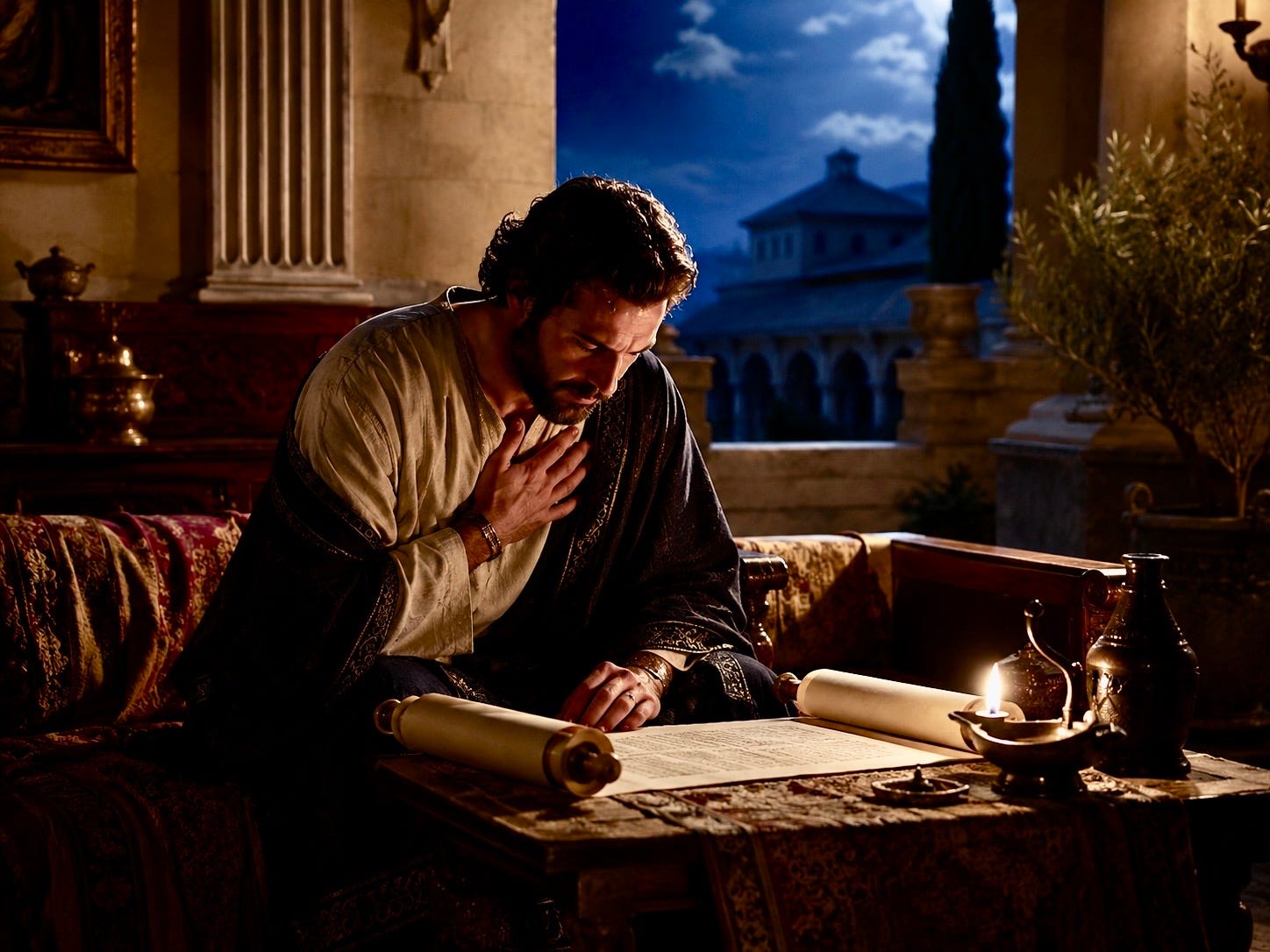
Image generated by ChatGPT (OpenAI) using the DALL·E model.
“Those whom I love I rebuke and discipline. So be earnest and repent.”
Revelation 3:19 NIV
These are the words of Jesus as recorded by the Apostle John in the last book of the Bible, Revelation. Jesus is speaking through John to the church in Laodicea. Wikipedia tells us that:
“The Laodicean Church was a Christian community established in the ancient city of Laodicea on the Lycus in the Roman province of Asia and was one of the early centers of Christianity. The church was established in the Apostolic Age, the earliest period of Christianity, and is probably best known for being one of the seven churches of Asia addressed by name in the Book of Revelation (Rev. 3:14–22).”
Laodicea was quite near Colossae, and the church here was probably connected with the Colossian church. The Apostle Paul mentions Laodicea four times in his epistle to the Colossians, indicating a close relationship between the two churches.
I’ve mentioned before that there are no coincidences; God is at the controls of all that happens. That’s why it’s not a coincidence that Barb’s devotional on the Book of Isaiah from August 25 included this very verse amongst others from Revelation. The Lord has an amazing way of showing us how Scripture is all tied together.
What’s the context of this comment from Jesus? He has just chastised them as being “lukewarm—neither hot nor cold” in their faith, something that can be truthfully said about the vast majority of churchgoing Christians today! They may occupy a pew every Sunday, attend a Bible study class, and give to the church regularly, but do not live the rest of their lives following the two most important commandments of the New Testament:
“Jesus replied: “ ‘Love the Lord your God with all your heart and with all your soul and with all your mind.’ And the second is like it: ‘Love your neighbor as yourself.’”
Jesus rebukes them. The Laodiceans are fairly well-to-do, and feel that they don’t need anything… even spiritually. They may be wealthy in the material sense, but they are dirt poor spiritually. Jesus advises them to depend on Him instead, with the end result of satisfying what they really need. The Bible Says has an excellent commentary on this verse:
This section of advice is closed with an explanation of Jesus’ discipline philosophy: Those whom I love, I reprove and discipline; therefore be zealous and repent.
As God’s children, He lovingly exercises discipline on us just as a parent disciplines their children (1 John 3:2). He wants us to grow in wisdom and maturity, therefore He will accordingly correct us when we stray from seeking what is good. Jesus has spoken quite plainly to the believers in Laodicea. The fact that Jesus says Those whom I love, I reprove and discipline makes clear that His direct and unflattering words are intended for His children. Jesus is not trying to get them to like Him—that would be self-seeking. Rather Jesus is telling them the truth, that they might gain great benefit. It will be up to the Laodiceans whether or not they will listen, and repent.
To repent means to alter your perspective and take a new direction. Jesus is trying to get the believers in Laodicea to see wealth and status through spiritual eyes rather than physical eyes. In doing so, Jesus attempts to lead them to their real self-interest. This is similar to the Apostle Paul’s admonition to be transformed into the image of Jesus by the renewing of our minds (Romans 12:1-2). God wants to get us to set aside the worldly perspective that is false and leads to death. He wants us to repent, to change our mind from false to true, and see reality as it is.
Jesus does not want a tepid response. Jesus wants the Laodiceans to be zealous. The idea behind the Greek word translated zealous is to have a deep desire to strive for something. It’s a passion to seek a particular outcome. Jesus wants the Laodiceans to see the true opportunity before them, and “go for it with all their might.” If we see the opportunity truly, it should drive us to exercise all diligence to accomplish it.
Our response to Jesus’ correction should be to be zealous and repent. We should happily accept Jesus’ correction and zealously seek His ways. We should trust that present trials will produce endurance in the long run (James 1:2-4). And we should trust that Jesus’s rewards are worth leaving behind everything, and pursuing with all our being, as we shall see in the next section of the letter to Laodicea.
Jesus definitely had not lost His love for the Laodicean church. His great love for them was shown by His rebuke. Scottish theologian William Barclay said it best when he said “It is, in fact, God’s final punishment to leave a man alone.”1 If the Lord didn’t love them, He would have turned His back completely on them.
Usually when Jesus speaks of His love for His people, the word used is the Greek ἀγάπη (agapē) denoting His sacrificial love for mankind. Here in Revelation 3:19, Jesus uses the word φιλέω (phileō). What’s the difference? Phileō love is the love of a friend for another, so here Jesus is stating that even though He’s rebuking and disciplining the Laodiceans, He still has a deep love for them as a friend. Spurgeon focused on this different word, saying: “The word here used for ‘love’ is a very choice one; it is one which signifies an intense personal affection.”2
The Friend of the Laodiceans now asks them to make a decision. From Enduring Word:
Therefore be zealous and repent: He commanded them to make a decision to repent, and to continue in zeal. “Turn your way,” Jesus said. “Don’t look to your own riches and resources, because they are really bankrupt. Turn around and look to Me.”
i. The ancient Greek word zealous comes from the same word as hot in Revelation 3:16. Though Jesus detested their lukewarmness, He would really rather them be hot with zeal rather than cold.
ii. “When you and I shall be stretched upon our dying beds, I think we shall have to regret, above everything else, our coldness of heart. Among the many sins… perhaps this will lie the heaviest upon our heart and conscience, ‘I did not live as I ought to have done; I was not as earnest in my Lord’s cause as I should have been.’ Then will our cold sermons, like sheeted ghosts, march before our eyes in dread array. Then will our neglected days start up, each one seeming to wave its hair as though it were one of the seven furies, and to look right into our hearts, and make our very blood curdle in our veins.” (Spurgeon)
iii. We need to make our life following Jesus, not just a hobby or an occasional activity. This goes against the spirit of our age, which was long ago expressed by a famous Englishman when he read a sermon by G.W.E. Russell: “Things have come to a pretty pass when religion is allowed to invade the sphere of private life.” (English statesman William Lamb [1779-1848])
iv. Trapp, on the believer’s repentance: “This is the rainbow, which if God seeth shining in our hearts, he will never drown our souls.”
It’s interesting to see what ChatGPT said about the devotional image that it created at my request:
The Moment of Conviction. A prosperous Laodicean man alone late in the evening, sitting beside an extinguishing oil lamp with an opened scroll of John’s message before him. His expensive surroundings contrast with his troubled expression. He has just read the words of Christ and realizes that the rebuke is directed at him. Dawn beginning outside the window could quietly symbolize the possibility of renewal.
No matter how badly we stray, God always lovingly convicts believers of their sin through the Holy Spirit and offers the gift of repentance and transformation.
Heaven On Wheels Daily Prayer:
Heavenly Father, I thank You for loving me enough to correct me. Help me to always be earnest in my faith and to turn away from my sins. Guide my heart to remain focused on You and Your will for my life. AMEN.
Scripture quotations taken from THE HOLY BIBLE, NEW INTERNATIONAL VERSION®, NIV®. Copyright © 1973, 1978, 1984, 2011 by Biblica US, Inc.®. Used by permission.
Commentary quotations from Enduring Word are used with the written permission of the author and reproduced here in their original format. © 1996-present The Enduring Word Bible Commentary by David Guzik – enduringword.com
Commentary from The Bible Says © 2026 The Bible Says, All Rights Reserved
Barclay, William “Letters to the Seven Churches” (Nashville, Tennessee: Abingdon Press, 1957)
Spurgeon, Charles Haddon “The New Park Street Pulpit” Volumes 1-6 and “The Metropolitan Tabernacle Pulpit” Volumes 7-63 (Pasadena, Texas: Pilgrim Publications, 1990)
Thanks alot for l Surrender towards the right way. Thank you my prayer partners am grateful and thankful for your support and may GOD bless you too in the mighty name of Jesus Christ we have prayed and Amen.