


““And now, O inhabitants of Jerusalem and men of Judah,
Judge between Me and My vineyard.
What more was there to do for My vineyard that I have not done in it?
Why, when I expected it to produce good grapes did it produce worthless ones?
So now let Me tell you what I am going to do to My vineyard:
I will remove its hedge and it will be consumed;
I will break down its wall and it will become trampled ground.
I will lay it waste;
It will not be pruned or hoed,
But briars and thorns will come up.
I will also charge the clouds to rain no rain on it.”
For the vineyard of the Lord of hosts is the house of Israel
And the men of Judah His delightful plant.
Thus He looked for justice, but behold, bloodshed;
For righteousness, but behold, a cry of distress.”
Isaiah 5:3-7 NASB1995
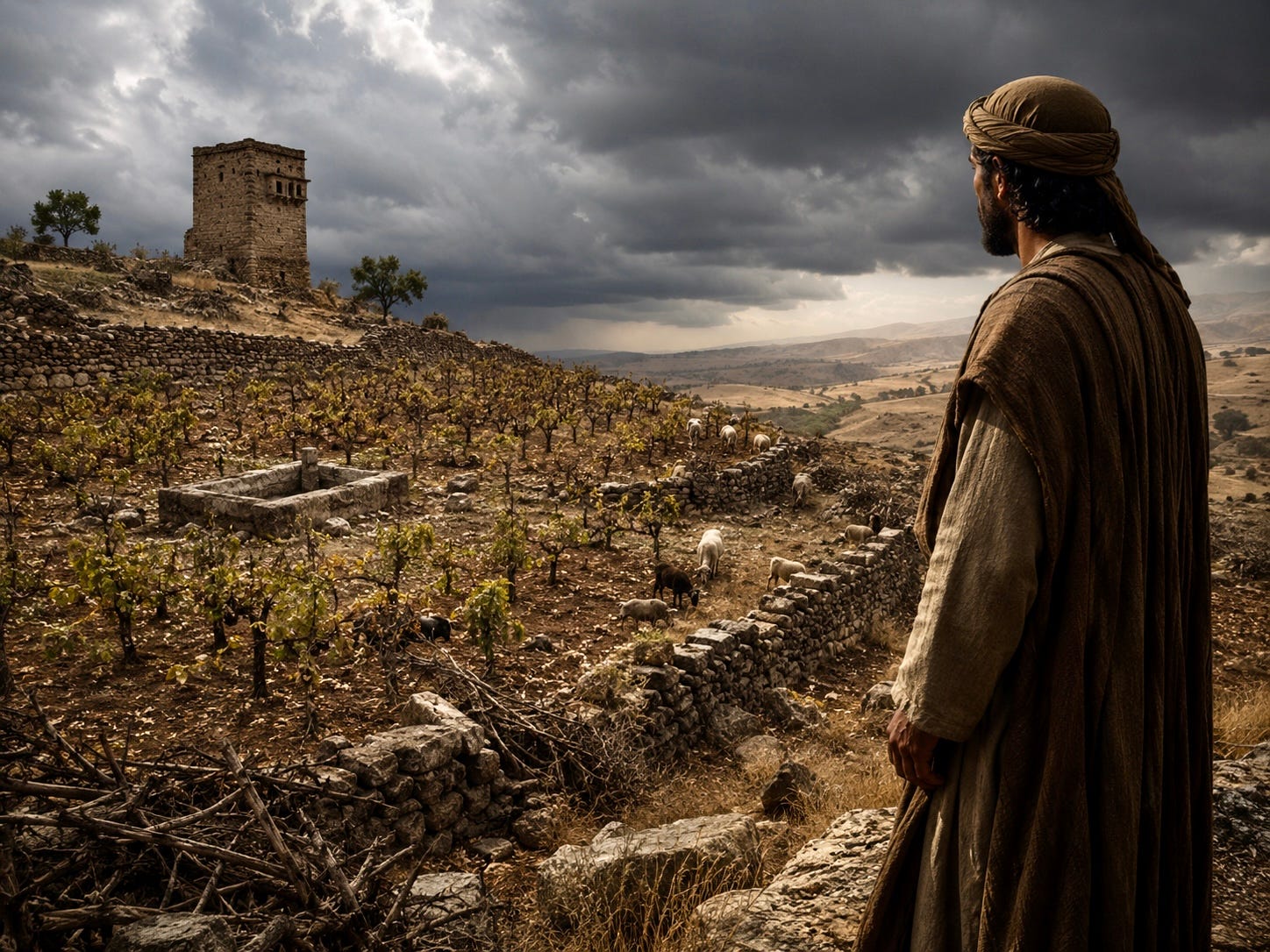
In my last devotional I planned to examine Isaiah 5:3-6 in this devotional but decided to add verse 7 (I think it makes more sense). The Lord is asking the people of Judah to tell Him what more could have been done for the vineyard (them). Without waiting for an answer, He tells them that He will break down the walls and lay the vineyard to waste. Weeds and briars will come up and there will be no rain. He expected justice and righteouness from the people of Judah but saw bloodshed and heard cries of distress. The AI image at the top shows the destruction of the vineyard.
Charles Spurgeon has these comments in Spurgeon Gems about these verses:
Verses 3-4:
O you that profess to be His people, what more could Christ have done for you? What more could the Holy Spirit have done? What richer promises, what wiser precepts, what kinder providences, what more gracious patience? “Wherefore, when I looked that it should bring forth grapes, brought it forth wild grapes?” Whence came this? The stock was good, the husbandry was wise. Whence came these wild grapes?
Verses 5-6:
“I will tell you what I will do.” He does not wait till the men of Judah have given their verdict. There was no need of any. The case was all too sadly clear. “I will take away the hedge thereof….and break down the wall thereof.” Those providences which guard men from sin shall be removed. You shall be allowed to sin if you like—and as you like. Your will shall have its freedom to the full. “And it shall be trodden down: and I will lay it waste.” There is no destruction like that which comes when God destroys the fruitless vineyard. When a human enemy or the wild boar out of the wood lays it waste, it may be restored again, but if, in righteous wrath, the Divine Owner of the vineyard Himself lays it waste, what hope remains for it?
What fearful words, “It shall be trodden down: and I will lay it waste.” “It shall not be pruned, nor digged; but there shall come up briars and thorns.” Nothing happens worse to a church or to a man than to be altogether without affliction—no pruning, no digging, no restraints, no prickings of conscience, no smitings with rod. “I will also command the clouds that they rain no rain upon it.” That is the worst of all!
Verse 7:
Oh, when those who profess to be God’s people live ungodly, dishonest, unchaste, ungracious lives, God is greatly grieved. His anger burns against such a church and against such a people. And well it may. “He looked for judgment,” for they professed to be taught of God, “but behold oppression.” He looked “for righteousness,” for they said they were righteous, “but behold a cry.” The passage has a special reference to God’s ancient people, and one cannot read it without noting how literally this terrible threatening has been fulfilled.
These chastisements remind me of the early chapters in Revelation, where Jesus first speaks to John and has a message for seven churches. Perhaps the most relevant messages that can be compared to this passage in Isaiah are to the churches at Sardis and Laodicea in Revelation 3:
““To the angel of the church in Sardis write: He who has the seven Spirits of God and the seven stars, says this: ‘I know your deeds, that you have a name that you are alive, but you are dead. Wake up, and strengthen the things that remain, which were about to die; for I have not found your deeds completed in the sight of My God. So remember what you have received and heard; and keep it, and repent. Therefore if you do not wake up, I will come like a thief, and you will not know at what hour I will come to you. But you have a few people in Sardis who have not soiled their garments; and they will walk with Me in white, for they are worthy. He who overcomes will thus be clothed in white garments; and I will not erase his name from the book of life, and I will confess his name before My Father and before His angels. He who has an ear, let him hear what the Spirit says to the churches.’
…
“To the angel of the church in Laodicea write: The Amen, the faithful and true Witness, the Beginning of the creation of God, says this: ‘I know your deeds, that you are neither cold nor hot; I wish that you were cold or hot. So because you are lukewarm, and neither hot nor cold, I will spit you out of My mouth. Because you say, “I am rich, and have become wealthy, and have need of nothing,” and you do not know that you are wretched and miserable and poor and blind and naked, I advise you to buy from Me gold refined by fire so that you may become rich, and white garments so that you may clothe yourself, and that the shame of your nakedness will not be revealed; and eye salve to anoint your eyes so that you may see. Those whom I love, I reprove and discipline; therefore be zealous and repent. Behold, I stand at the door and knock; if anyone hears My voice and opens the door, I will come in to him and will dine with him, and he with Me. He who overcomes, I will grant to him to sit down with Me on My throne, as I also overcame and sat down with My Father on His throne. He who has an ear, let him hear what the Spirit says to the churches.’ ””
Revelation 3:1-6, 14-22 NASB1995
These two New Testament churches were not producing good fruit but were dead or merely complacent in their missions (being satisfied with their wealth). The people of Judah, who were given a perfect vineyard in the Lord, produced no fruit at all (they were dead) or produced sour or mediocre fruit that would be spit out if consumed.
Enduring Word has good commentary on these verses:
a. Judge, please, between Me and My vineyard: The question is simple. Who is to blame for the harvest of only wild grapes? Is it the fault of the owner of the vineyard, or is it the fault of the vineyard itself?
i. We know, and they knew, that farming is a matter of cause and effect. Literally, one could never “blame” a vineyard for lack of production. But in the LORD’s vineyard, the will of man is a factor.
b. What more could have been done to My vineyard: In the story, there was nothing left undone by the owner of the vineyard. He did all he could do. In the same way, God cannot be blamed at all for the wild grapes Israel brought forth. God did all He could do, apart from making men robots, acting apart from or against their wills.
i. The fault lies with man, not God. “It will be seen then…that every soul of man had the chance of becoming a fruitful vineyard; and if it became the reverse, it was due to no failure in either the wisdom or grace of God.” (Meyer)
ii. “O you that profess to be his people, what more could Christ have done for you? What more could the Holy Spirit have done? What richer promises, what wiser precepts, what kinder providences, what more gracious patience?” (Spurgeon)
c. Why then, when I expected it to bring forth good grapes, did it bring forth wild grapes? It is possible for God to do a work in His people, but for His people to receive that work in vain. Paul warned, we then, as workers together with Him also plead with you not to receive the grace of God in vain. (2 Corinthians 6:1)
i. Of course, a literal vineyard doesn’t “do” anything. But we, as God’s vineyard, are called to work with the grace of God, so that grace is not received in vain. Grace isn’t given because of any works, past, present or promised; yet it is given to encourage work, not to say work is unnecessary. God doesn’t want us to receive His grace and become passive. Paul knew that God gives His grace, we work hard, and the work of God is done.
ii. Jesus used this same image in His parable of the wicked tenants and the vineyard (Matthew 21:33-46).
iii. “Has it been so with us? Have we rewarded the Well-beloved thus ungratefully for all his pains? Have we given him hardness of heart, instead of repentance; unbelief, instead of faith; indifference, instead of love; idleness, instead of holy industry; impurity, instead of holiness?” (Spurgeon).
…
a. I will take away its hedge: All the owner of the vineyard must do is stop providing special protection to the vineyard, and it shall be burned…it shall be trampled down.
i. In a limited sense, God has given the responsibility of “taking away hedges” to the church. When a Christian is stubbornly unrepentant, it may be the job of the church to “turn them over” to Satan, so they will feel the pain of their sin and repent (1 Timothy 1:20; 1 Corinthians 5:4-5). The church does this by putting such ones outside the spiritual protection found among God’s people.
b. I will lay it waste; it shall not be pruned or dug: The vineyard will receive nothing from the LORD. The vineyard resisted and protested the “pruning” and “digging” and “watering” the owner did. So now, the owner says, “Fine. No more pruning or digging or watering. You will see for yourself if that is better.”
i. Many discouraged children of God wish the LORD would stop pruning, stop digging, stop watering. Those things may be hard, but it is even worse when the LORD stops doing them.
c. He looked for justice, but behold oppression; for righteousness, but behold, a cry for help: The prophet plays on words here. In the Hebrew, he wrote “He looked for mishpat, but behold mispat; for tsedaqua, but behold tseaqua.”
I also feel that it is worth sharing Matthew Henry’s commentary on Isaiah 5:1-7, as noted in the Bible Hub:
5:1-7 Christ is God's beloved Son, and our beloved Saviour. The care of the Lord over the church of Israel, is described by the management of a vineyard. The advantages of our situation will be brought into the account another day. He planted it with the choicest vines; gave them a most excellent law, instituted proper ordinances. The temple was a tower, where God gave tokens of his presence. He set up his altar, to which the sacrifices should be brought; all the means of grace are denoted thereby. God expects fruit from those that enjoy privileges. Good purposes and good beginnings are good things, but not enough; there must be vineyard fruit; thoughts and affections, words and actions, agreeable to the Spirit. It brought forth bad fruit. Wild grapes are the fruits of the corrupt nature. Where grace does not work, corruption will. But the wickedness of those that profess religion, and enjoy the means of grace, must be upon the sinners themselves. They shall no longer be a peculiar people. When errors and vice go without check or control, the vineyard is unpruned; then it will soon be grown over with thorns. This is often shown in the departure of God's Spirit from those who have long striven against him, and the removal of his gospel from places which have long been a reproach to it. The explanation is given. It is sad with a soul, when, instead of the grapes of humility, meekness, love, patience, and contempt of the world, for which God looks, there are the wild grapes of pride, passion, discontent, and malice, and contempt of God; instead of the grapes of praying and praising, the wild grapes of cursing and swearing. Let us bring forth fruit with patience, that in the end we may obtain everlasting life.
If one looks at the world, it is darkly depressing to see how people behave in general, but it is even more disconcerting to see those who actually proclaim the faith, yet they are full of pride, passion (lust), discontent, malice, and contempt of God (and God’s word). Our salvation does not depend on works, but once we are saved, we are to tend His vineyard with great care and love and produce excellent fruit.
My next devotional examines the first of six “woes” in Isaiah 5:8-10 - Woe to the greedy.
Heaven on Wheels Daily Prayer:
Dear Lord - Help me to be vigilant in Your vineyard (our church) to help tend the grapes and produce excellent fruit! Amen.
Citations and Credits:
Scripture quotations taken from the (NASB®) New American Standard Bible®, Copyright © 1960, 1971, 1977, 1995 by The Lockman Foundation. Used by permission. All rights reserved. www.Lockman.org.
Precept Austin was accessed on 08/24/2026 to review commentary for Isaiah 5:3-7.
Commentary from Enduring Word is used with written permission and without any alteration. ©1996-present The Enduring Word Bible Commentary by David Guzik – enduringword.com. At the link referenced, the bibliography used by David Guzik can be accessed.
BibleHub.com was accessed on 08/24/2066 to review commentary for Isaiah 5:3-7.
Thank You LORD Almighty. In Jesus ' mighty name, Amen and Amen.