


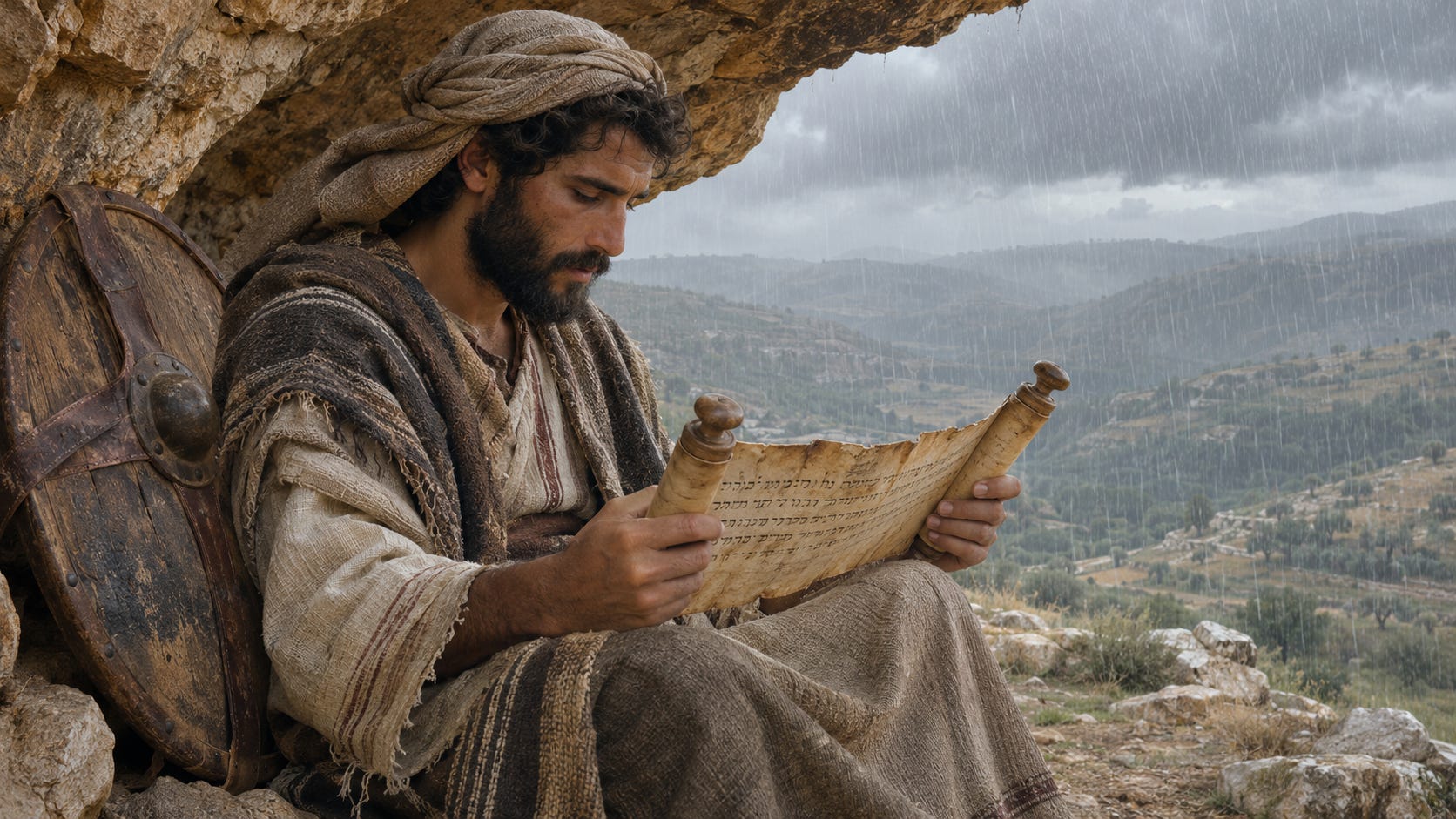
Image generated with ChatGPT by OpenAI. Description: With his shield resting beside him and rain sweeping across the Judean hills, the traveler settles into the shelter and gives his full attention to Scripture.
“You are my refuge and my shield; I have put my hope in your word.”
Psalms 119:114 NIV
Over the years, we’ve explored Psalm 119 eight different times. That’s not surprising; it is the longest Psalm with 176 total verses, which means that it could take almost a year for me to write a devotional for each verse (given that I write every other day). As I’ve mentioned before, Psalm 119 is not only the longest Psalm, but the longest chapter in the Bible! Here are several other interesting facts about this Psalm (from Wikipedia):
Psalm 119 is one of about a dozen alphabetic acrostic poems in the Bible. Its 176 verses are divided into twenty-two stanzas, one stanza for each letter of the Hebrew alphabet; within each stanza, each of the eight verses begins (in Hebrew) with that letter.[10] The name of God (Yahweh/Jehovah) appears twenty-four times.
This verse is a beautiful and easily memorized prayer, a statement of faith for any believer. It begins with the acknowledgement of God as “my refuge and my shield”. That’s more than just saying that God occasionally provides help; He is a constant refuge to the faithful. In the original Hebrew, the word is סֵתֶר (sēṯer), meaning a hiding place or shelter.
BibleHub said this about God’s care of His people:
As a hiding place, He shelters His people amid danger, sorrow, and the hostility of the wicked (Psalm 32:7; Psalm 91:1–2). As a shield, He stands in defense of those who belong to Him, as He did for Abraham and David (Genesis 15:1; Psalm 3:3). The two images unite security and protection: the Lord receives His people into His care and guards them against every force that would overthrow their faith.
This is reminiscent of Ephesians 6:16, where Paul refers to the Armor of God and the shield of faith:
“In addition to all this, take up the shield of faith, with which you can extinguish all the flaming arrows of the evil one.”
Enduring Word provides commentary from two 19th Century Biblical scholars; Adam Clarke and Charles Spurgeon:
ii. “There is a time in which I may be called to suffer in secret; then thou hidest me. There may be a time in which thou callest me to fight; then thou art my Shield and Protector.” (Clarke)
iii. “This is an experiential verse, and it testifies to that which the writer knew of his own personal knowledge: he could not fight with his own thoughts, or escape from them, till he flew to his God, and then he found deliverance. Observe that he does not speak of God’s word as being his double defence, but he ascribes that to God himself.” (Spurgeon)
What more can we say about the second part of this verse, other than it is a solid declaration of faith? “I have put my hope in your word.” The psalmist is stating his confidence that the Lord will fulfill His promises, because His Word and His character are faithful and unchanging.
In our New Testament times, we can still hold onto that hope. It is fulfilled in Jesus Christ, the Word made flesh. Through His sacrifice God secured salvation and eternal life for all who believe. The Word continues to sustain His people, teaching us obedience and providing an anchor in the unfailing promises of God.
Want to learn more about the Psalms? Read our other devotionals exploring this treasury of the Bible:
Heaven On Wheels Daily Prayer:
Father in Heaven, I thank You for being my refuge and my shield. When I feel anxiety or am overwhelmed by the evil of the world, You help me to find safety and strength in Your presence. May I always place my hope in Your Word and trust Your promises, especially when life is challenging. AMEN.
Scripture quotations taken from THE HOLY BIBLE, NEW INTERNATIONAL VERSION®, NIV®. Copyright © 1973, 1978, 1984, 2011 by Biblica US, Inc.®. Used by permission.
BibleHub was accessed on November 23, 2026 for commentary on Psalms 119:114
Commentary quotations from Enduring Word are used with the written permission of the author and reproduced here in their original format. © 1996-present The Enduring Word Bible Commentary by David Guzik – enduringword.com
Clarke, Adam “Clarke’s Commentary: The Holy Bible Containing the Old and New Testaments with a Commentary and Critical Notes” Volume 3 (Job-Song of Solomon) (New York: Eaton and Mains, 1827)
Spurgeon, Charles Haddon “The Treasury of David: Volume 3” (Psalms 111-150) (Peabody, Massachusetts: Hendrickson, 1988)