


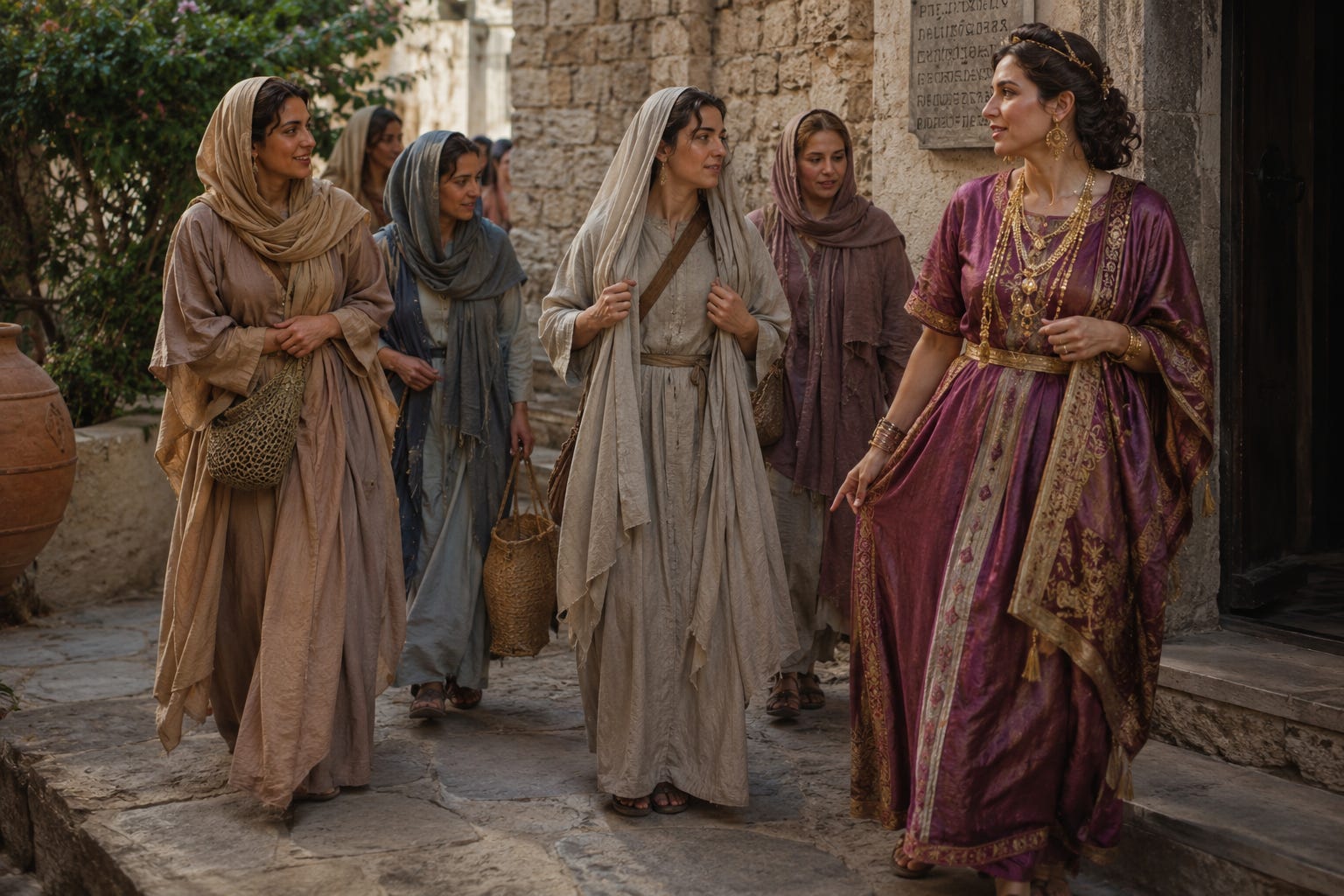
Image generated by ChatGPT (OpenAI) using the DALL·E model.
“I also want the women to dress modestly, with decency and propriety, adorning themselves, not with elaborate hairstyles or gold or pearls or expensive clothes, but with good deeds, appropriate for women who profess to worship God.”
1 Timothy 2:9-10 NIV
Barb’s continuing look at Ephesians has focused quite a bit over the past few days on how men and women should act towards one another, so it’s no surprise that God chose these verses from the First Epistle to Timothy for me to study and write about. There are no coincidences with God!
This epistle is traditionally attributed to Paul, writing to his younger colleague Timothy who has taken on the task of ministering to the church in Ephesus. In total, the epistle is instructive in defining the organization of the early church and the responsibilities of the leaders. Paul also exhorts Timothy to maintain the truth in the face of many doctrinal errors that were arising at the time.
In these two verses, Paul is setting forth the idea that women should emphasize their spiritual preparation each day rather than their physical preparation. In other words, they are to dress and fashion themselves modestly, with propriety and moderation. Let’s look at those two words.
The Merriam Webster Dictionary defines propriety as “the quality or state of being proper or suitable : APPROPRIATE”, while moderation means “avoiding extremes of behavior or expression : observing reasonable limits”.
Now, no offense to a few of the women at our church, but some definitely dress for worship services in clothing and accessories that are not “proper or suitable” nor do they “observe reasonable limits”. It’s not just this church; since Barb and I started attending services again in 2007, we’ve raised eyebrows at what some ladies deem “appropriate” clothing for attending church.
These words — propriety and moderation — explain what modest apparel is. I thought David Guzik’s commentary on Enduring Word explained it well:
i. Propriety asks, “Is it appropriate for the occasion? Is it over-dressed or under-dressed? Is it going to call inappropriate attention to myself?” Moderation asks, “Is it moderate? Is it just too much — or far too little?” Moderation looks for a middle ground.
ii. The braided hair or gold or pearls or costly clothing Paul mentions were adornments that went against the principles of propriety and moderation in that culture.
iii. How you dress reflects your heart. If a man dresses in a casual manner, it says something about his attitude. Likewise, if a woman dresses in an immodest manner, it says something about her heart.
iv. “Woman has been invidiously defined: An animal fond of dress. How long will they permit themselves to be thus degraded?” (Clarke)
c. But… with good works: The most important adornment is good works. If a woman is dressed in propriety and moderation, with good works, she is perfectly dressed. Good works make a woman more beautiful than good jewelry.
As you can glean from Guzik’s commentary, God finds the woman who dresses modestly and appropriately, and who practices “good deeds” (works) to be truly beautiful!
At the time this epistle was written, clothing was the main indicator of social status and moral character. For the early Christians, respectable clothing would have been seen as appropriate for worship as it would not draw undue attention to the wearer. Remember the words in 1 Peter 3:3-4 about being humble and living a life that honors God? They mirror the words of Paul to Timothy:
“Your beauty should not come from outward adornment, such as elaborate hairstyles and the wearing of gold jewelry or fine clothes. Rather, it should be that of your inner self, the unfading beauty of a gentle and quiet spirit, which is of great worth in God’s sight.”
In those days, respectable — not flashy — apparel would have been understood by most early Christians as appropriate for worship. Modesty isn’t just about clothing, but also about the intention behind your appearance. Scripture says a lot about modesty, and believers are to focus on inner beauty and godliness over outward appearance. Reflect on the words of Proverbs 31:30, for example:
“Charm is deceptive, and beauty is fleeting; but a woman who fears the Lord is to be praised.”
Propriety can also be defined as self-control. That’s one of the fruits of the Spirit, and something that should be practiced in order to please God. Self-control requires discipline in all areas, including on how one dresses and presents his/herself to the world. It’s a virtue that helps believers resist the pressures of society to conform to “standards” and conduct lives God would approve of.
It’s not just clothing that Paul refers to here; “elaborate hairstyles or gold or pearls” were also viewed in the Greco-Roman world as being associated with wealth and social status. Paul is advising against these, and suggesting that women focus on adorning themselves with the Spirit rather than those outward displays of self-aggrandizement.
Jesus taught us that believers should reflect His light through good deeds, as in Matthew 5:16. In Galatians 5:22-23, we also see that gentleness and self-control are the fruit of the Spirit, and “Against such things there is no law”. Paul was turning the world on its head with this epistle, defining propriety as godliness instead of meeting the expectations of society.
In the last part of these verses, Paul refers to this behavior as being a standard for Christian women of the time — “appropriate for women who profess to worship God.” These would be the women who claim to follow God, those who had made a public declaration of faith. That was not just a public baptism or testimony, but living a lifestyle of faith and obedience to God.
Combining professed belief with the practice of Christian living was what Paul was encouraging the Ephesian women to follow as a lifestyle..
Heaven On Wheels Daily Prayer:
Today’s prayer comes from Knowing Jesus:
Heavenly Father, thank You for the many instructions on godly living we receive in Your Word. I pray that I may grow in grace and conduct myself in a manner that honours Your name. Keep me from drawing attention to myself inappropriately. May my inner thoughts be pure and holy, and my outer clothing bring honour to Your name. I pray that all I say and do is always acceptable in Your sight. This I ask in Jesus’ name, AMEN.