


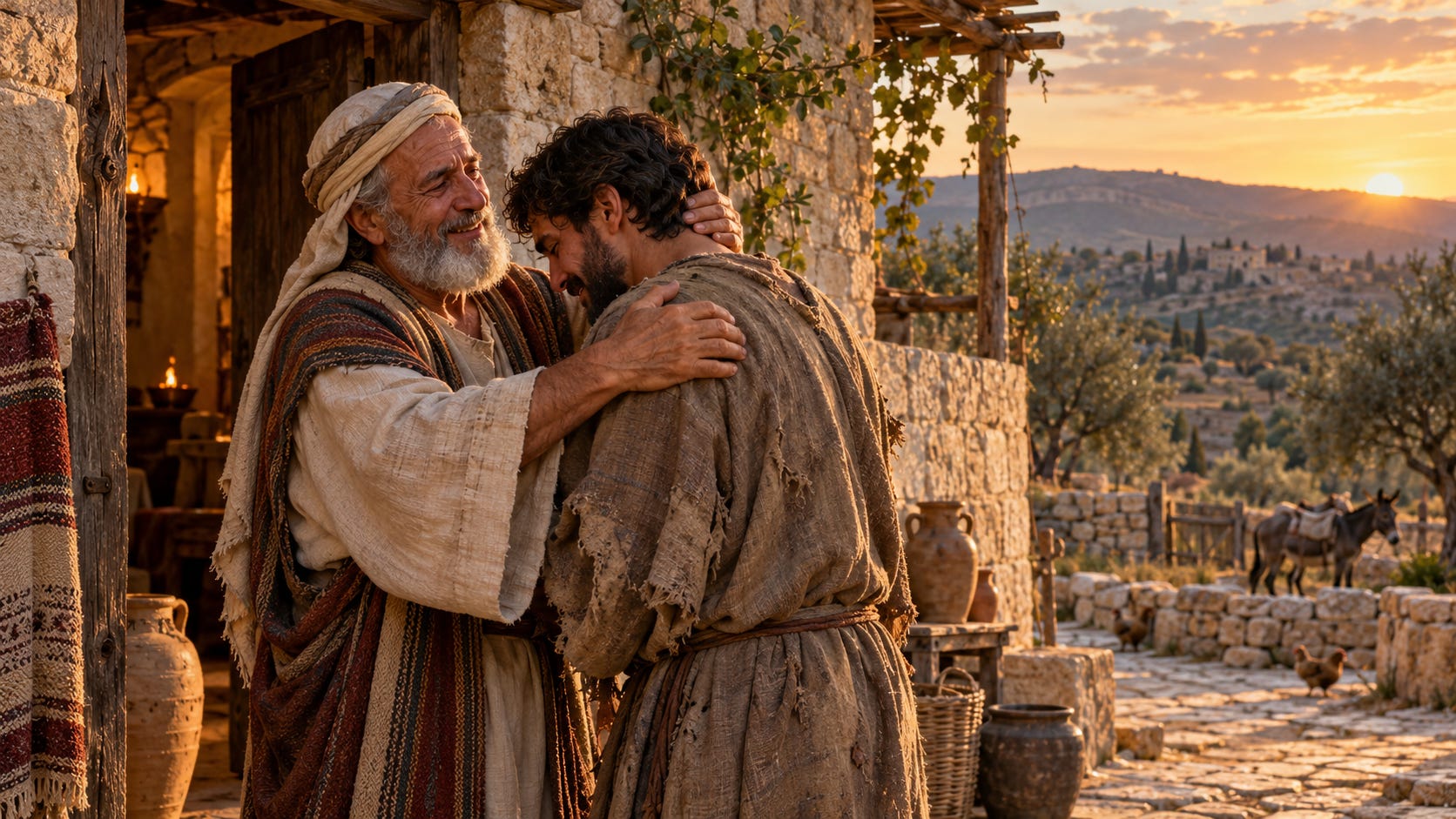
An elderly Israelite father welcomes home his visibly remorseful adult son, placing a gentle hand on his shoulder. The son’s dusty clothes and bowed head contrast with the father’s tender expression. Warm light spills from a simple stone house. This would illustrate God’s delight in mercy through a human encounter. Image generated with ChatGPT by OpenAI.
“Who is a God like you, who pardons sin and forgives the transgression of the remnant of his inheritance? You do not stay angry forever but delight to show mercy.”
Micah 7:18 NIV
Micah is one of the twelve Minor Prophets, sharing that honor with some more well-known prophets like Jonah and Malachi. His name in Hebrew is מִיכָיָ֫הוּ (Mikayahu), meaning “Who is like Yahweh?”. He hailed from a village named Moresheth in Judah, and prophesied during the 8th Century BC.
Wikipedia notes this about the prophecies of Micah:
Micah reproaches unjust leaders, defends the rights of the poor against the rich and powerful;[7] while looking forward to a world at peace centered on Zion under the leadership of a new Davidic monarch.[8]
This is the last chapter of Micah, a book that is divided into three major sections encompassing chapters 1-2, 3-5, and 6-7. Our verse today falls in what is referred to in the Wikipedia article as “a hymnic prayer of petition and confidence.”
The verse begins with a rhetorical question — “Who is a God like you, who pardons sin and forgives the transgression of the remnant of his inheritance?” In a way, this is a very fitting question from a man whose name asks the question “Who is like Yahweh?” By asking this question, Micah was highlighting the difference between Israel’s living God — who offered holiness, mercy, justice, and power — and the stone and metal idols of the surrounding nations. Unlike those idols, Yahweh rules over all of His creation and remains faithful to His covenant with His people.
Yahweh “pardons sin”. Micah isn’t just saying that He minimizes our sin; He removes the guilt of sin from those who turn to Him with faith. In the context of Micah’s time, the Lord’s forgiveness even reaches out to those who had rebelled against Him and brought judgment onto Israel and Judah. His mercy is as great as His infinite creation.
In saying that God “forgives the transgression of the remnant of his inheritance,” Micah explains that Yahweh isn’t dealing with His repentant people in the way their past behavior warranted. Instead, He is treating them with the same deliverance and forgiveness He showed in the past with Israel’s Passover and would show in the future with the sacrificial death of Christ and its once and for all time forgiveness for repentant sinners.
Why would He do this for the “remnant of His inheritance”? Many in Israel had sunk to idolatry and cheered injustice, but God would never abandon the people He had chosen as His inheritance.
The final sentence illustrates that God does get angry at His people, and He has shown His judgment in the past. But divine anger is not what He has in mind for His redeemed people. He’s committed to the promises made in His covenant, and He will discipline, then restore His people.
The last phrase explains that God “delight(s) to show mercy”. He takes pleasure in demonstrating His unwavering love and mercy for His people. 800 years after Micah wrote these words, God would display His mercy to the fullest through Jesus. Through Jesus, God forgives sin and upholds His righteousness.
Heaven On Wheels Daily Prayer:
Today’s prayer comes from Knowing Jesus:
Thank You, Father, for Your unchanging love to me. Thank You for Your faithfulness to Israel and to the Church, despite the times when we have individually or collectively strayed far from You. You showed Your unconditional love for me when You sent the Lord Jesus to take the punishment for my sins. Thank You, Lord, that You delight in mercy. In Jesus’ name, AMEN.
Scripture quotations taken from THE HOLY BIBLE, NEW INTERNATIONAL VERSION®, NIV®. Copyright © 1973, 1978, 1984, 2011 by Biblica US, Inc.®. Used by permission.
BibleHub was accessed on October 13, 2026 for commentary on Micah 7:18