


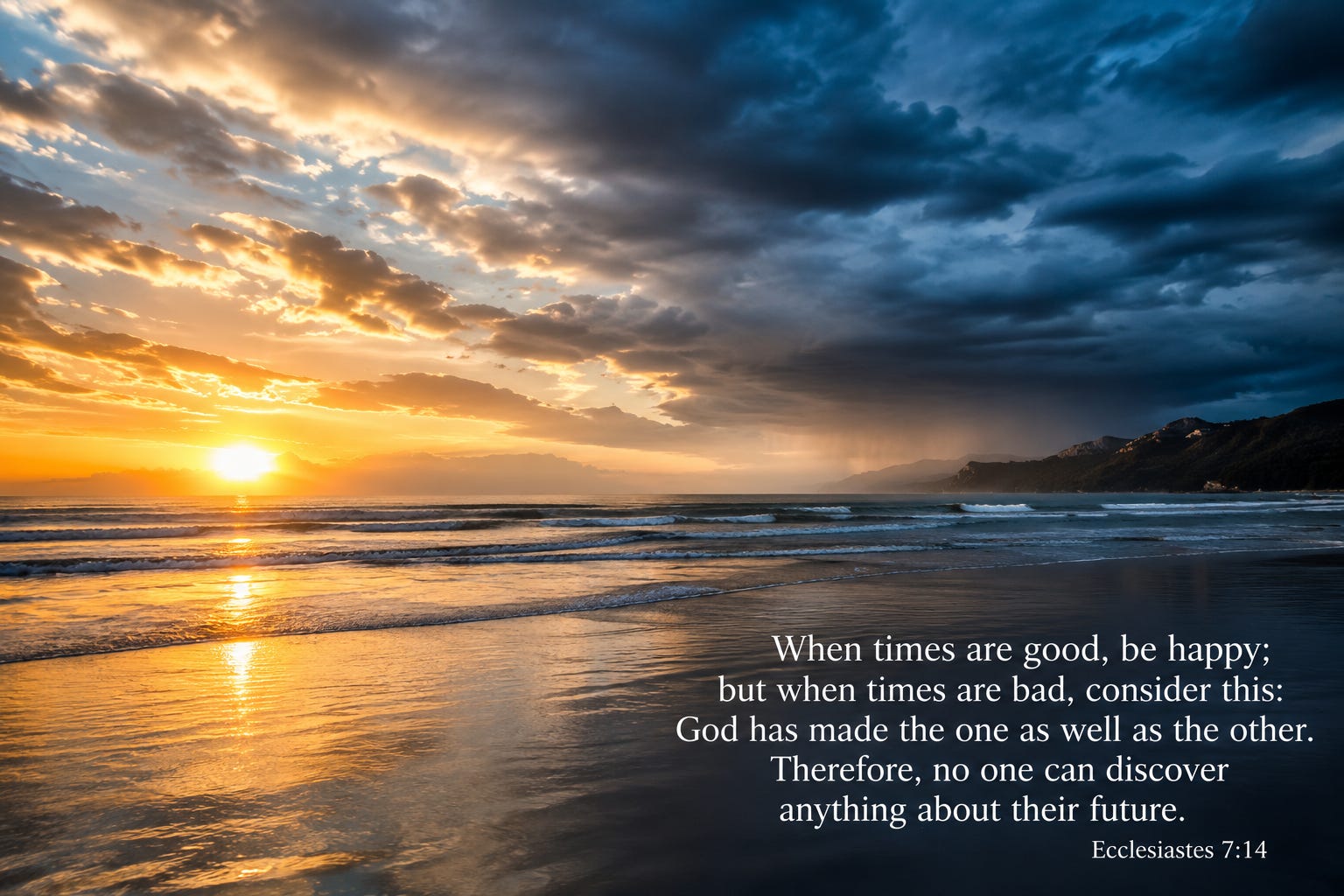
Image generated by ChatGPT (OpenAI) using the DALL·E model.
“When times are good, be happy; but when times are bad, consider this: God has made the one as well as the other. Therefore, no one can discover anything about their future.”
Ecclesiastes 7:14 NIV
The author of Ecclesiastes is thought to be King Solomon, who refers to himself in the text as קֹהֶלֶת — “Kohelet, son of David, King of Jerusalem.” Kohelet is an odd choice for a name… it’s a feminine name meaning “teacher” or “preacher”. The meaning of the name is quite apt, and some Biblical scholars believe that Solomon chose the name because at the time it was written, he was old and “weak like a woman” (Isaiah Trani). Other scholars also cited in the Wikipedia entry for Ecclesiastes have a much better explanation for the name:
According to Salmon ben Jeroham, "This is because, even as a woman births and raises children, Qoheleth revealed and organized wisdom". According to Yefet ben Ali, and later, Abraham ibn Ezra and Joseph Ibn Kaspi, "He ascribed this activity to his wisdom, and because Wisdom is female, he used a feminine name."
The beginning words of this verse are uplifting: “When times are good, be happy.” Kohelet continues “but when times are bad, consider this: God has made the one as well as the other.”
Humans cannot control what happens to them. We can’t prevent natural disasters, political or economic upheavals, or wars; diseases or old age eventually cause our demise regardless of our lot in life. The one thing we can control is how we perceive our lives — in other words, our attitudes and the way that we look at our situation. So why would Kohelet/Solomon need to remind us to be happy in good times? Isn’t that a given?
The Bible Says has a good commentary on this:
It might seem odd that we would need to be told to choose happiness when things are going well. But on reflection, when things are going well, it is typical human behavior to be unhappy because our circumstances aren’t even better. Solomon advises us to see things as they are, and when we are blessed, to be grateful and enjoy it. To choose to be happy.
Kohelet follows up immediately with the reminder that when things aren’t going along swimmingly, we should look at the less-than-wonderful situation with the perspective that God made bad times as well as good times. Often a situation can be bad for one person or group, yet good for others.
I have a personal example of this — a few years ago, our neighborhood was hit by a small tornado accompanied by hail, uprooting trees and causing damage to our roof. That was bad for us and many other homeowners in the neighborhood, but it was a financial boon for our next-door neighbor, who owns a roofing company! What was adversity for many people resulted in prosperity for him.
Think of another weather-related situation: A farmer in a drought-stricken area like ours would be thrilled by a day-long rainstorm that would soak his parched fields, but the local baseball team would be unhappy with the same storm that would result in a rainout and a loss of revenue at the ballpark. It all depends on the perspective. Sure, we should be happy when times are good, but we should also consider that we might gain some benefit when things are bad.
The verse ends by telling us “Therefore, no one can discover anything about their future.” God made both the good and bad times. A person with wavering or no faith would curse God for causing those bad times, while those with true faith know that they are going to see adversity and that God is placing them in that situation for a reason. Once again from The Bible Says:
This appears to be saying that God gave us this full range of experiences, prosperity as well as adversity, for our benefit. That we might learn. Discover. That we might have a complete opportunity to discover all God has for us to gain in our life under the sun. In observing that man will not discover anything that will be after him, Solomon is pointing out the plain truth that we cannot know the future. Our future might hold adversity and it might hold prosperity. We do not need to worry which it is, because God has made the one as well as the other, and both are in God’s hands, who has our best interest at heart.
Precept Austin offers additional insight into the final phrase of this verse:
God allows this balance (prosperity...adversity) to keep us humble and dependent. We cannot predict the future. We must walk by faith, not by sight (2Co 5:7+), and not by control or presumption. This juxtaposition of prosperity and adversity echoes Ecclesiastes’ theme of divine mystery and our limited perspective. In prosperity, rejoice. In adversity, reflect. Both come from God, and both are designed to humble us and teach us to trust Him and to grow in the grace and knowledge of our Lord and Savior Jesus Christ (2Pe 3:18+).
I think the end of that commentary really sums up the verse well. Everything comes from God, both what we perceive as good and also “bad” things. Remaining humble, trusting in God, and growing in the grace of Jesus are what God wants us to do regardless of circumstances.
Heaven On Wheels Daily Prayer:
Father in Heaven, when adversity enters my life as I know it will, remind me to recognize that it is as much of a part of Your divine plan as joy is. Give me the wisdom to understand the lessons You are teaching me during difficult times, and remind me to remain grateful and joyful when things are going well for me. May I always seek to grow in my faith and understanding through every experience You place me in. AMEN.
Am Grateful and thankful, Amen.