


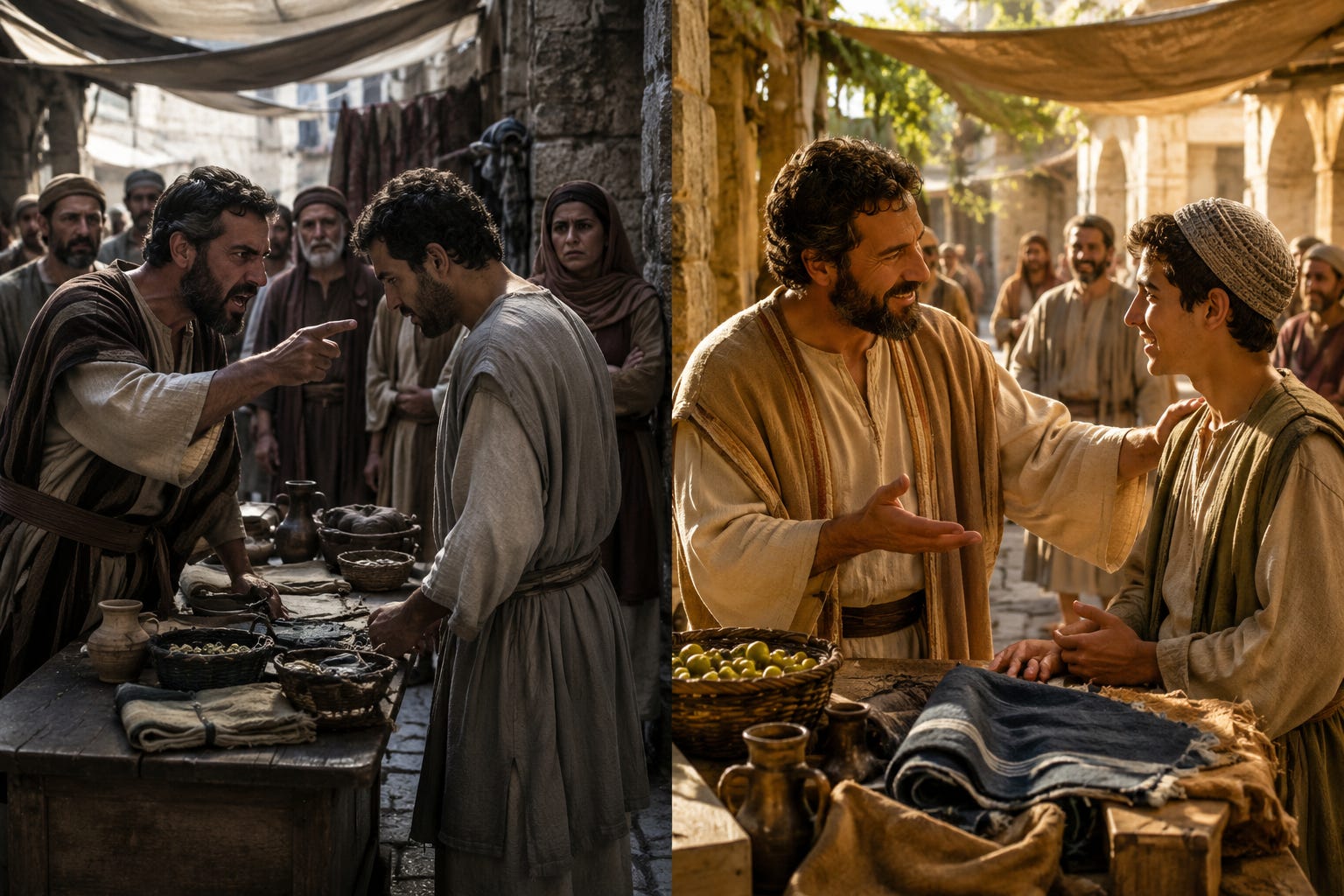
Image generated by ChatGPT (OpenAI) using the DALL·E model.
“From the fruit of their mouth a person’s stomach is filled; with the harvest of their lips they are satisfied. The tongue has the power of life and death, and those who love it will eat its fruit.”
Proverbs 18:20-21 NIV
Want more of the biblical wisdom of Proverbs? Click the button below!
The Bible is filled with wisdom about the power of speech and its use for both good and evil. In today’s proverbs, we learn two lessons: The first lesson is that what we say bears fruit, and what we say (or how we say it) will eventually come back to us with very real consequences. The second is that the tongue is a very powerful tool, even holding the power of life or death through what is said in speech.
Words can build up, or words can tear down. The image that ChatGPT put together for me shows that in action; speaking in anger (on the left) is bringing everyone down, speaking encouraging and love-filled words (on the right) is nurturing the merchant’s relationship with his apprentice.
Barb and I are currently on a cruise, and we saw this proverb in action today. There’s a “guest speaker” who has been giving talks on a wide variety of topics, apparently an expert in all things. The Book of Proverbs may not be on that list of areas of expertise, as he seemed genuinely angry with us when we politely expressed our disagreement with one of his many opinions. Proverbs 18:20, stated plainly, provides the knowledge that words have consequences, just as actions do.
The Bible Says has this commentary on the proverb:
The fruit of a man’s mouth suggests that speech produces something harvest-like. Words help shape relationships, reputations, opportunities, and atmospheres. What we say does not vanish. It matures into effects that come back to us.
That is why he will be satisfied with the product of his lips. Whether for good or ill, speech returns in consequence. Solomon’s point is not merely that words matter abstractly, but that they participate in the cause-and-effect order God built into moral reality.
It’s the theological equivalent of Newton’s Third Law: “For every action, there is an equal and opposite reaction. Or every action always reacts in the opposite direction.” Acting surprised by someone having a contrary opinion demonstrates a profound lack of understanding of humanity. The author of this proverb, most likely King Solomon, was well aware of the effects — good or bad — of our words on others.
The righteous person finds satisfaction in aligning their words and actions with God’s wisdom, the spiritual satisfaction of a life lived in accordance with The Word. Most of the time, it is best to say little or nothing and keep peace, rather than sow discord by giving your mouth free rein.
Proverbs 18:21 describes the power of our words. As noted on The Bible Says, “The tongue carries tremendous moral force.” The commentary continues:
Death and life are both in the power of the tongue because words can wound, corrupt, deceive, divide, and destroy—or heal, teach, encourage, reconcile, and guide. Speech can pull people toward ruin or nourish them toward life. It is one of the chief instruments through which the heart affects the world.
Those who love it will eat its fruit. If we rely heavily on speech, we will also experience the consequences it produces. The proverb is both warning and invitation: steward the tongue wisely, because its fruits are real and often lasting.
World War II provides us with perfect examples of the power of the tongue to “pull people toward ruin or nourish them toward life”. Adolf Hitler used his speaking skills to rally Germany to see itself as “the master race” and degrade the rest of the world as sub-human, eventually leading the nation into a war that would result in the deaths of tens of millions. Winston Churchill, a true master of language, was able to accomplish much good with his words. He rallied a militarily outclassed nation to ultimate victory with one of the most stirring motivating speeches ever written:
Even though large tracts of Europe and many old and famous States have fallen or may fall into the grip of the Gestapo and all the odious apparatus of Nazi rule, we shall not flag or fail.
We shall go on to the end, we shall fight in France, we shall fight on the seas and oceans, we shall fight with growing confidence and growing strength in the air, we shall defend our Island, whatever the cost may be.
We shall fight on the beaches, we shall fight on the landing grounds, we shall fight in the fields and in the streets, we shall fight in the hills.
We shall never surrender, and even if, which I do not for a moment believe, this Island or a large part of it were subjugated and starving, then our Empire beyond the seas, armed and guarded by the British Fleet, would carry on the struggle, until, in God’s good time, the New World, with all its power and might, steps forth to the rescue and the liberation of the old.
He was able to persuade President Franklin D. Roosevelt, also a master of words, to support Britain in a number of ways before the US entered the war. Together, the two forged a friendship that was reflected in the alliance which won the conflict.
The last part of this verse implies that those who are aware of the power of their words realize that they will eventually reap the fruit of those words, for good or ill. Like seeds, words grow and produce fruit. Scripture offers many examples of “reaping what you sow”, particularly in Galatians 6:7-8:
“Do not be deceived: God cannot be mocked. A man reaps what he sows. Whoever sows to please their flesh, from the flesh will reap destruction; whoever sows to please the Spirit, from the Spirit will reap eternal life.”
Galatians 6:7-8 NIV
Especially in our age of instant communication by written or spoken word, understanding that our words can either edify or destroy lives is critically important.
Heaven On Wheels Daily Prayer:
Father in Heaven, I come before You today in acknowledgement of the power of my words. Grant me the discernment to choose my words wisely, and to remain silent rather than cause harm by opening my mouth. Help me to speak with truth and kindness, to bring joy and instruction to others. Let my words satisfy You first, then myself and others, producing good fruit in all of our lives. AMEN.