


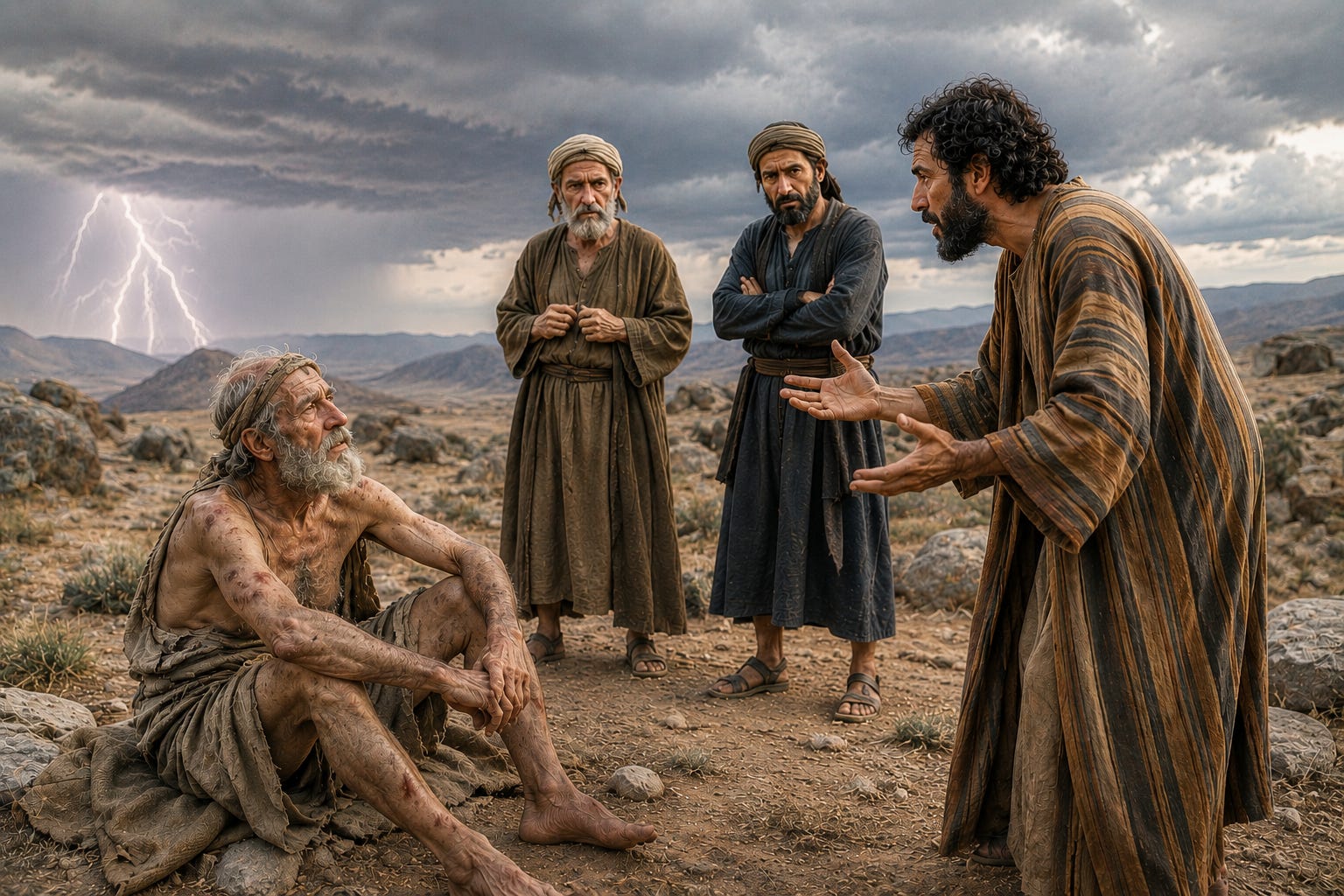
Elihu speaking to Job (seated) about God’s nature. Image generated by ChatGPT (OpenAI) using the DALL·E model.
“The Almighty is beyond our reach and exalted in power; in his justice and great righteousness, he does not oppress.”
Job 37:23 NIV
Today’s verse comes from the latter part of the Book of Job, specifically when Elihu (one of the three friends of Job who are offering him advice about his plight) hears thunder and interprets it as God speaking. Elihu is actually giving Job some good advice at this point, essentially telling him to quit trying to speak to God and just fear (respect) Him and His commandments instead.
Elihu begins by emphasizing that God is incomprehensible to man — “The Almighty is beyond our reach.” As humans, we can never understand God’s purposes and actions, and Elihu seems to be reminding Job to stop trying to second-guess God’s purpose for him. The ancient Hebrew word שַׁדַּי (šaday - Almighty) is used throughout the Book of Job to describe God, emphasizing His authority and power.
In Isaiah 55:8-9, we also see evidence of God’s supreme power over His creation and how we can never hope to understand His thoughts:
““For my thoughts are not your thoughts, neither are your ways my ways,” declares the Lord. “As the heavens are higher than the earth, so are my ways higher than your ways and my thoughts than your thoughts.”
Not only is God omniscient (all-knowing), but He is also omnipotent (all-powerful). Look almost anywhere in the Bible, and we see demonstrations of God’s power: Creation, the unceasing enumeration of miracles He performs, and His dominion over nations. Elsewhere in Job, God speaks of His control over His creation, reminding Job that He always accomplishes His will. That power was demonstrated in His deliverance of Israel from Egypt, as well as the resurrection of Jesus Christ in later years.
Elihu moves on to focus on God’s moral attributes, His “justice and great righteousness”. Those attributes are central to His character, and visible throughout the Old Testament — think of the Law He gave to Israel, which centers on distributing justice to His people and emphasizing the need for righteous living. The Old Testament prophets called on the people of Israel to reflect God’s justice and righteousness.
These attributes are fulfilled in the New Testament by the sacrificial death and resurrection of Jesus Christ, who exemplifies God’s righteousness and who brought justice to all through the Cross.
The last phrase of the verse — “he does not oppress” — highlights how fair and compassionate God is. The human rulers described throughout scripture, with a few exceptions, abused their power. God uses His power for justice and the good of His creation. Elihu probably chose this phrase to remind Job that God always provides comfort to believers, and is motivated by love for His people.
God’s gentle and humble heart is exemplified in the life of Jesus, who said in Matthew 11:28-30:
““Come to me, all you who are weary and burdened, and I will give you rest. Take my yoke upon you and learn from me, for I am gentle and humble in heart, and you will find rest for your souls. For my yoke is easy and my burden is light.”
Heaven On Wheels Daily Prayer:
Thank You, God almighty, for Your power, justice, and righteousness, all of which are beyond our comprehension. Help me to trust in Your wisdom, particularly in difficult times. Grant me the strength to rely on Your guidance, and help me to find comfort in Your presence. You are a constant source of hope and strength in my life, and I am forever grateful for Your justice and righteousness. When I falter and have moments of doubt, remind me of Your greatness and that You will always be with me. May I always honor You in my thoughts and in my actions, AMEN.
Am grateful and thankful for this blessing may the Lord bless you too.