


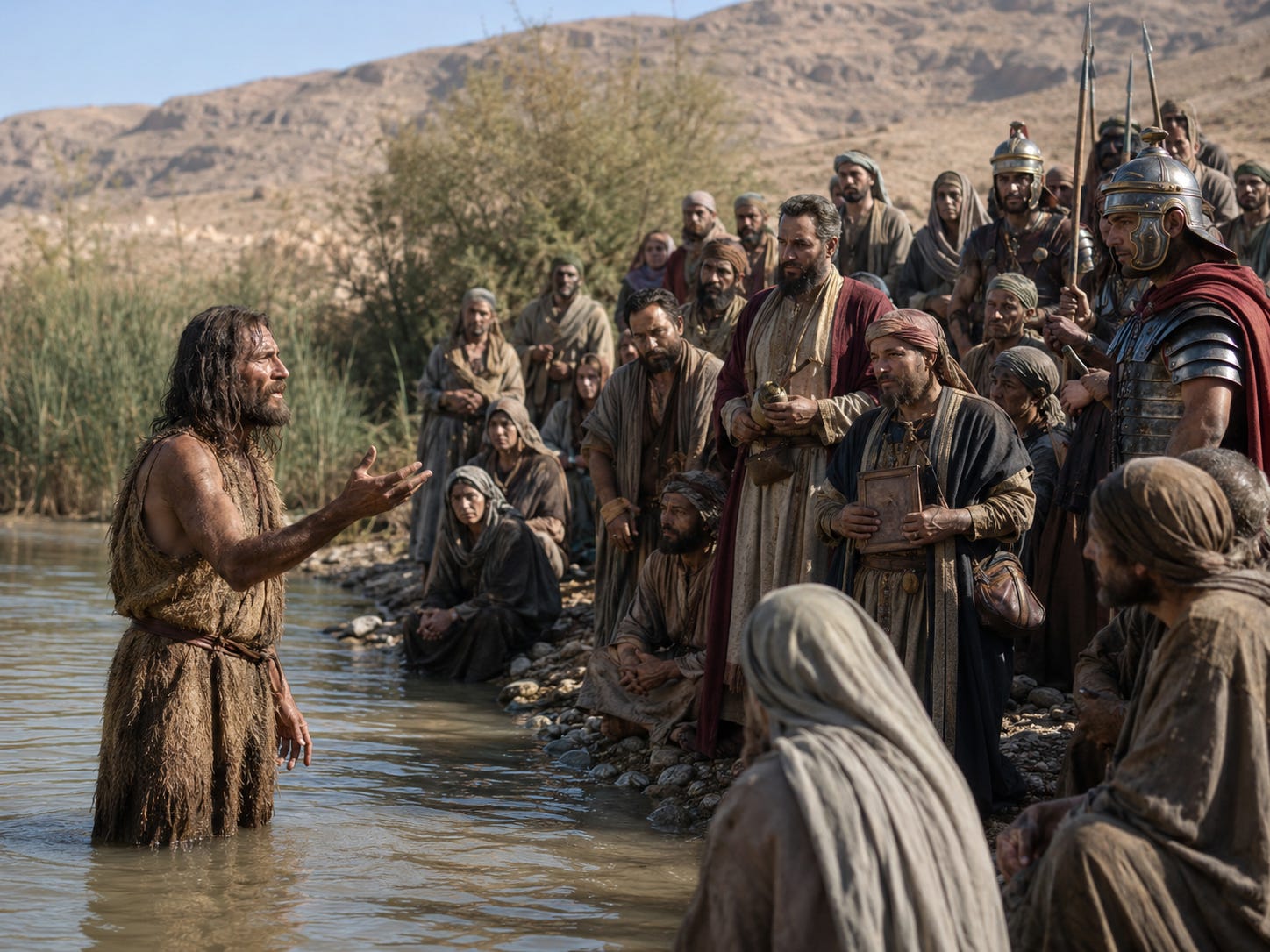
Image generated by ChatGPT (OpenAI) using the DALL·E model.
“John answered, “Anyone who has two shirts should share with the one who has none, and anyone who has food should do the same.””
Luke 3:11 NIV
With yet another Gospel verse focusing on generosity and giving, it’s obvious that God wants me and all of our readers to think about how they are serving His church.
In this verse from the Gospel of Luke we hear that John is answering a question. This isn’t the apostle John; rather, it’s John the Baptist and son of Zechariah who is in the midst of his ministry of “preaching a baptism of repentance for the forgiveness of sins. (Luke 3:3).
John has just referred to those in the crowds seeking to be baptized as a “brood of vipers” (Luke 3:7), admonishes them to repent, and tells them to quit patting themselves on the back for being “children of Abraham” (Luke 3:8) — i.e., Jewish — and thus the chosen people of God. John is trying to impress on them that their alleged faith means nothing if they continue to sin.
The Bible Says explains:
For a Jew, their entire identity and sense of security was wrapped up in the promise that they were children of Abraham. God’s covenant promise to Abraham, that He would bless him and protect him and his descendants, extended to them. Some Jews, including many religious leaders took God’s promise as a sort of overriding protection from their own responsibilities under their covenant with God.
Instead of following God by faith as their father Abraham did, and as they promised to do under the covenant they made with God, they distorted and manipulated His laws and promises to extort others and justify themselves in God’s name. God’s covenant clearly spelled out consequences for disobedience (Deuteronomy 28:15-68). However, people often see what they want to see, and hear what they want to hear.
After hearing this rather distressing message from the baptizer that being Jewish isn’t a ticket to heaven, the crowd demands an answer: “What should we do then?” (Luke 3:10). John begins listing what they should do, beginning with today’s verse — “Anyone who has two shirts should share with the one who has none, and anyone who has food should do the same.”
In this verse and the three that follow, John sets out the simple answer to the crowd in general, and then specifically to tax collectors and soldiers — basically, put love into practice.
Enduring Word’s David Guzik made the following comments on John’s demands:
a. What shall we do then? John’s instructions were quite ordinary. He demanded that people share, that they be fair with each other, and that they not be mean and cruel; that they be happy with what they get. These are things we teach our smallest children.
i. Integrity in the ordinary things is still a mark of true repentance. We sometimes think God requires us to do great or impossible things to demonstrate repentance. Often, He instead looks for integrity in the ordinary things.
ii. He has shown you, O man, what is good; and what does the LORD require of you but to do justly, to love mercy, and to walk humbly with your God? (Micah 6:8)
John was preaching what Jesus would teach in the near future — it’s basically what we know today as the “golden rule”:
“So in everything, do to others what you would have them do to you, for this sums up the Law and the Prophets.”
As I was studying commentary on this verse, I found the following writing from The Bible Says to be very instructive, particularly in these times when some are thinking that socialism and communism are “a good idea”:
In other words, instead of twisting God’s laws to manipulate and extort one another, they should obey them. This teaching comes directly from God’s covenant/treaty with Israel, in which He promised Israel that they would be blessed if they followed His laws. Much of the blessing would be the natural consequence of following His commands; a society/team/organization that treats one another lovingly will naturally be far superior to one that follows the pagan morality of mutual exploitation.
And they should start with considering their neighbor and his needs, looking for the opportunities God has given them to serve their neighbor.
Some have mistaken John’s counsel, the man who has two tunics is to share with him who has none as a support for a political system of redistribution, such as communism. However, John’s admonition only applies if the generosity is voluntary.
Communism is a system where government dictates how much the common folk can control. Through coercion, it takes from those whom it deems have more than their allotted amount and redistributes some of it to those it favors, then keeps the rest for itself.
Because redistribution is forced, communism does not share in the Biblical sense. Communism does not teach the virtue of generosity or love, because it denies people the possessions by which they can be generous. Communism breeds envy towards those who have more than yourself. This is the opposite of love. Envy then petitions and empowers the government to take from others. This is the opposite of being generous with what you have, to share with him who has none.
Communism’s policy of forced redistribution runs against the generosity and love which John the Baptist and the Bible teach,
“He who steals must steal no longer; but rather he must labor, performing with his own hands what is good, so that he will have something to share with one who has need.”
(Ephesians 4:28)
We should treat others as we would like to be treated, but that is ours to choose. We should see our neighbor in his need and love him and share our tunics and our food with him who has none, but that is ours to choose. And we are to do likewise with everything else in our possession, including our time, our money, etc. because if we do not, we will face judgement from God.
If we love our neighbor as we love ourself, and trust God enough to be generous with our possessions, then we will “bear good fruit” (Luke 3:9) and avoid “the wrath to come” (Luke 3:7).
Good commentary!
John was the forerunner for Jesus, who would teach the generations to come of the need for generosity of heart. I think God’s reason in having me write so many of these devotionals recently that focus on generosity and giving is that He wants for us to do some self-examination…
Are we generous with what we have, sharing it with others joyfully? Or are we always grabbing for more money and possessions, then holding onto them as if those material things are all that matters?
Do we enjoy giving to others, especially those in need? Do we give regularly to the Lord, and do we do that sacrificially — meaning that the giving comes first and foremost? Would you rather give a windfall to the Lord instead of treating yourself to some new “toys”? If you call yourself a Christian but don’t give regularly to the Lord or serve His people with your time, treasure, and talent, then perhaps you might want to seriously think about what it means to be a Christian!
Christians who are truly living their faith like to give to the church and to others, as the Spirit of Christ lives in them. Jesus gave himself for us in the ultimate sacrifice, and reminds us in Acts 20:35 that “It is more blessed to give than to receive.”
Heaven On Wheels Daily Prayer:
Father in heaven, we thank You for every blessing You have placed in our hands. Teach us to see the needs of Your church and of others with compassionate hearts, knowing that generosity is one way to make our faith visible in this world. We trust You as our Provider, and may we always use Your gifts to us to bless others. AMEN.
Beautifully said Steve thank you