


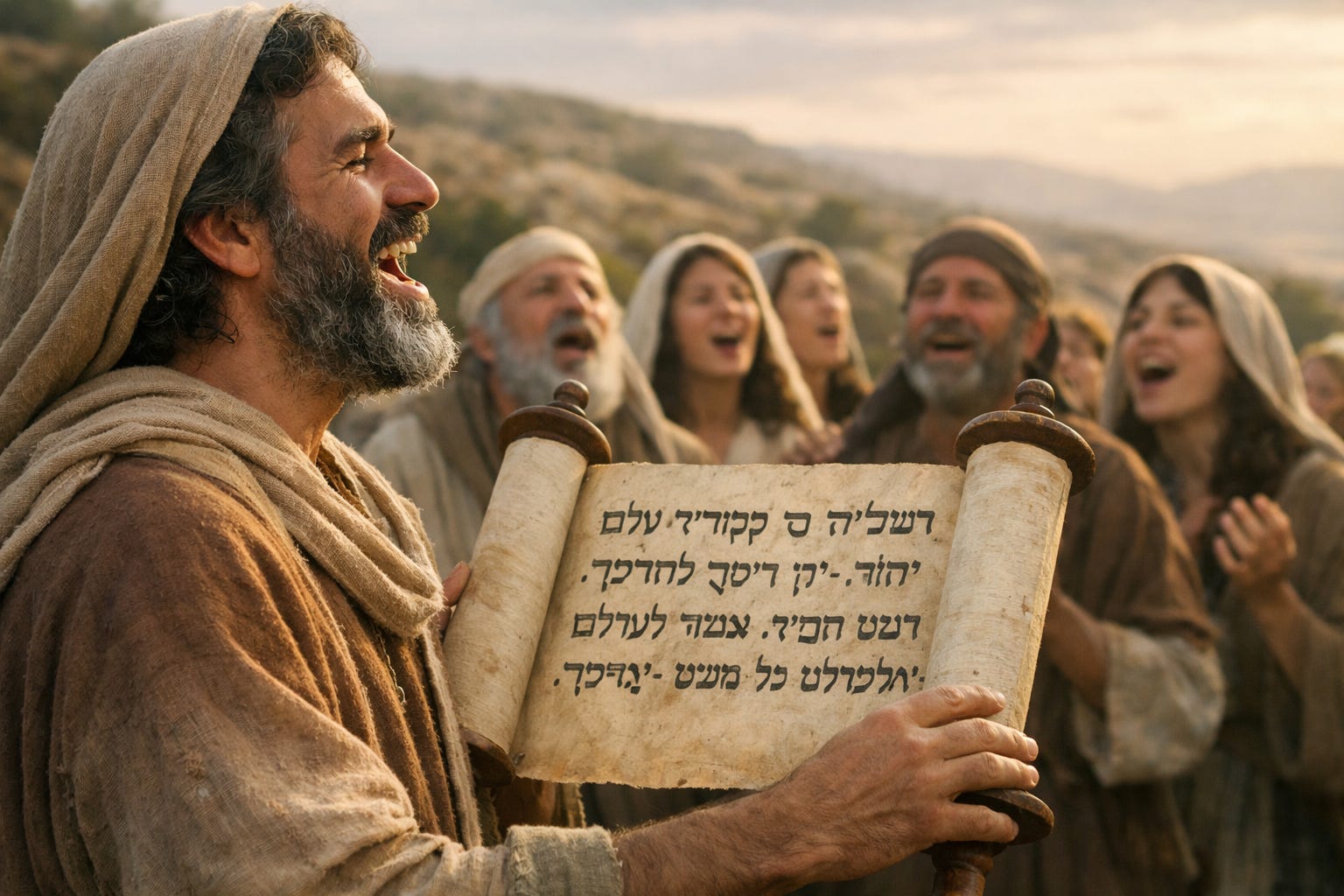
Image generated by ChatGPT (OpenAI) using the DALL·E model.
“See how I love your precepts; preserve my life, Lord, in accordance with your love. All your words are true; all your righteous laws are eternal.”
Psalms 119:159-160 NIV
Today we return to Psalm 119, which is one of the acrostic psalms. These are psalms (9, 10, 25, 34, 37, 111, 112, 119, and 145) written in such a way that each verse or section starts with a successive letter of the Hebrew alphabet. Why were they written like this? Well, most of us (at least English speakers) learned our alphabet by singing the silly “alphabet song”, and the acrostic psalms were how the Hebrews learned their ABCs. They sang the Word of God (as seen in the image at the top of this devotional) — sadly, this feature didn’t carry over to our present-day languages.
Other verses in Psalm 119 studied on Heaven On Wheels include:
You can visit our treasury of devotionals about psalms using this link.
The psalmist (not David or Asaph here, but an unknown writer) expresses his deep love for God’s precepts at the beginning of verse 159. What’s a precept? The ancient Hebrew word is פִּקּוּדִים (piqqûḏîm), defined in Strong’s Concordance as “a mandate (of God; plural only, collectively, for the Law):—commandment”. So he’s referring to God’s commandments and guidelines, and his desire to live in accordance with God’s will.
The love expressed here is not just emotional, but is demonstrated by the psalmist’s obedience and dedication to God’s Law. Loving God’s commandments reflects a person’s love for God Himself — this is seen in John 14:15 where Jesus says “If you love me, keep my commands.”
The psalmist is asking for God to acknowledge that love by preserving his life. We see throughout Scripture that God rewards those who earnestly seek Him (see Hebrews 11:6). In the original Hebrew of this verse, he uses the covenant name of God יְהֹוָה (yᵊhōvâ or YHWH), making this a much more personal request. The writer understands God’s faithfulness toward His people, and knows that a truly abundant life is found only in a relationship with God. The same concept is repeated in the New Testament. Take John 10:10 for example, where Jesus says “I have come that they may have life, and have it to the full.”
Moving on to the next verse, the psalmist emphasizes that God’s Word is the absolute truth. A word study on the Hebrew word used here for “true” is instructive. That word is אֱמֶת ('ĕmeṯ), and it means “firmness, faithfulness, truth… sureness, reliability… stability, continuance”. God and His Word are completely trustworthy and never changing.
Jesus prays the words “Sanctify them by the truth; your word is truth.” in John 17:17, which reinforces the Word as the ultimate source and standard of truth. The Word and God’s “eternal law” are unchanging, as stated so eloquently by Charles H. Spurgeon (cited on Enduring Word):
i. “The Scriptures are as true in Genesis as in Revelation, and the five books of Moses are as inspired as the four Gospels.... There is not one single mistake either in the word of God or in the providential dealings of God. Neither in the book of revelation nor of providence will there be any need to put a single note of errata. The Lord has nothing to regret or to retract, nothing to amend or to reverse.” (Spurgeon)
Through God’s Word and His precepts, we are guided to live our lives in a manner pleasing to Him.
Heaven On Wheels Daily Prayer:
Father in Heaven, I pray to You today with deepest gratitude for Your Eternal Word and the guidance it provides to my life. Like the psalmist, I love Your precepts and I try to live by them. Please preserve and protect my life according to Your loving kindness. Guide me to remain unwavering in my faith and to cherish the commandments You have given to us. May Your Word continue to be a lamp to my feet and a light to my path, guiding me through all of the challenges of life. AMEN.