


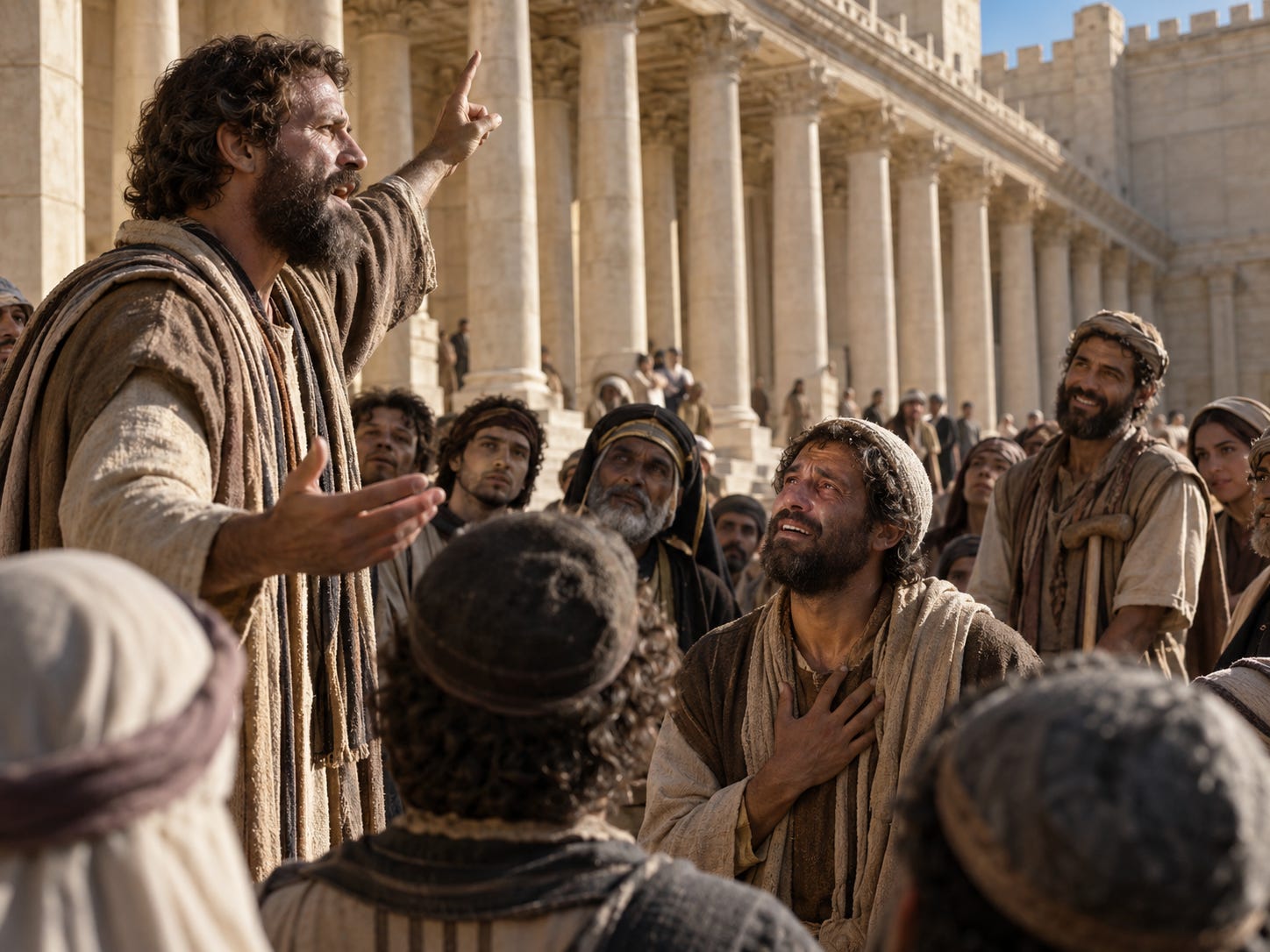
Image generated by ChatGPT (OpenAI) using the DALL·E model.
“Repent, then, and turn to God, so that your sins may be wiped out, that times of refreshing may come from the Lord,”
Acts 3:19 NIV
It always makes me happy when I get to write a devotional about repentance, since it seems that many (most?) churches are afraid to use that word in sermons. Barb wrote a series of devotionals on the Acts of the Apostles back in 2024, but we usually look at verses differently, so I don’t feel like I’m repeating anything here. You can read the introduction to Barb’s series using this link.
Repent, in the original Koine Greek that Acts was written in, is μετανοέω (metanoeō). Blue Letter Bible lists one of the definitions as “to change one's mind for better, heartily to amend with abhorrence of one's past sins,” and features a quote from F.F. Bruce that explains:
Repentance (metanoia, 'change of mind') involves a turning with contrition from sin to God; the repentant sinner is in the proper condition to accept the divine forgiveness."
Repentance is hard. Very hard. Think of your life as a Christian so far. Have you ever confessed a sin to the Lord, offering to “never do it again,” and then fell off the proverbial wagon the very next day, repeating that sin again… and again?
The key phrase in the quote from F.F. Bruce is “turning with contrition from sin to God.” As Christians, we don’t just mindlessly sin (or at least we shouldn’t!). We are convicted of sin by the indwelling Holy Spirit, and as believers, we should feel remorse for sinning. If you sin — and we all do to some degree — and don’t feel even a twinge of guilt or a desire to stop repeating that sin in the future, then perhaps it’s time to do some prayerful soul-searching about whether you truly are a believer.
I found an article on GotQuestions.org providing some meaningful answers to the question “If I am saved and all my sins are forgiven, why not continue to sin?” From that article:
The idea that a person could “trust in Jesus Christ” for salvation and then go on living just as he/she lived before, is absolutely foreign to the Bible. Believers in Christ are new creations (2 Corinthians 5:17). The Holy Spirit changes us from producing the acts of the flesh (Galatians 5:19-21) to producing the fruit of the Spirit (Galatians 5:22-23). The Christian life is a changed life because the Christian is changed.
and
What differentiates Christianity from every other religion is that Christianity is based on what God has done for us through Jesus Christ—divine accomplishment. Every other world religion is based on what we must do to earn God’s favor and forgiveness—human achievement. Every other religion teaches that we must do certain things and stop doing certain other things in order to earn God’s love and mercy. Christianity, faith in Christ, teaches that we do certain things and stop doing certain things because of what Christ has done for us.
How could anyone, having been delivered from sin’s penalty, eternity in hell, go back to living the same life that had him on the path to hell in the first place? How could anyone, having been cleansed from the defilement of sin, desire to go back to the same cesspool of depravity? How could anyone, knowing what Jesus Christ did on our behalf, go on living as if He were not important? How could anyone, realizing how much Christ suffered for our sins, continue sinning as if those sufferings were meaningless?
and one more paragraph…
For the truly converted, then, continuing to live sinfully is not an option. Because our conversion resulted in a completely new nature, our desire is to no longer live in sin. Yes, we still sin, but instead of wallowing in it as we once did, we now hate it and wish to be delivered from it. The idea of “taking advantage” of Christ’s sacrifice on our behalf by continuing to live sinfully is unthinkable. Christians who have no desire to live for Christ, but instead find themselves living lives indistinguishable from those of unbelievers, should examine whether they have ever genuinely received Christ as Savior. “Examine yourselves to see whether you are in the faith; test yourselves. Do you not realize that Christ Jesus is in you—unless, of course, you fail the test?” (2 Corinthians 13:5).
That’s a bit of a long introduction to this speech by the apostle Peter to a group of onlookers in Jerusalem who had just witnessed him performing the miracle of healing a lame man, but I think it’s necessary to understand both the concept and reality of repentance before understanding this verse. Peter is calling upon the people of Jerusalem to give up their unbelief and return to God through Jesus, the Messiah whom they had rejected and given up to crucifixion. The AI image at the top of this devotional shows one man in the crowd who appears to be taking Peter’s message of repentance and turning to God seriously.
Through his call for repentance, Peter is asking for the crowd to consider doing three things — confessing their sins, changing their hearts (realizing that their actions were wrong), and turning away from rebelling against God and towards obeying Him.
When they repent, the crowd can expect their sins to be “wiped out” (ἐξαλείφω, exaleiphō; erased, obliterated) since God grants complete forgiveness through the atoning death and resurrection of Jesus Christ.
Peter promises not only that their sins will be expunged from the eternal record through repentance and turning to God, but “that times of refreshing may come from the Lord.” I found this a bit confusing, so I turned to Precept Austin for some commentary. It turns out that the term has an eschatological (end times) background.
Biblical scholar John Phillips, in his book Exploring Acts, looked at the phrase this way:
The term times of refreshing refers to those Old Testament prophecies that promised that before the return of Christ there would be an outpouring of the Spirit and that many Jews would repent and turn to God in preparation for the millennial kingdom (Dt. 30:1-3; Joel 2:28-32; Zech. 12:10-14). If the Jews had repented then and there, the initial fulfillment of such prophecies, as were evidenced at Pentecost, would have blossomed into a complete fulfillment, and the return of Christ could have taken place within a generation. A few individuals did repent, but the leaders of Israel and the mass of the people both in the homeland and in the Diaspora rejected God's second call (FROM PETER AND THE OTHER APOSTLES) and the ministry of the Holy Spirit as adamantly as they had rejected the ministry of Christ Himself. But the national principle was clear: no repentance, no refreshing. The individual principle was the same: no repentance, no refreshing. Those who did repent came at once into the good of that refreshing poured out at Pentecost. Those who repent today still do. They are baptized into the mystical Body of Christ. (Exploring Acts) (Bolding added)
Got that? Repentance brings spiritual renewal and refreshment from the Lord. That’s not just a future promise in our eternal life, but a present reality. We experience this refreshing through the presence of the Lord, via the Holy Spirit. That’s why it’s important to seek the Spirit always, and be filled with It.
Repentance isn’t a once and done occurrence. It’s a continual conscious mental behavioral attitude transformation (wow, that’s a mouthful!). As Christians, we have been called to live in a condition of ongoing repentance and renewal.
Heaven On Wheels Daily Prayer:
Father in Heaven, I come before you today with a repentant heart, seeking your forgiveness for my sins. Help me to turn to you so that my sins may be wiped out and I may experience times of refreshing from your presence. AMEN.
Thank you very much.
Thanks alot for your presence and support. May GOD of abundance bless you through Christ Jesus. In Jesus ' name, AMEN.