


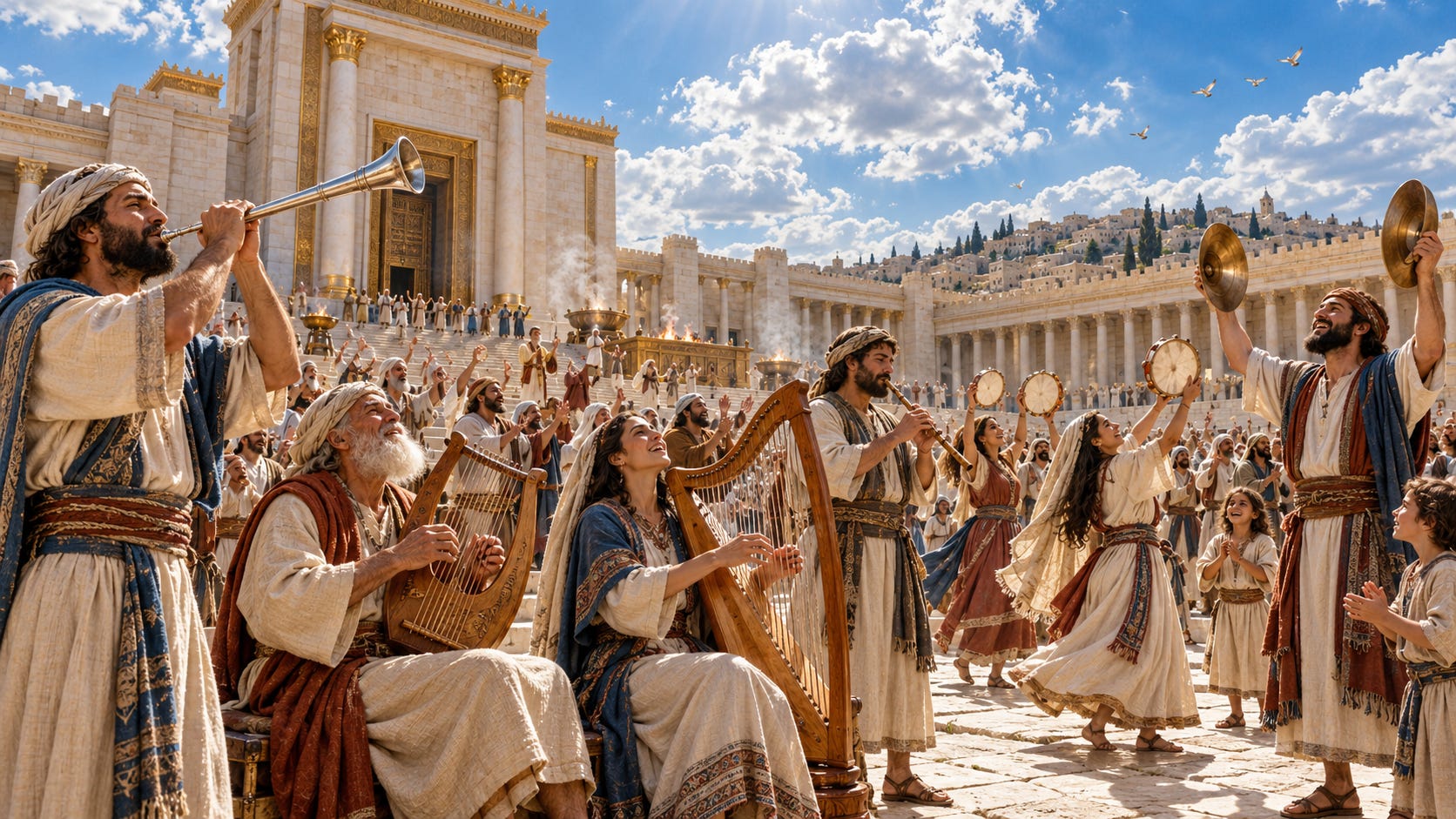
Image generated with ChatGPT by OpenAI.
“Praise the LORD. Praise God in his sanctuary; praise him in his mighty heavens. Praise him for his acts of power; praise him for his surpassing greatness. Praise him with the sounding of the trumpet, praise him with the harp and lyre, praise him with timbrel and dancing, praise him with the strings and pipe, praise him with the clash of cymbals, praise him with resounding cymbals. Let everything that has breath praise the LORD. Praise the LORD.”
Psalms 150:1-6 NIV
God’s hand directed me to the last verse of the last psalm today; Psalm 150:6. When I saw the rest of the entire six verses of this psalm, I realized it would be more fitting to explore them as a whole rather than just quote the last verse.
We use AI for one thing only — to create the images that accompany our Heaven On Wheels devotionals. I’ve been pretty happy with what ChatGPT does, creating images that are historically accurate, emotionally engaging, and — like in today’s image — depict a verse or verses beautifully.
The Book of Psalms ends with a Psalm that is somewhat different from all 149 that preceded it. Enduring Word explains:
Each of the five divisions of the Book of Psalms closes with a doxology (Psalm 41:13, 72:18-19, 89:52, 106:48). This entire psalm can be seen as a doxology that not only closes the fifth and final volume of the collected psalms, but also closes the entire Book of Psalms.
Psalm 150 contains no argument, no real teaching, no real explanation. It is an eloquent, passionate cry to all creation to give Yahweh the praise due to Him.
“The psalm is more than an artistic close of the Psalter: it is a prophecy of the last result of the devout life, and, in its unclouded sunniness, as well as in its universality, it proclaims the certain end of the weary years for the individual and for the world.” (Alexander Maclaren)
What’s a doxology? Let’s call upon Wikipedia for a definition:
A doxology (Ancient Greek: δοξολογία doxologia, from δόξα, doxa 'glory' and -λογία, -logia 'saying')[1][2][3] is a short hymn of praises to God in various forms of Christian worship, often added to the end of canticles, psalms, and hymns. The tradition derives from a similar practice in the Jewish synagogue,[4] where a variant of the Kaddish serves to terminate each section of the service.
Psalm 150 is short, it was a hymn in its original form, and it is certainly filled with praises to God — He is praised 12 times in six verses. It begins with “Praise the LORD,” then continues with a suggestion on where He should be praised — “in His sanctuary, in His mighty heavens.” What is His sanctuary? It can be a small room where you offer up your solitary prayers, a humble country church, a bustling megachurch, or a magnificent cathedral. It can also be anywhere in His creation. The Bible Says had this to say about His sanctuary:
This verse reinforces the notion that worship not only takes place within human-made structures but encompasses the infinite wonder of God’s creation. The sanctuary can be a physical temple or a symbolic representation of the believer’s inward devotion. Meanwhile, the mighty expanse reminds us that there is no limit to the reach of God’s sovereignty. From the highest skies to the deepest oceans, His presence is made known and His overwhelming splendor commands the praises of all living things.
Next, we are reminded of why we should praise the LORD; “for his acts of power; for his surpassing greatness.” God has always demonstrated His power, delivering His people from oppression, and building them up in times of peace. From the viewpoint of the Psalmist, recognizing God’s unfailing faithfulness and how His actions reveal His character is reason enough for celebration and praise. This psalm is an invitation for all believers to recognize the myriad ways God demonstrates His presence and power, and respond to those attributes with joyous and LOUD worship!
That leads into the next section of Psalm 150: how we should praise the LORD — “Praise him with the sounding of the trumpet, praise him with the harp and lyre, praise him with timbrel and dancing, praise him with the strings and pipe, praise him with the clash of cymbals, praise him with resounding cymbals.”
I highlighted these verses on one of my many passes through the Psalms during the years we were doing “Bible In One Year” programs. I must confess that there was an ulterior motive for this — I shamefully responded to a Facebook friend with those words when she decided to inform the world of the “right way” of worshipping the LORD, which was with traditional quiet hymns and not with loud contemporary Christian worship music…
Finally, we get to the last part of Psalm 150 which provides instruction on who and/or what is to praise the LORD — “Let everything that has breath praise the LORD. Praise the LORD.” In the Enduring Word commentary on this Psalm, David Guzik writes that:
i. Derek Kidner noted that the literal phrase is, “Let all breath praise the Lord.”
ii. John Trapp wrote, “Or, Let every breath praise the Lord…. We have all as much reason to praise God as we have need to draw breath.”
iii. “The word nesamah [has breath] denotes all living creatures, endowed with life by the Creator (Genesis 1:24-25; 7:21-22), but always in distinction from the Creator.” (VanGemeren)
iv. “The one condition of praise is the possession of breath, that is to say, life received from Him must return in praise to Him.” (Morgan)
v. Revelation 5:13 tells us that this will happen: And every creature which is in heaven and on the earth and under the earth and such as are in the sea, and all that are in them, I heard saying: “Blessing and honor and glory and power be to Him who sits on the throne, and to the Lamb, forever and ever!”
The last words (which also began this Psalm) are literally the Hebrew word we associate with honoring God — הַלְּלוּ־יָהּ or Hallelujah — Praise God!
Heaven On Wheels Daily Prayer:
Father in Heaven, I come before You today in awe of Your greatness, praising You in all places, where we sit or kneel in prayer, or in contemplation of Your creation. I thank You for all of Your deeds and Your greatness, both in the past and in the promise of a future with You. May I always praise You with joy, dedicating my heart and life to glorifying You in all I do. AMEN.