


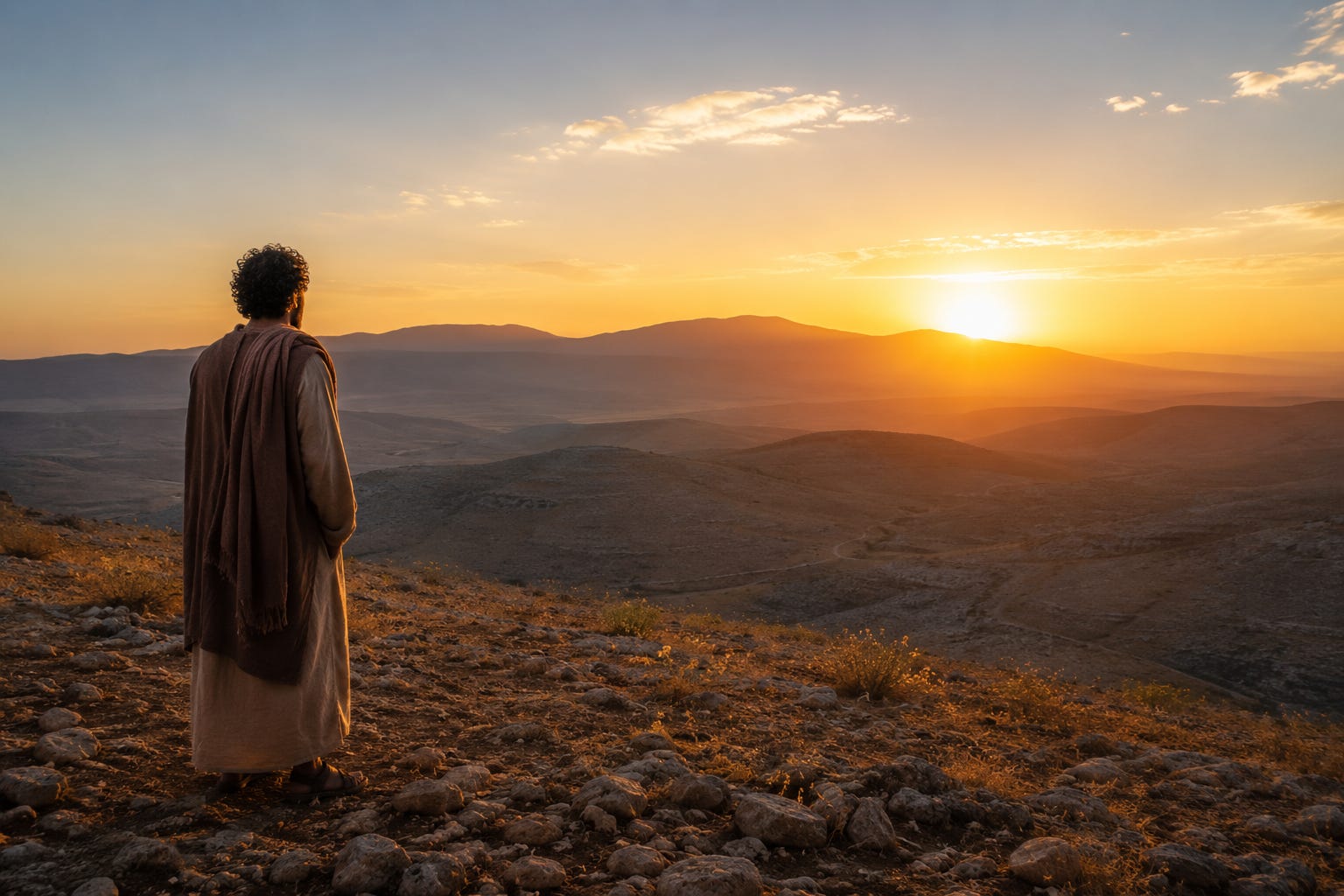
Image generated by ChatGPT (OpenAI) using the DALL·E model.
“Dear friends, now we are children of God, and what we will be has not yet been made known. But we know that when Christ appears, we shall be like him, for we shall see him as he is.”
1 John 3:2 NIV
Wow, when I said in my last devotional that God was emphasizing the First Epistle of John, I wasn’t kidding. Once again, He has pointed me to this treasure of the New Testament.
As mentioned previously, John maintains a loving, familial relationship with the infant Christian church. Here he greets them as good friends, and assures them of their status as “children of God”. In the Epistle to the Romans, Paul gives a similar and more detailed assurance:
“The Spirit himself testifies with our spirit that we are God’s children.”
As a child of God, you feel that blessed assurance that you have a special place in God’s heart and mind!
John’s next statement was probably a bit more confusing to those who were reading or hearing the letter: “and what we will be has not yet been made known.” We know that we are children of God, but what happens in our future? What will we become in the new heaven and the new earth? We cannot know in this lifetime, nor can we imagine what awaits us.
John Stott, cited on Enduring Word, said “What we are does not now appear to the world; what we shall be does not yet appear to us,” and Charles Spurgeon (from the same source) elaborated:
ii. “If I may use such an expression, this is not the time for the manifestation of a Christian’s glory. Eternity is to be the period for the Christian’s full development, and for the sinless display of his God-given glory. Here, he must expect to be unknown; it is in the hereafter that he is to be discovered as a son of the great King.” (Spurgeon)
What do we do in the meantime, as we struggle with the confusing unknowns of eschatology? Live in faith and trust in God’s promises for the future.
John does provide a hint of an answer to the question of “what we will be” in the second sentence of this verse: “But we know that when Christ appears, we shall be like him, for we shall see him as he is.”
He begins with the central belief of Christian eschatology; that Christ will come again. We know this for a fact as it is stated in numerous places in the New Testament, for example:
““Men of Galilee,” they said, “why do you stand here looking into the sky? This same Jesus, who has been taken from you into heaven, will come back in the same way you have seen him go into heaven.””
and
“For the Lord himself will come down from heaven, with a loud command, with the voice of the archangel and with the trumpet call of God, and the dead in Christ will rise first.”
John’s use of the word “appears” tells us that Christ will return in a very visible and undeniable way, compared to His humble beginnings in His first coming. And when He appears, “we shall be like him”.
David Guzik of Enduring Word comments on what these words mean… and do not mean:
ii. This does not mean that we cease to be ourselves, full of the distinct personality and character God has given us. Heaven will not be like the Nirvana of Eastern mysticism, where all personality is dissolved into God like a drop into the ocean. We will still be ourselves, but our character and nature will be perfected into the image of Jesus’ perfection. We will not be “clones” of Jesus in heaven!
iii. The Christian should long to be like Jesus, yet remember that God will never force a person to be like Jesus if he doesn’t want to. And that is what hell is for: people who don’t want to be like Jesus. The sobering, eternal truth is this: God gives man what he really wants. If you really want to be like Jesus, it will show in your life now, and it will be a fact in eternity. If you don’t really want to be like Jesus, it will also show in your life now, and it will also be a fact in eternity.
iv. We shall be like Him: This reminds us that even though we grow into the image of Jesus now, we still have a long way to go. None of us will be finished until we see Jesus, and only then truly we shall be like Him.
Believers will “be like Him” in moral and spiritual way, being transformed by the process of sanctification that will be completed at Christ’s return:
“But our citizenship is in heaven. And we eagerly await a Savior from there, the Lord Jesus Christ, who, by the power that enables him to bring everything under his control, will transform our lowly bodies so that they will be like his glorious body.”
We’ll be free from sin and its effects, and we’ll share in Christ’s glory and righteousness:
“For those God foreknew he also predestined to be conformed to the image of his Son, that he might be the firstborn among many brothers and sisters. And those he predestined, he also called; those he called, he also justified; those he justified, he also glorified.”
How will this come about? “for we shall see him as he is.” We will not be glorified ourselves, but we will be in the full and unhindered presence of the Lord! I love this comment by David Guzik about heaven:
ii. Heaven is precious to us for many reasons. We long to be with loved ones who have passed before us and whom we miss so dearly. We long to be with the great men and women of God who have passed before us in centuries past. We want to walk the streets of gold, see the pearly gates, and see the angels around the throne of God worshipping Him day and night. However, none of those things, precious as they are, make heaven really “heaven.” What makes heaven, heaven, is the unhindered, unrestricted, presence of our Lord, and to see Him as He is will be the greatest experience of our eternal existence.
Guzik also notes:
e. We shall be like Him, for we shall see Him as He is: John made the connection between seeing Him as He is and our transformation to be like Jesus. We can say that the same principle is at work right now. To the extent that you see Jesus as He is, to that same extent, you are like Him in your life.
i. We can say that this happens by reflection. “When a man looks into a bright mirror, it makes him also bright, for it throws its own light upon his face; and, in a much more wonderful fashion, when we look at Christ, who is all brightness, he throws some of his brightness upon us.” (Spurgeon)
What a great message John delivered to the early Christians! It still resonates two thousand years later, bringing us all hope and joy in both our personal transformation and the promise of the second coming of Christ.
Heaven On Wheels Daily Prayer:
Today’s prayer comes from Knowing Jesus:
Heavenly Father, thank You for Your incredible grace and inestimable love that I should be called Your child. Thank You that Jesus came to earth and identified with my filthiness and sin so that I might be clothed in His purity and righteousness, positioned in Christ, in-dwelled by the Spirit, and accepted in the Beloved. And thank You that I have the amazing blessing to look forward to in heaven that I will see my precious Saviour as He is. In my glorified body I will be like Him and be fully able to worship Him in spirit and truth. What a glorious day. In Jesus’ name, AMEN.
Thanks, for this message is perfect (we have a friend in heaven!)
Amen.