


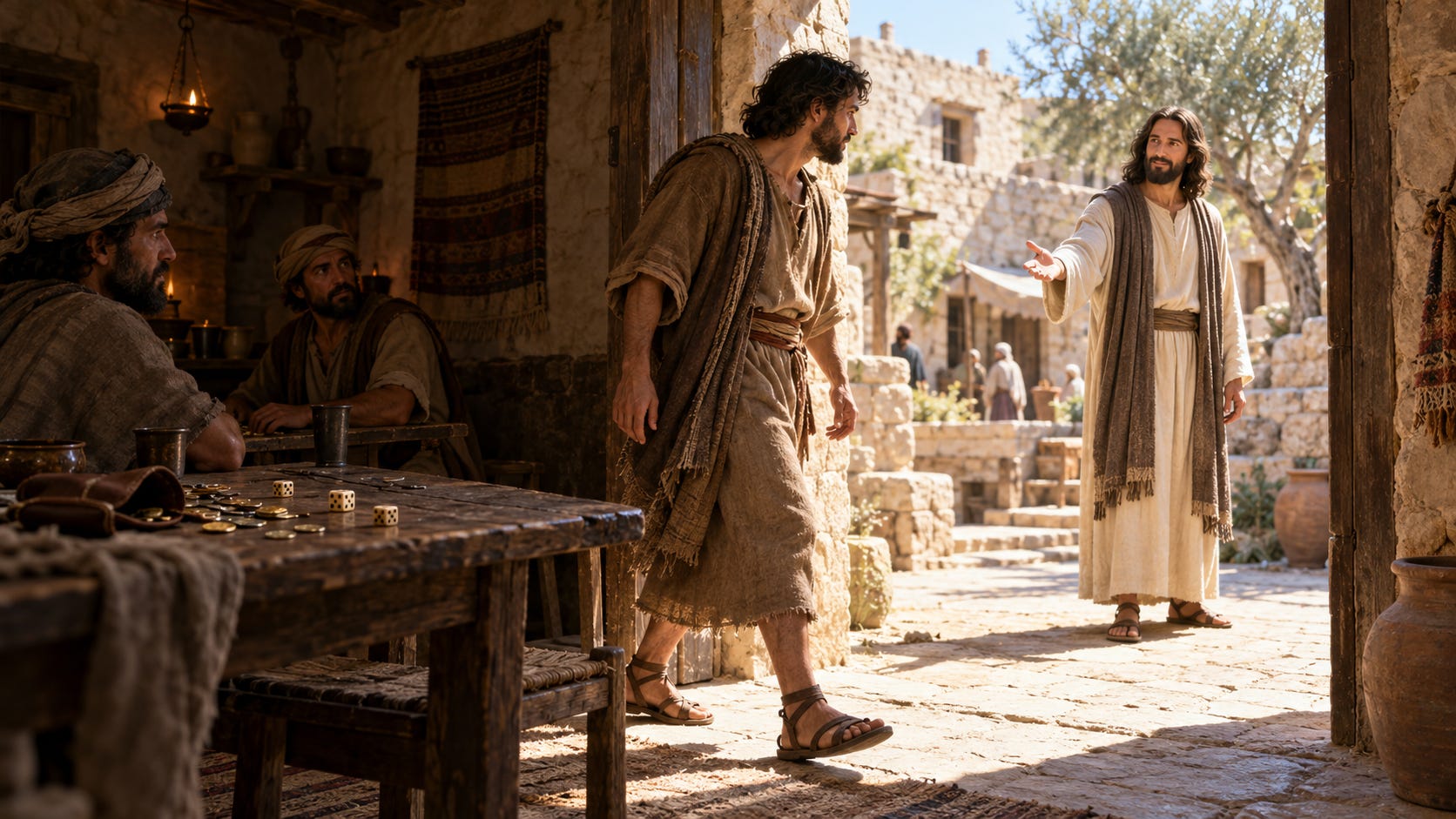
A first-century man steps away from a dim gambling gathering toward Jesus, who stands outside in natural daylight. The man has left his dice and coins behind; his expression shows resolve as he meets Jesus’ welcoming gaze. This makes turning from a sinful way of life visible through a concrete choice. Image generated with ChatGPT by OpenAI.
“But you know that he appeared so that he might take away our sins. And in him is no sin. No one who lives in him keeps on sinning. No one who continues to sin has either seen him or known him.”
1 John 3:5-6 NIV
Sin is the topic that God has pointed me to for the past five devotionals, and as I like to say, there are no coincidences when it comes to God. He is directing me to examine my behavior and to inspire you to do likewise.
The First Epistle of John deals with love and fellowship with God, so it is fertile ground for devotionals on both of these subjects. In fact, we’ve written 29 separate devotionals about this one letter! Wikipedia notes that:
The author describes various tests by which readers may ascertain whether or not their communion with God is genuine, and teaches that the proof of spiritual regeneration is a life of active righteousness.[8] It also distinguishes between the world (which is full of evil and under the dominion of Satan) and the children of God (who are set apart from the world).[9]
John begins these two verses with the truth: “But you know that he appeared so that he might take away our sins. And in him is no sin.” This is the mission of Jesus Christ, to take away the sins of the world. This was pointed out before the birth of Jesus, when the angel Gabriel told Joseph “you are to give him the name Jesus, because he will save his people from their sins.” (Matthew 1:21 NIV) Jesus is the Greek form of Joshua (Yehoshua), meaning “Yahweh is salvation”.
David Guzik of Enduring Word summarizes how Jesus takes away our sin:
i. Jesus takes away our sin in the sense of taking the penalty of our sin. This is immediately accomplished when one comes by faith to Jesus.
ii. Jesus takes away our sin in the sense of taking the power of sin away. This is an ongoing work in the lives of those who walk after Jesus.
iii. Jesus takes away our sin in the sense of taking the presence of sin away. This is a work that will be completed when we pass into eternity and are glorified with Jesus.
We cannot do any of these things. We must respond to the work of Jesus. From the same source:
i. We cannot take away the penalty of our own sin. It is impossible to cleanse ourselves in this way. We must instead receive the work of Jesus in taking away our sin.
ii. We cannot take away the power of sin in our lives. This is His work in us, and we respond to that work. Someone who comes to Jesus does not have to clean himself up first, but he must be willing to have Him take away his sin.
iii. We cannot take away the presence of sin in our lives. This is His work in us, ultimately accomplished when we will be glorified with Him.
Jesus had no sin. Out of all who have lived on this planet, He alone was perfectly obedient to the Father. He was tempted in every way common to humanity, but He remained sinless (see Hebrews 4:15) That is why He could take all of our sin upon Himself and “take away our sins.” His sacrifice fully satisfied God’s judgment and brought those who believe into fellowship with God.
The next part of the verse is a bit harder to get our heads around: “No one who lives in him keeps on sinning.” John isn’t saying that believers don’t sin — in 1 John 1:8-10 and 2:1-2, he commands confession, and points out Jesus as our Advocate (I suggest following those two links and reading John’s explanation.) What John is saying is that any person united to Christ cannot stay in a pattern of unrepentant sin.
Once again from Enduring Word:
ii. In some ways, the question is not “Do you sin or not?” We each sin. The question is, “How do you react when you sin? Do you give in to the pattern of sin, and let it dominate your lifestyle? Or do you humbly confess your sin, and do battle against it with the power Jesus can give?”
iii. This is why it is so grieving to see Christians make excuses for their sin, and not humbly confess them. Unless the sin is dealt with squarely, it will contribute to a pattern of sin that may soon become their lifestyle – perhaps a secret lifestyle, but a lifestyle nonetheless.
iv. What is important is that we never sign a “peace treaty” with sin. We never wink at its presence or excuse it by saying, “Everybody has his own sinful areas, and this is mine. Jesus understands.” This completely goes against everything we are in Jesus, and the work He has done in our life.
The verse ends with the words “No one who continues to sin has either seen him or known him.” John was writing to churches that were being run by false teachers who claimed spiritual knowledge, but rejected the truth provided by the apostles and disregarded God’s commands. Here, John is avowing that truly knowing Jesus transforms the way people conduct their lives. Devoting yourself to sin in a persistent manner without confession and repentance is a sure sign that you do not live in Jesus.
Heaven On Wheels Daily Prayer:
Father in Heaven, I thank You for sending us Jesus, who came to take away our sins. In Him, there is no sin. Help me to live in Christ and be a living reflection of His righteousness, striving to live in accordance with His teachings and life. I pray for the strength to keep Your commandments to demonstrate my love for You and others. Continue to transform my heart and mind, so I may live a life that honors You. AMEN.