


“Therefore the Lord God of hosts,
The Mighty One of Israel, declares,
“Ah, I will be relieved of My adversaries
And avenge Myself on My foes.
I will also turn My hand against you,
And will smelt away your dross as with lye
And will remove all your alloy.
Then I will restore your judges as at the first,
And your counselors as at the beginning;
After that you will be called the city of righteousness,
A faithful city.”
Zion will be redeemed with justice
And her repentant ones with righteousness.”
Isaiah 1:24-27 NASB1995
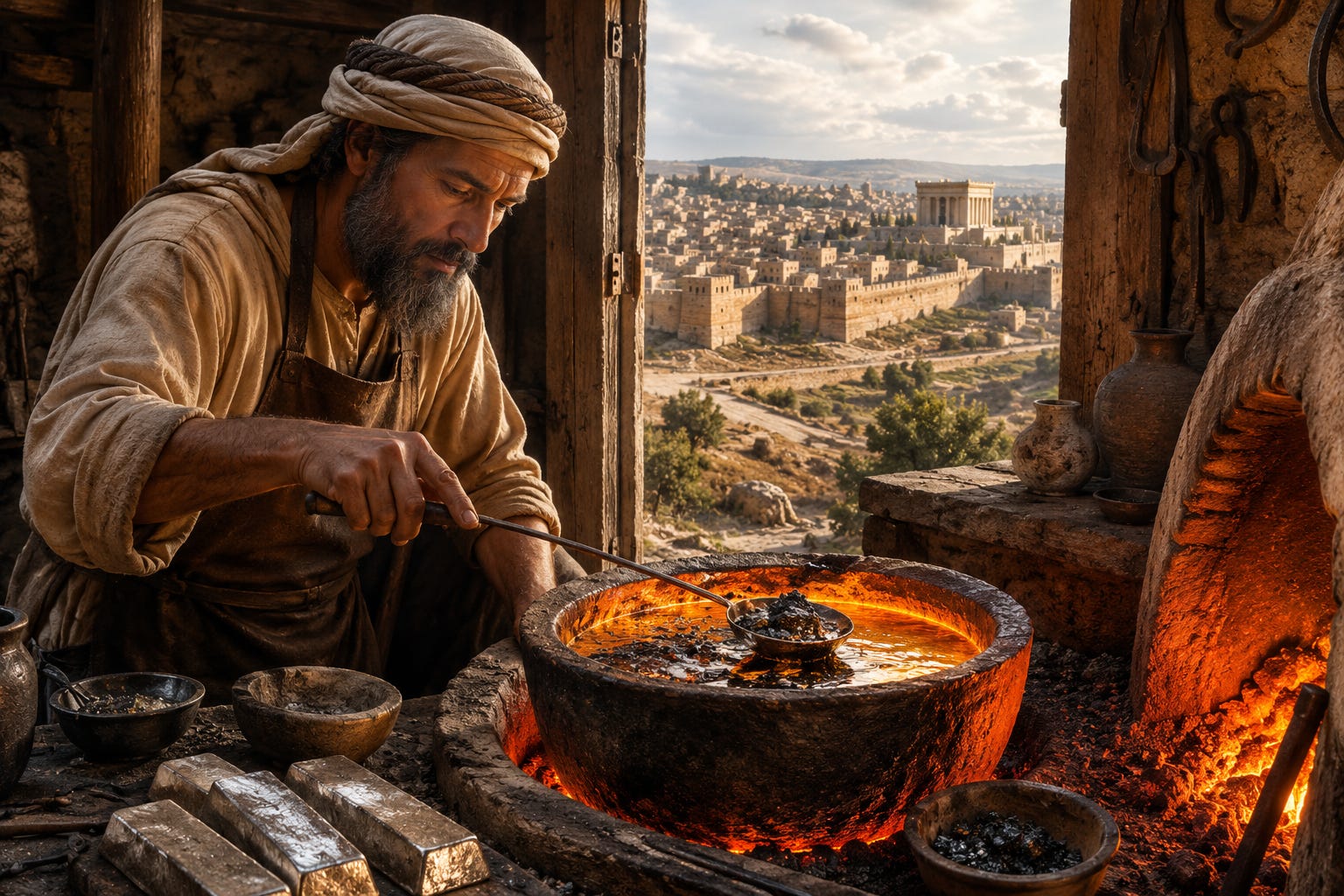
The AI image at the top shows a silversmith removing the dross from the silver in his smelter. ChatGPT explained this as restoration through purification.
So, we arrive at what will be God’s solution to the problems of Jerusalem and the people of Judah. Note that this passage is full of will statements. These strongly imply that this is a prophecy, that these actions will take place in the future. Here is what Precept Austin says about these future actions:
The question is when will God avenge Himself on His foes? And while we know that the wrath of God has been and is even now being revealed from heaven against all ungodliness and unrighteousness of men (Ro 1:18-note), this verse certainly could apply to the pouring out of His righteous wrath in the events of the book of the Revelation as described in more detail in the following notes [see full text in Precept Austin at the link]. As an aside, some scholars have identified more than 500 references from the Old Testament in the book of the Revelation. For example Arnold Fruchtenbaum writes…
there are over five hundred references to the Old Testament in the Book of Revelation. The following is a list of such references (Precept Austin: refer to his book for this list), but it makes no claim to being exhaustive or complete. Some of these references back to the Old Testament do speak of the very same thing as the Revelation. However, in others, the Revelation merely borrows a phrase or motif for the purpose of developing a new area. This distinction should be kept in mind in the study of those Old Testament references. (Fruchtenbaum, A. G. The Footsteps of the Messiah: A Study of the Sequence of Prophetic Events. Tustin, CA: Ariel Ministries)
My point is that the book of the Revelation deals significantly with Israel even as God dispenses wrath to His foes (some of which will be ethnic Jews, cp Zech 13:8, 9). In fact Fruchtenbaum lists over 70 references from Isaiah (some with multiple verses) as references in the Revelation. It follows that a proper understanding of the eschatology of Isaiah rests on a good grasp of the eschatology of the Revelation and of Daniel, for Daniel’s prophecies in chapter 2, 7, 9-12, are closely linked with and form a firm foundation for the book of the Revelation.
Well, there it is - we are now sneaking into the eschatology of Isaiah. There will be much more to come, I assure you. For the Zion reference, here’s a quote from John Hartley on Precept Austin about Zion:
…is possibly related to Arabic sâna from root s-w-n, meaning protect, defend; hence sıyôn may have meant place of defence, fortress. Others suggest derivation from root sāhâ “be bald”; cf. Syriac spelling sehyôn for this name.
Zion is the fortified mound between the Kidron and the Tyropean valleys that David captured from the Jebusites (2Sa 5:7). Subsequently, it became known as the city of David. With the building of the temple to the north, that hill later became known as Mount Zion. Zion may even refer specifically to the temple vicinity or more generally to Jerusalem itself; sometimes it includes the entire nation, the covenant community itself (Is 1:27; Ps 97:8). “Zion” appears frequently in Ps and Lam. It seldom refers to the political capital of Judah, but much more often stands for the city of God in the new age.
From the time Solomon built the temple, Zion became the center of Yahweh’s activity. Yahweh identified himself as “the One who dwells on Mount Zion” (Isa 8:18). Here he initiates his work of salvation and here he begins his judgment against sin (Amos 1:2). (Harris, R L, Archer, G L & Waltke, B K Theological Wordbook of the Old Testament. Moody Press)
Let’s see what Jesus had to say about these future events (the story continues in the book of Revelation, of course):
“As He was sitting on the Mount of Olives, the disciples came to Him privately, saying, “Tell us, when will these things happen, and what will be the sign of Your coming, and of the end of the age?”
And Jesus answered and said to them, “See to it that no one misleads you. For many will come in My name, saying, ‘I am the Christ,’ and will mislead many. You will be hearing of wars and rumors of wars. See that you are not frightened, for those things must take place, but that is not yet the end. For nation will rise against nation, and kingdom against kingdom, and in various places there will be famines and earthquakes. But all these things are merely the beginning of birth pangs. “Then they will deliver you to tribulation, and will kill you, and you will be hated by all nations because of My name. At that time many will fall away and will betray one another and hate one another. Many false prophets will arise and will mislead many. Because lawlessness is increased, most people’s love will grow cold. But the one who endures to the end, he will be saved. This gospel of the kingdom shall be preached in the whole world as a testimony to all the nations, and then the end will come.
“Therefore when you see the abomination of desolation which was spoken of through Daniel the prophet, standing in the holy place (let the reader understand), then those who are in Judea must flee to the mountains. Whoever is on the housetop must not go down to get the things out that are in his house. Whoever is in the field must not turn back to get his cloak. But woe to those who are pregnant and to those who are nursing babies in those days! But pray that your flight will not be in the winter, or on a Sabbath. For then there will be a great tribulation, such as has not occurred since the beginning of the world until now, nor ever will. Unless those days had been cut short, no life would have been saved; but for the sake of the elect those days will be cut short. Then if anyone says to you, ‘Behold, here is the Christ,’ or ‘There He is,’ do not believe him. For false Christs and false prophets will arise and will show great signs and wonders, so as to mislead, if possible, even the elect. Behold, I have told you in advance. So if they say to you, ‘Behold, He is in the wilderness,’ do not go out, or, ‘Behold, He is in the inner rooms,’ do not believe them. For just as the lightning comes from the east and flashes even to the west, so will the coming of the Son of Man be. Wherever the corpse is, there the vultures will gather.
“But immediately after the tribulation of those days the sun will be darkened, and the moon will not give its light, and the stars will fall from the sky, and the powers of the heavens will be shaken. And then the sign of the Son of Man will appear in the sky, and then all the tribes of the earth will mourn, and they will see the Son of Man coming on the clouds of the sky with power and great glory. And He will send forth His angels with a great trumpet and they will gather together His elect from the four winds, from one end of the sky to the other.”
Matthew 24:3-31 NASB1995
I tiptoed into the mystery of the abomination of desolation in my study of the book of Daniel (see this Heaven on Wheels link for a summary of the second part of the book of Daniel). I’m convinced that I will have many more opportunities to link these things together as we proceed through Isaiah, so I will not go down giant eschatology wilderness trails quite yet.

In the meantime, here is a similar prophecy in the book of Jeremiah to this passage in Isaiah:
““Behold, days are coming,” declares the Lord, “when I will make a new covenant with the house of Israel and with the house of Judah, not like the covenant which I made with their fathers in the day I took them by the hand to bring them out of the land of Egypt, My covenant which they broke, although I was a husband to them,” declares the Lord. “But this is the covenant which I will make with the house of Israel after those days,” declares the Lord, “I will put My law within them and on their heart I will write it; and I will be their God, and they shall be My people.”
Jeremiah 31:31-33 NASB1995
Just to set a constraint on my philosophy for your edification, I am definitely not an advocate of replacement or supercessionist theology (the idea that the Christian church completely replaced the people and nation of Israel). God does not renege on His promises. This Gotquestions.org article explains replacement theology quite adequately, in my opinion; I’m probably more of a quasi-dispensationalist. So going forward, the prophecies of Isaiah will be viewed as having applicability to the remnant of Israel where appropriate. This prophecy in Ezekiel also describes how God will bring together that remnant into the bond of the covenant:
““As I live,” declares the Lord God, “surely with a mighty hand and with an outstretched arm and with wrath poured out, I shall be king over you. I will bring you out from the peoples and gather you from the lands where you are scattered, with a mighty hand and with an outstretched arm and with wrath poured out; and I will bring you into the wilderness of the peoples, and there I will enter into judgment with you face to face. As I entered into judgment with your fathers in the wilderness of the land of Egypt, so I will enter into judgment with you,” declares the Lord God. “I will make you pass under the rod, and I will bring you into the bond of the covenant; and I will purge from you the rebels and those who transgress against Me; I will bring them out of the land where they sojourn, but they will not enter the land of Israel. Thus you will know that I am the Lord.”
Ezekiel 20:33-38 NASB1995
Well, that was a hot mess (my devotional, not Scripture)!! I guess I left out Zechariah and Revelation, among others. I have to admit that linking these things together never really crossed my mind back in the days of the Bible in One Year Plan, because I didn’t read much commentary or try to deep dive into one book at a time. Thank You, Lord, for guiding me this way!
My next devotional examines Isaiah 1:28-31 - An oak whose leaf fades away.
Heaven on Wheels Daily Prayer:
Dear Lord - I began in Isaiah 1 to study the book of Isaiah. Well, now it appears that I will also be studying Jeremiah, Zechariah, Ezekiel, Revelation, Daniel (again) and a host of other scripture. Only You, Lord… Amen.
Citations and Credits:
Scripture quotations taken from the (NASB®) New American Standard Bible®, Copyright © 1960, 1971, 1977, 1995 by The Lockman Foundation. Used by permission. All rights reserved. www.Lockman.org.
Precept Austin was accessed on 07/25/2026 to review commentary for Isaiah 1:24-27.
Commentary from Enduring Word is used with written permission and without any alteration. ©1996-present The Enduring Word Bible Commentary by David Guzik – enduringword.com. At the link referenced, the bibliography used by David Guzik can be accessed. This commentary was not used for this particular devotional.