


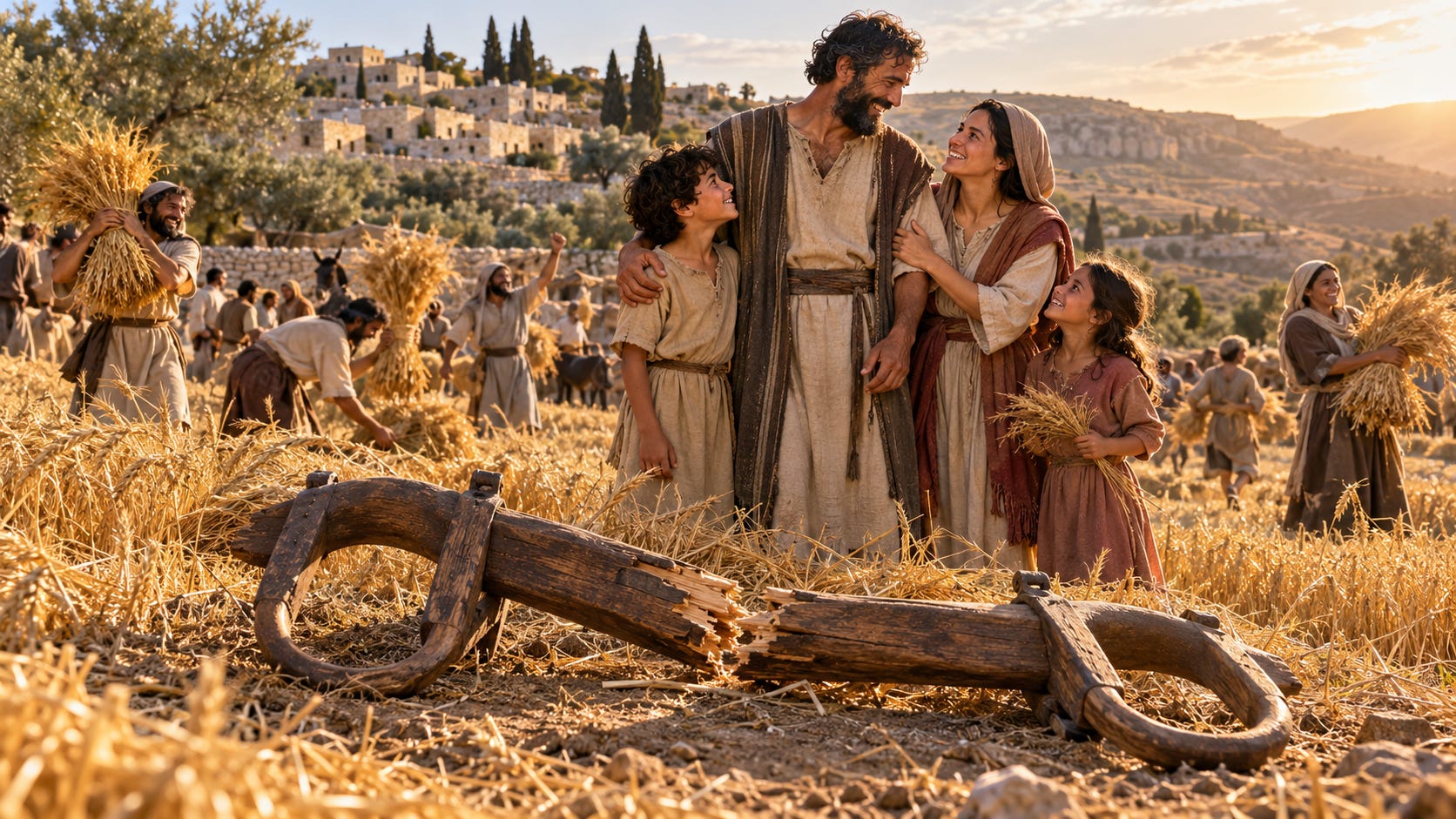
“You shall multiply the nation,
You shall increase their gladness;
They will be glad in Your presence
As with the gladness of harvest,
As men rejoice when they divide the spoil.
For You shall break the yoke of their burden and the staff on their shoulders,
The rod of their oppressor, as at the battle of Midian.
For every boot of the booted warrior in the battle tumult,
And cloak rolled in blood, will be for burning, fuel for the fire.”
Isaiah 9:3-5 NASB1995
The next passage in Isaiah 9 is looking at the promises of Jehovah to the people of Israel. The nation shall multiply, their gladness will be increased, they will be glad in His presence (like rejoicing with the harvest). Their yoke of burden will be broken and rod of their oppressor, as in the battle of Midian. Peace will be the outcome and the personal implements of war (boots and bloody cloaks) will be fuel for the fire.
First, let’s look at the battle of Midian and its outcome, from the book of Judges, as a refresher (the story actually starts in Judges 6, but I elected to share the details of the battle and the drawing of the 300 from Judges 7):
“Then Jerubbaal (that is, Gideon) and all the people who were with him, rose early and camped beside the spring of Harod; and the camp of Midian was on the north side of them by the hill of Moreh in the valley.
The Lord said to Gideon, “The people who are with you are too many for Me to give Midian into their hands, for Israel would become boastful, saying, ‘My own power has delivered me.’ Now therefore come, proclaim in the hearing of the people, saying, ‘Whoever is afraid and trembling, let him return and depart from Mount Gilead.’ ” So 22,000 people returned, but 10,000 remained.
Then the Lord said to Gideon, “The people are still too many; bring them down to the water and I will test them for you there. Therefore it shall be that he of whom I say to you, ‘This one shall go with you,’ he shall go with you; but everyone of whom I say to you, ‘This one shall not go with you,’ he shall not go.” So he brought the people down to the water. And the Lord said to Gideon, “You shall separate everyone who laps the water with his tongue as a dog laps, as well as everyone who kneels to drink.” Now the number of those who lapped, putting their hand to their mouth, was 300 men; but all the rest of the people kneeled to drink water. The Lord said to Gideon, “I will deliver you with the 300 men who lapped and will give the Midianites into your hands; so let all the other people go, each man to his home.” So the 300 men took the people’s provisions and their trumpets into their hands. And Gideon sent all the other men of Israel, each to his tent, but retained the 300 men; and the camp of Midian was below him in the valley.
Now the same night it came about that the Lord said to him, “Arise, go down against the camp, for I have given it into your hands. But if you are afraid to go down, go with Purah your servant down to the camp, and you will hear what they say; and afterward your hands will be strengthened that you may go down against the camp.” So he went with Purah his servant down to the outposts of the army that was in the camp. Now the Midianites and the Amalekites and all the sons of the east were lying in the valley as numerous as locusts; and their camels were without number, as numerous as the sand on the seashore. When Gideon came, behold, a man was relating a dream to his friend. And he said, “Behold, I had a dream; a loaf of barley bread was tumbling into the camp of Midian, and it came to the tent and struck it so that it fell, and turned it upside down so that the tent lay flat.” His friend replied, “This is nothing less than the sword of Gideon the son of Joash, a man of Israel; God has given Midian and all the camp into his hand.”
When Gideon heard the account of the dream and its interpretation, he bowed in worship. He returned to the camp of Israel and said, “Arise, for the Lord has given the camp of Midian into your hands.” He divided the 300 men into three companies, and he put trumpets and empty pitchers into the hands of all of them, with torches inside the pitchers. He said to them, “Look at me and do likewise. And behold, when I come to the outskirts of the camp, do as I do. When I and all who are with me blow the trumpet, then you also blow the trumpets all around the camp and say, ‘For the Lord and for Gideon.’ ” So Gideon and the hundred men who were with him came to the outskirts of the camp at the beginning of the middle watch, when they had just posted the watch; and they blew the trumpets and smashed the pitchers that were in their hands. When the three companies blew the trumpets and broke the pitchers, they held the torches in their left hands and the trumpets in their right hands for blowing, and cried, “A sword for the Lord and for Gideon!”
Each stood in his place around the camp; and all the army ran, crying out as they fled. When they blew 300 trumpets, the Lord set the sword of one against another even throughout the whole army; and the army fled as far as Beth-shittah toward Zererah, as far as the edge of Abel-meholah, by Tabbath. The men of Israel were summoned from Naphtali and Asher and all Manasseh, and they pursued Midian.
Gideon sent messengers throughout all the hill country of Ephraim, saying, “Come down against Midian and take the waters before them, as far as Beth-barah and the Jordan.” So all the men of Ephraim were summoned and they took the waters as far as Beth-barah and the Jordan. They captured the two leaders of Midian, Oreb and Zeeb, and they killed Oreb at the rock of Oreb, and they killed Zeeb at the wine press of Zeeb, while they pursued Midian; and they brought the heads of Oreb and Zeeb to Gideon from across the Jordan.”
Judges 7:1-25 NASB1995
The legend of this battle, won through supernatural means, would be important to Isaiah’s audience. It’s also worth noting that the men of Israel that fought in that battle were summoned from the tribes of Naphtali and Asher! We just learned that the Light will come from the region of Naphtali (near the Sea of Galilee).

So who is the nation that is/will become mighty? I like this commentary from Precept Austin; Bruce Hurt is a literalist when it comes to scripture and he has a good argument against the replacement theologists (those that believe God gave up on Israel and replaced them with the church of Christ):
Multiply the nation - What nation? This may seem obvious but some commentators veer off course and generalize these promises to all nations (e.g., Ray Ortlund fails to interpret these passages as specifically related to Israel in Isaiah: God Saves Sinners - Preaching the Word - Ortlund also refers to the “church” 282 times in his comments on a prophecy that never mentions the church once!). If context is king (and it is!) in assuring accurate Interpretation, the present context leaves no doubt that the nation is Israel. However since the nature of the promises (eg, end of wars Isa 9:5) begs a future fulfillment of the promise to Israel, some who believe that God is finished with Israel are forced to find some other way of trying to explain these great promises. God is not finished with Israel (The miraculous re-birth of Israel as a nation in May, 1948 should be sufficient support that God still has some “unfinished business” with and in Israel! See related study - Israel of God - Is God “Finished” with Israel in His prophetic plan?)
As an aside, dear reader, if one jettisons the literal interpretation of Isaiah’s prophecy and tries to explain the prophetic references to Israel as actually speaking of “the church”, then many passages in Isaiah become almost impossible to interpret. But if one holds to a literal (I am a literalist, not a dispensationalist!) interpretation of the text and believes firmly that God is not finished with Israel, the prophecies of Isaiah which are not yet fulfilled become exciting and imminently understandable. The reason this point is being emphasized is to alert the Acts 17:11 (note) “Berean” reader that he or she needs to be very careful in reading commentaries on Isaiah (including the one you are reading), because many of the commentaries are geared to be compatible with one’s overall theological leaning (eg, reformed theology, dispensational theology, covenant theology, etc) rather than simply allowing the text to speak for itself (See Read the Text Literally).
So what Isaiah is saying here is that God will cause the nation of Israel to grow and will also increase their joy. What has been only a small believing remnant of Jews over the centuries will be increased at the end of this age.
There are some good links to follow in that commentary, including the one on learning to read the text literally. I, too, believe that God is not done with Israel, because scripture tells me so.
I thought I would share one more commentary quoted in Precept Austin, this one from Rob Morgan (comments from Precept Austin are in brackets):
All of these prophecies [HE IS REFERRING TO Isaiah 9:3-5] have implications for the future, and as we will see in a moment some of them are pointing toward our Lord’s return in glory at the Second Coming. Isaiah was looking beyond our Lord’s first coming to His second coming and the establishing of His kingdom. Instead of a small number, the Jewish people would be a mighty nation. Instead of oppression, they would have joy. Instead of defeat and exile, the Lord will rule and reign over the earth from Mount Zion. Isaiah is full of this message; it’s one of his great themes. For example, look at Isaiah 11:1-5
“A shoot will come up from the stump of Jesse; from his roots a Branch will bear fruit.” [MORGAN SAYS - This is talking about the Messiah, the Son of David, son of Jesse]. “The Spirit of the Lord will rest on Him—the Spirit of wisdom and of understanding, the Spirit of counsel and of power, the Spirit of knowledge and of the fear of the Lord—and He will delight in the fear of the Lord. He will not judge by what He sees with His eyes or decide by what He hears with His ears; but with righteousness He will judge the needy, with justice He will give decisions for the poor of the earth. He will strike the earth with the rod of His mouth; with the breath of His lips He will slay the wicked. Righteousness will be His belt and faithfulness the sash around His waist.”
Now, if we had time, I’d turn over to Revelation 19:11-21 and read about the moment of Christ’s return and show you how similar these passages are. There are three moments of victory that mean everything to me. One is in the past—when Jesus conquered death and rose victorious from the tomb. One is in the present—for Jesus gives me victory day by day over temptation and sin and sadness. One is in the future—when Jesus will rule and reign as the King of Kings over all of time and eternity. He is our victory-giver. (Sermon)
One more passage from the New Testament seems appropriate. Jesus tells us about the yoke of His burden in the Gospel of Matthew:
““Come to Me, all who are weary and heavy-laden, and I will give you rest. Take My yoke upon you and learn from Me, for I am gentle and humble in heart, and you will find rest for your souls. For My yoke is easy and My burden is light.””
Matthew 11:28-30 NASB1995
https://bible.com/bible/100/mat.11.28-30.NASB1995
My next devotional examines one of the most beloved passages of prophecy in the Bible found in Isaiah 9:6-7 - For a child will be born to us.
Heaven on Wheels Daily Prayer:
Dear Lord - Thank you for pointing me to great resources about how to read scripture literally. Your Word is sufficient! Amen.
Citations and Credits:
Scripture quotations taken from the (NASB®) New American Standard Bible®, Copyright © 1960, 1971, 1977, 1995 by The Lockman Foundation. Used by permission. All rights reserved. www.Lockman.org.
Precept Austin was accessed on 10/11/2026 to review commentary for Isaiah 9:3-5.
Biblehub.org was accessed on 10/11/2026 to review commentary for Isaiah 9:3-5.
Commentary from Enduring Word is used with written permission and without any alteration. ©1996-present The Enduring Word Bible Commentary by David Guzik – enduringword.com. At the link referenced, the bibliography used by David Guzik can be accessed.