


“Woe to those who drag iniquity with the cords of falsehood,
And sin as if with cart ropes;
Who say, “Let Him make speed, let Him hasten His work, that we may see it;
And let the purpose of the Holy One of Israel draw near
And come to pass, that we may know it!””
Isaiah 5:18-19 NASB1995
The third woe from Isaiah 5 is a bit of a head-scratcher upon a first reading (or even after reading it several times). I did a “Bible in One Year” plan for many years that would have included Isaiah and I do not remember the “woes” in this chapter, except perhaps the one that will be in my next devotional (woe to those who call evil good…). But I love digging deeper into scripture now and finding an explanation not just for readers but also for me, the ultimate Biblical amateur.
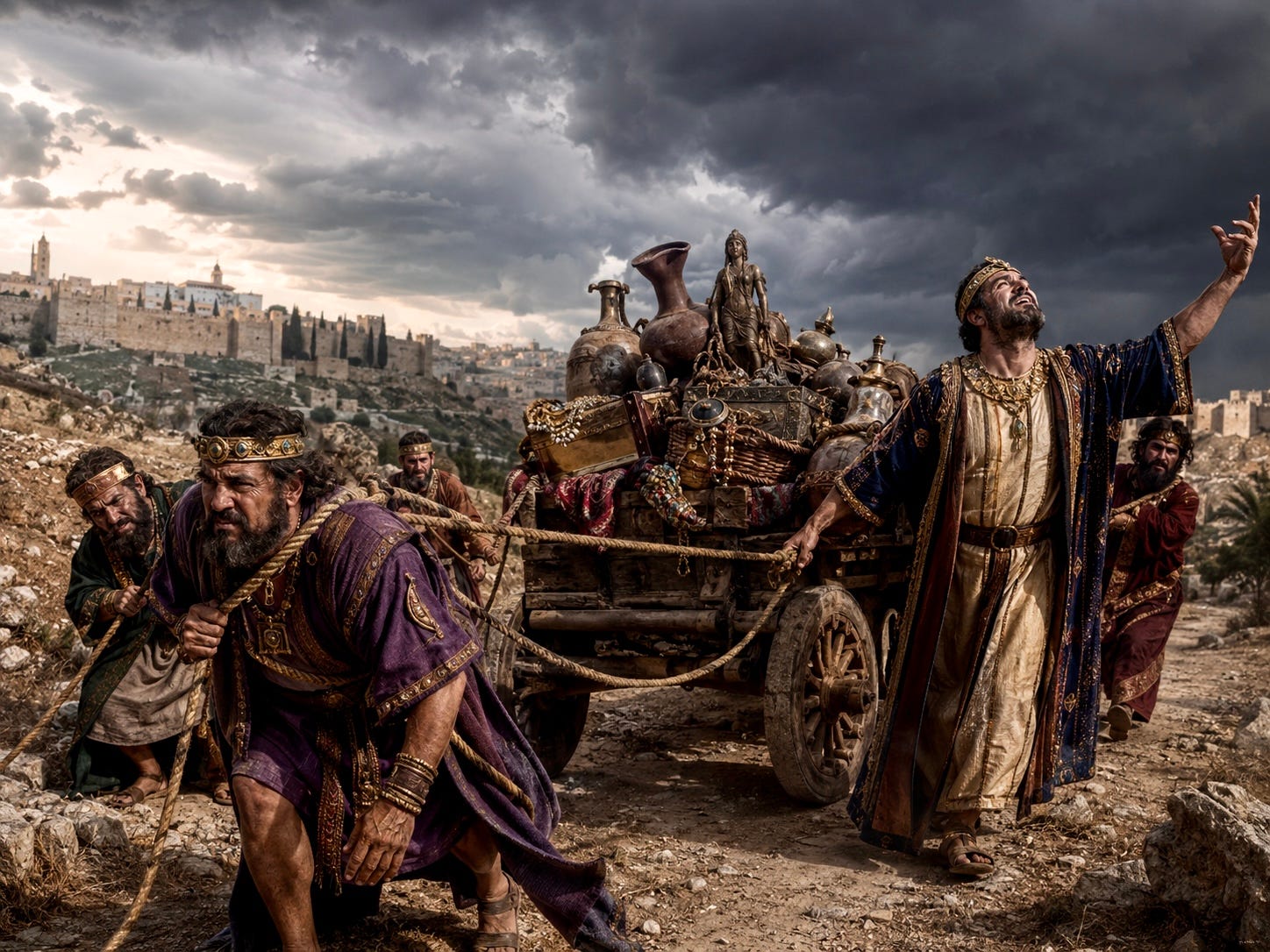
First, there is this interesting insight from an AI tool, ChatGPT (the tool created the image at the top):
The image brings Isaiah’s metaphor to life by showing men literally dragging a heavy cart of sin behind them, bound to it by thick ropes. The load of wealth, wine, and idols represents the wrongdoing they have accumulated and chosen to carry rather than abandon.
The richly dressed man defiantly gesturing toward the heavens reflects verse 19, where the people mock God and challenge Him to hurry up and act. Meanwhile, the gathering storm clouds suggest that the judgment they arrogantly dismiss is already approaching.
Isaiah is telling the people of Judah and Jerusalem (and us, even if we consider ourselves believers) that we are so invested in our sins that we drag them around behind us, even though they are a burden on our bodies, minds and souls. And not only do we drag our sins around, we even turn to God and mock Him, demanding that He hasten His works so that “we can see it and we can know it”.
Do those words remind you of a NT passage?
“The Pharisees and Sadducees came up, and testing Jesus, they asked Him to show them a sign from heaven. But He replied to them, “When it is evening, you say, ‘It will be fair weather, for the sky is red.’ And in the morning, ‘There will be a storm today, for the sky is red and threatening.’ Do you know how to discern the appearance of the sky, but cannot discern the signs of the times? An evil and adulterous generation seeks after a sign; and a sign will not be given it, except the sign of Jonah.” And He left them and went away.”
Matthew 16:1-4 NASB1995
At this point in the Gospel of Matthew, the Pharisees and Sadducees had seen or heard of many miracles that Jesus had performed; in fact, in the chapter before this one, the second miraculous feeding occurred with 4,000 in attendance. But they were wicked and stubborn, being adulterous to the tenets of their faith. So what is the sign of Jonah? Gotquestions.org answers this question quite effectively:
The “sign of Jonah” is a reference to Jesus Christ’s death, burial, and resurrection (see Matthew 12:40; cf. Jonah 1:17). The religious leaders already had more than enough proof of Jesus Christ’s identity. They knew the messianic prophecies Christ was fulfilling. They had seen with their own eyes His miracles of healing and exorcisms. What more could He do if these signs weren’t indisputable evidence enough? Nothing, concluded Jesus. The fact that they continued seeking a sign demonstrated the hardness of their unbelieving hearts. The only definitive sign they might accept to validate Christ’s authority would be His triumph over death on the cross (Romans 6:9; 2 Timothy 1:10). The Pharisees probably did not comprehend what Jesus meant just then, but they might have remembered and understood His words after the resurrection.
Scripture teaches that it’s wise to test the legitimacy of a person who claims to be God’s prophet (1 John 4:1). Jesus wasn’t saying that it is evil or wrong to seek for a sign. God gave signs to Moses (Exodus 4:1–9) and Gideon (Judges 6:11–22) to validate His Word. He urged King Ahaz, “Ask the Lord your God for a sign, whether in the deepest depths or in the highest heights” (Isaiah 7:11; see also Isaiah 7:10–25). Miraculous signs are sometimes the catalyst to spark a person’s faith and trust in Jesus (see John 2:23; 11:45). God gives signs to help those struggling to believe (John 4:43–54).
The purpose of a divine sign is always to lead people to respond to God’s message in faith. The scribes and Pharisees asked for a sign to trick Jesus and ultimately destroy Him. For this reason, Jesus said to them, “An evil and adulterous generation seeks for a sign.” He perceived the rebellion and unbelief in their hearts. Moreover, Jesus recognized these men as spokespersons for an entire generation of unfaithful, unbelieving people.
Refusing to let go of our sins even in the face of our salvation is driven by stubbornness and pride and the fact that we lie to ourselves (“the cords of falsehood”) and say that these are not really sins. The people in Isaiah’s time had heard about the probability of exile and punishment for their ways but they are throwing that back at God, telling Him to prove it by doing it now. Precept Austin quotes Raymond Ortlund with a pithy statement:
Picture people, not horses, harnessed to a heavy wagon, pulling it along, straining with all their might. Isaiah understands the burden that sin is. But we do it to ourselves! Why? Because sin is deceitful. The prophet says, "Woe to those who draw iniquity with cords of falsehood." That's how it happens. Sin lies to us. It's not as though sin fulfills its promises to make life better. It's a drag. So why don't we throw off the harnesses and run free? Because we are deceived—doubly so, for even as we cling to our favorite sins, so heavy but so dear to us, we also wonder, "I'm so bored. I'm so disappointed. Why isn't God more real to me? And look at the condition of this whole wretched world. Where is God?" That is what Isaiah discerns in the human heart, according to Isa 5:19—a mind that blames God, defies God, taunts God. - Preaching the Word – Isaiah: God Saves Sinners. (Isaiah - God Saves Sinners Preaching the Word) (Color and bolding added by Precept Austin).

Are you still dragging a heavy cart behind you loaded with sins that you can’t let go? I know that my cart looks a lot like the one in this picture. I still have these sins that I confess every time I pray. I am forgiven, but the burden still remains:
Envy
Pride
Gluttony
Greed
Wrath
Lust
Sloth
Anxiety
Focused on worldly distractions/pleasures
Hatred
Impatience
Lying
Stealing from God
Hard-heartedness
Selfishness
Ingratitude
Doubt
Resentment
It’s a lifelong battle but little by little these things are pushed aside by the Holy Spirit and replaced with the fruit of His love and grace. Sometimes the cart is nearly empty, other times it fills up in an instant! One thing that we can never allow ourselves to do is to huffily demand that God hurry up in His promises and shake a finger at Him in frustration. We are being refined, not coddled.
My next devotional examines Isaiah 5:20 - Woe to those who call evil good.
Heaven on Wheels Daily Prayer:
Dear Lord - I pray these sinful states to You regularly and ask You for a removal of this vicious burden that I have placed on myself. Thank You for the progress that has been made! Amen.
Citations and Credits:
Scripture quotations taken from the (NASB®) New American Standard Bible®, Copyright © 1960, 1971, 1977, 1995 by The Lockman Foundation. Used by permission. All rights reserved. www.Lockman.org.
Precept Austin was accessed on 08/30/2026 to review commentary for Isaiah 5:18-19.
Gotquestions.org was accessed on 08/30/2026 to answer this question: Why does Jesus say that “an evil and adulterous generation seeks for a sign” (Matthew 12:39)? © COPYRIGHT 2002-2026 GOT QUESTIONS MINISTRIES. ALL RIGHTS RESERVED.
Commentary from Enduring Word is used with written permission and without any alteration. ©1996-present The Enduring Word Bible Commentary by David Guzik – enduringword.com. At the link referenced, the bibliography used by David Guzik can be accessed.
Beautifully written, Barb, thank you