



“Woe to those who are wise in their own eyes
And clever in their own sight!”
Isaiah 5:21 NASB1995
The fifth woe in Isaiah 5 is directed at those who take great pride in their own wisdom and cleverness. The image created by ChatGPT sets an interesting scene:
Here’s the concept for today’s image: A wealthy, finely dressed Judean official sits prominently in a courtyard surrounded by scrolls, confidently lecturing several people gathered around him. His posture and expression show unmistakable self-satisfaction. But behind him, two older, genuinely wise men exchange concerned glances, recognizing the folly in what he is saying. The official is completely oblivious.
The Bible is full of wonderful scripture about the dangers of being too full of yourself and smugly strutting your alleged expertise, wisdom, opinions, and wit across the world’s stage to lord it over others. Here are a few verses:
“An idiot will become intelligent
When the foal of a wild donkey is born a man.”
Job 11:12 NASB1995
“Do not be wise in your own eyes;
Fear the Lord and turn away from evil.
It will be healing to your body
And refreshment to your bones.”
Proverbs 3:7-8 NASB1995
“Do you see a man wise in his own eyes?
There is more hope for a fool than for him.”
Proverbs 26:12 NASB1995
“Be of the same mind toward one another; do not be haughty in mind, but associate with the lowly. Do not be wise in your own estimation.”
Romans 12:16 NASB1995
“Let no man deceive himself. If any man among you thinks that he is wise in this age, he must become foolish, so that he may become wise. For the wisdom of this world is foolishness before God. For it is written, “He is the one who catches the wise in their craftiness”; and again, “The Lord knows the reasonings of the wise, that they are useless.””
1 Corinthians 3:18-20 NASB1995
I love that last one from 1 Corinthians: The Lord knows the reasonings of the wise, that they are useless”. The wisdom of this world is indeed foolishness before God.
Have you ever worked for someone or with someone who was so insufferably arrogant and always “right” about everything that it would drive you crazy? I must confess I was pretty pompous and “clever” back in my career days and would argue facts until I lost friends, but I couldn’t hold a candle to some of the leaders we had to contend with. I grew fond of managers who were able to remain humble and sympathetic to those in the trenches doing the hard work and also give those workers some credit.
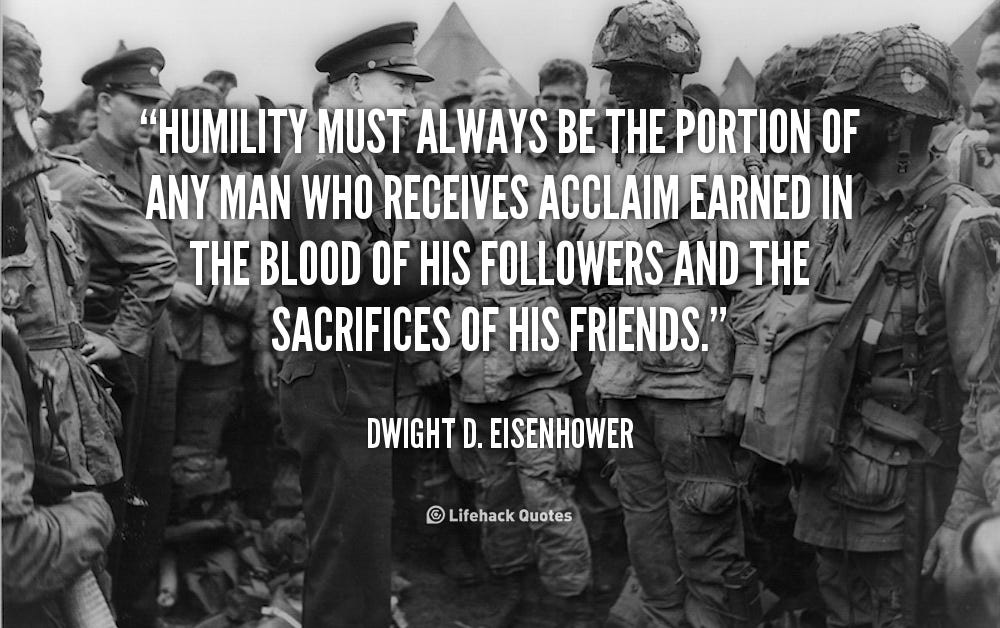
In my studies about World War II I am always fascinated to see how some leaders in that great conflict were more admired than others. In retrospect, Dwight Eisenhower was viewed as a very humble man (and he was a believer) who cared deeply about the responsibilities of his tasks as Supreme Commander Allied Expeditionary Forces (SHAEF). The quote above, with a photo taken when he chose to visit the paratroopers of the 101st Airborne just before D-Day, shows that Eisenhower always recognized the deep respons that comes from sending men to their deaths. Other leaders that modeled this modest and calm approach to their commands included US General Omar Bradley, British Field Marshall Sir Harold Alexander (Churchill’s favorite general), and US Fleet Admiral Chester Nimitz.
Of course one could argue that the low-key modesty and team leadership style of Eisenhower, for example, fell victim to the pomposity of a man like British General Sir Bernard Law Montgomery, who talked SHAEF into the debacle known as Operation Market Garden in September, 1944; Monty also later took “credit” for saving everybody during the Battle of the Bulge. Although the reputation of Monty has been repaired to some degree after the fact by a few historians, he was a man who always seemed “wise in his own eyes”. I’m not sure how much of the splendid film “Patton” exaggerates the figure of General George S. Patton, but history will tell you that in spite of his lack of humility, Patton was in most respects a great military leader, but he may have succumbed to the battle of the wits with Montgomery in Sicily and wanted to outflank him just because of his own ego; Steve’s uncle died in the ensuing battles in the race between Palermo and Messina. And I’m not touching the third rail of General MacArthur…

We live in an age where everyone who has a computer or smartphone can instantly become an armchair “expert” on any topic. People become “wise in their own eyes” and refuse to ever, ever acknowledge that they might be wrong. The deep cesspools of ludicrous conspiracy theories about everything under the sun are created by fools who are “just asking questions” and then more fools who blindly follow them. Go to the comments section on any random topic and the keyboard warriors are usually present (seriously, the topic doesn’t matter). Then go to the comments in an article about Christian beliefs and the fools who are “wise in their own eyes” are marching in like an army and slapping themselves on the back for putting those dumb Christianists in their place with witty bon mots such as “say hi to the invisible sky god” and “I believe in the Flying Spaghetti Monster, it’s just as irrational”.
This arrogance isn’t limited to atheist trolls. I saw a cartoon recently on Facebook that was shared by somebody in all seriousness. I didn’t grab it (and now I can’t find it) but I can describe it as a drawing of a lone figure facing a huge crowd of people. The lone figure says that he is a Lutheran and everyone else of other Protestant faiths are wrong and are not saved (he didn’t even include Catholics or Orthodox in the mix). I encountered this pedantry in a group that I joined a few years ago that exposes some of the wrong beliefs of the ELCA (Evangelical Lutheran Church of America). I noted in that site that we had left the ELCA and started going to services at a non-denominational church; I was told in no uncertain terms by several members of the group that my salvation was at risk if I didn’t move to another denomination that was Lutheran, like the Missouri Synod. Do you think this “wisdom in their own eyes” might be responsible for my favorite spaghetti chart from truthforsaints.com?

Isaiah recognized this arrogance in the leaders of Judah and Jerusalem. What is interesting about these “woe” statements is that they are coming to us in shorter and faster phrases, so the receivers of those statements have to be thinking about the judgment that will come. My next devotional examines the last “woe” statement from Isaiah 5:22-23 - Woe to the valiant men who are drinking strong drink and taking bribes.
Heaven on Wheels Daily Prayer:
Dear Lord - Please help me to be humble and know that any wisdom that means anything comes from You. Amen.
Citations and Credits:
Scripture quotations taken from the (NASB®) New American Standard Bible®, Copyright © 1960, 1971, 1977, 1995 by The Lockman Foundation. Used by permission. All rights reserved. www.Lockman.org.
Precept Austin was accessed on 09/02/2026 to review commentary for Isaiah 5:21.
Commentary from Enduring Word is used with written permission and without any alteration. ©1996-present The Enduring Word Bible Commentary by David Guzik – enduringword.com. At the link referenced, the bibliography used by David Guzik can be accessed. Commentary was accessed but not used for this devotional.