


“Woe to those who add house to house and join field to field,
Until there is no more room,
So that you have to live alone in the midst of the land!
In my ears the Lord of hosts has sworn, “Surely, many houses shall become desolate,
Even great and fine ones, without occupants.
For ten acres of vineyard will yield only one bath of wine,
And a homer of seed will yield but an ephah of grain.””
Isaiah 5:8-10 NASB1995
This is the first of six woes that Isaiah identifies in Isaiah 5 as the reasons for God turning His back on the people of Jerusalem and Judah and allowing the vineyard to become fallow. The word woe comes from a Hebrew interjection as noted in the Strong’s definition from the Blue Letter Bible lexicon:
הוֹי hôwy, hoh'ee; a prolonged form of H1930 (akin to H188); oh!:—ah, alas, ho, O, woe.
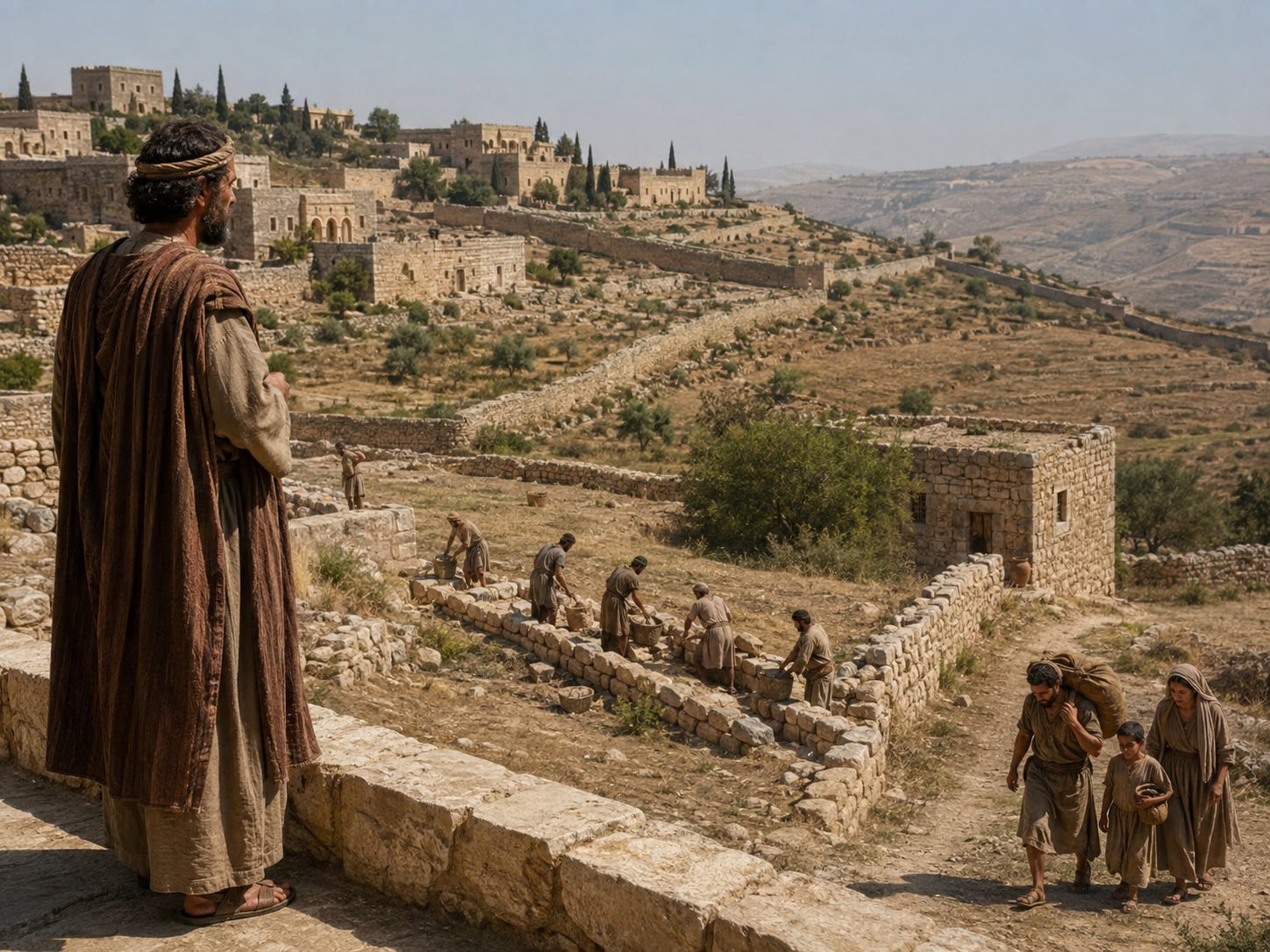
ChatGPT had this to say about the image at the top that it created:
A wealthy Judean landowner stands on the terrace of a large, impressive stone house overlooking an enormous estate. Below him, laborers are moving boundary stones or building another wall outward, visibly absorbing a small neighboring farm. Off to one side, a poor family is leaving their modest home carrying a few possessions, displaced by the expanding estate. Farther across the landscape are several other substantial houses and fields belonging to the wealthy owner—but strangely few ordinary homes remain.
The landowner doesn’t need to look cartoonishly evil. In fact, I’d make him look satisfied and prosperous, perhaps quietly surveying everything he has accumulated. That makes the image more disturbing because he sees his expansion as success, while Isaiah sees injustice.
Isaiah has noted that many of the wealthier families in Judah and Jerusalem have started acquiring land or even usurping it from others to have more substantial houses and fields that they own. They displace poorer families that have been on the property to do this. According to Leviticus 25, the land belongs to God and the rules are set for property management according to the year of the Jubilee (every 50 years):
“‘The land, moreover, shall not be sold permanently, for the land is Mine; for you are but aliens and sojourners with Me. Thus for every piece of your property, you are to provide for the redemption of the land.
‘If a fellow countryman of yours becomes so poor he has to sell part of his property, then his nearest kinsman is to come and buy back what his relative has sold. Or in case a man has no kinsman, but so recovers his means as to find sufficient for its redemption, then he shall calculate the years since its sale and refund the balance to the man to whom he sold it, and so return to his property. But if he has not found sufficient means to get it back for himself, then what he has sold shall remain in the hands of its purchaser until the year of jubilee; but at the jubilee it shall revert, that he may return to his property.”
Leviticus 25:23-28 NASB1995
The “house-to-house” and “field-to-field” building frenzy that results in no more room and pushes out the poorer families in all likelihood violates the laws that were laid down in Leviticus and Isaiah has observed this. Because they have done this, the houses will become desolate and the land will not yield fruit and grain.

There is a cautionary tale from this Biblical woe for us in the 21st century. Although I am a strong supporter of free markets and would not like someone or some group (like an overbearing government) to intervene or destroy those free markets or propose onerous taxes or even worse penalties to confiscate wealth, you do have to wonder about places like the one in the photo. A beautiful and opulent mansion like this is either admired or envied by those who view it (not by me, because I don’t have the stamina to wander around such a modern castle, so I prefer a much smaller domicile, although it’s true that someone else would do the cleaning and cooking). Who can use all of those rooms??
The sin of covetousness is never satisfied. You might currently have a house with a decent number of rooms, but then you start to long for the larger palace with many more rooms, elaborate kitchens, servants and special rooms with limited purposes, like an indoor swimming pool and gymnasium and movie theater and multi-car garage. You might have many wives like David had, but you spot a beautiful woman bathing and decide that you must have her, too (and you plot to kill her husband). There are many more examples that I could explore. Sinful humans are never content with what they have, much less show any gratitude.
There’s an interesting perspective on this that is explored in an absolutely wonderful book by C.S. Lewis called the “The Great Divorce” (highly recommended). This book has a unique look at the realms of heaven and hell. There is a bus stop in the gloomy city of hell (the city, looking like a drab English market town, is rapidly descending into permanent nighttime). The bus takes people to view heaven and their loved ones that are there.
One of the denizens of hell is Napoleon Bonaparte. He has built a huge mansion light years away from many of the occupants and is all alone. Here is an excerpt from the book talking about the older occupants (from https://theallfreenovel.com/14215/2/the_great_divorce):
‘Would they get to the bus stop in time, if they ever set out?’
‘Well—theoretically. But it’d be a distance of light-years. And they wouldn’t want to by now: not those old chaps like Tamberlaine and Genghis Khan, or Julius Caesar, or Henry the Fifth.’
‘Wouldn’t want to?’
‘That’s right. The nearest of those old ones is Napoleon. We know that because two chaps made the journey to see him. They’d started long before I came, of course, but I was there when they came back. About fifteen thousand years of our time it took them. We’ve picked out the house by now. Just a little pin prick of light and nothing else near it for millions of miles.’‘But they got there?’
‘That’s right. He’d built himself a huge house all in the Empire style—rows of windows flaming with light, though it only shows as a pin prick from where I live.’
‘Did they see Napoleon?’
‘That’s right. They went up and looked through one of the windows. Napoleon was there all right.’
‘What was he doing?’
‘Walking up and down—up and down all the time—left-right, left-right—never stopping for a moment. The two chaps watched him for about a year and he never rested. And muttering to himself all the time. “It was Soult’s fault. It was Ney’s fault. It was Josephine’s fault. It was the fault of the Russians. It was the fault of the English.” Like that all the time. Never stopped for a moment. A little, fat man and he looked kind of tired. But he didn’t seem able to stop it.’
I hope this makes some sense to the reader. C.S. Lewis uses Napoleon as an example of someone who once “had it all” in this life (including a vast Empire, a stunning Empress wife, a large military force and riches beyond compare) but he decided he wanted more, so he set out to conquer Russia, too, and launched an invasion. He lost everything in this last venture and the final blow came at the battle of Waterloo; he was exiled permanently to a remote island until he died.
Note that in this imagined afterlife from Lewis, Napoleon has built a massive empire-style mansion that is brightly lit (like our mansion in the photo) but he can only be seen by those who have traveled a very long distance. They then view him for a year pacing and muttering, casting blame for his defeats. His “house-to-house” and “field-to-field” strategies in his mortal life have left him unable to even rest for a second for all eternity. He is exiled and all alone. This hearkens back to the admonition by Isaiah that the wealthy and greedy landowner lives alone in the midst of the land. He might be counting his coins, but he is like Napoleon, exiled in his mortal life and in his eternal damnation.

One other observation could be made about how “field-to-field” development seems to be problematic. We have done a lot of traveling through many towns and small (and large) cities in the US, sometimes taking routes that avoid freeways and meander through the neighborhoods. Other than downtown areas that may preserve some places of historical interest or nurture a few unique shops and restaurants, most of these places would look just like the photo at the top. There are chain restaurants and fast food joints and strip malls and chain motels and gas stations, then the same things start up again a few blocks later. Yes, these things are convenient, but they are also monotonous.
You can drive through the environs and suburbs of almost any populated place in America and see empty strip malls right next to new ones being built (why couldn’t the empty one be renovated?). Occasionally you glimpse some houses and schools and parks, but those are usually concealed behind the commercial developments. A visitor from outside the US would have a hard time telling you if he is in Anaheim or Tucson or Aurora or Fort Worth or Nashville or Cocoa Beach (you do get a glimpse of ocean in that last one). I can understand the business needs behind these developments, but that doesn’t make it more loveable or lovely to look at. And Isaiah’s proclamation is probably true - there is less yield from ten Walgreen’s clustered within five miles of each other than one store that can serve a much broader customer base, even if you have to travel for five minutes longer to get there. There are some glimmers of hope in more recent urban and suburban designs that have pedestrian malls, unique shops and restaurants, and community gathering places.
Ok, enough pontificating. I’ll leave you with the commentary from Enduring Word:
a. Woe to those who join house to house: The picture is of greedy real estate buying and development.
i. “For it cannot be condemned as a thing in itself wrong, if a man add field to field and house to house; but he looked at the disposition of mind, which cannot at all be satisfied, when it is once inflamed by the desire of gain. Accordingly, he describes the feelings of those who never have enough, and whom no wealth can satisfy.” (Calvin)
ii. “Covetous persons are of the dragon’s temper, who, they say, is so thirsty, that no water can quench his thirst. Covetousness is a dry drunkenness, saith one, an insatiable dropsy, and like hell itself.” (Trapp)
b. Many houses shall be desolate, great and beautiful ones, without inhabitant: In judgment, their real estate deals will not be successful, and they will have many vacant and unsold houses.
i. “When men are covetous after the things of this world, God has a way of making them to be filled with disappointment and with bitterness.” (Spurgeon)
My next devotional examines Isaiah 5:11-17 - Woe to those who “party endlessly”.
Heaven on Wheels Daily Prayer:
Dear Lord - Help me to be grateful, always, for what I have and not covet what I don’t have. I thank You for how You have provided for us! Amen.
Citations and Credits:
Scripture quotations taken from the (NASB®) New American Standard Bible®, Copyright © 1960, 1971, 1977, 1995 by The Lockman Foundation. Used by permission. All rights reserved. www.Lockman.org.
Precept Austin was accessed on 08/26/2026 to review commentary for Isaiah 5:8-10.
Commentary from Enduring Word is used with written permission and without any alteration. ©1996-present The Enduring Word Bible Commentary by David Guzik – enduringword.com. At the link referenced, the bibliography used by David Guzik can be accessed.
I have fallen in love with today's heavens on wheels daily prayer precised and concised what a great sure deal prayer that was. May GOD of make it happen through Christ Jesus our Lord and Amen.
Amen! Coveteouness I have wondered about. Early in the ministry when I preached of it's horrors in the marketplace, a family member said to me, "you preach like that because of your economic status". I never forgot that statement. Is my coveteouness hidden behind my inability to purchase, to choose a more affluent lifestye? Therefore I'm safe by my in- opportunity. Your words today awaken in me that feeling again. I don't splurge because I can't splurge. Which means there is a hidden coveteouness trait behind the scenes.
Thanks Barbe Sande for your penetrating words and challenge to know, ourselves. And the true meaning of coveteouness.
Thank you!