


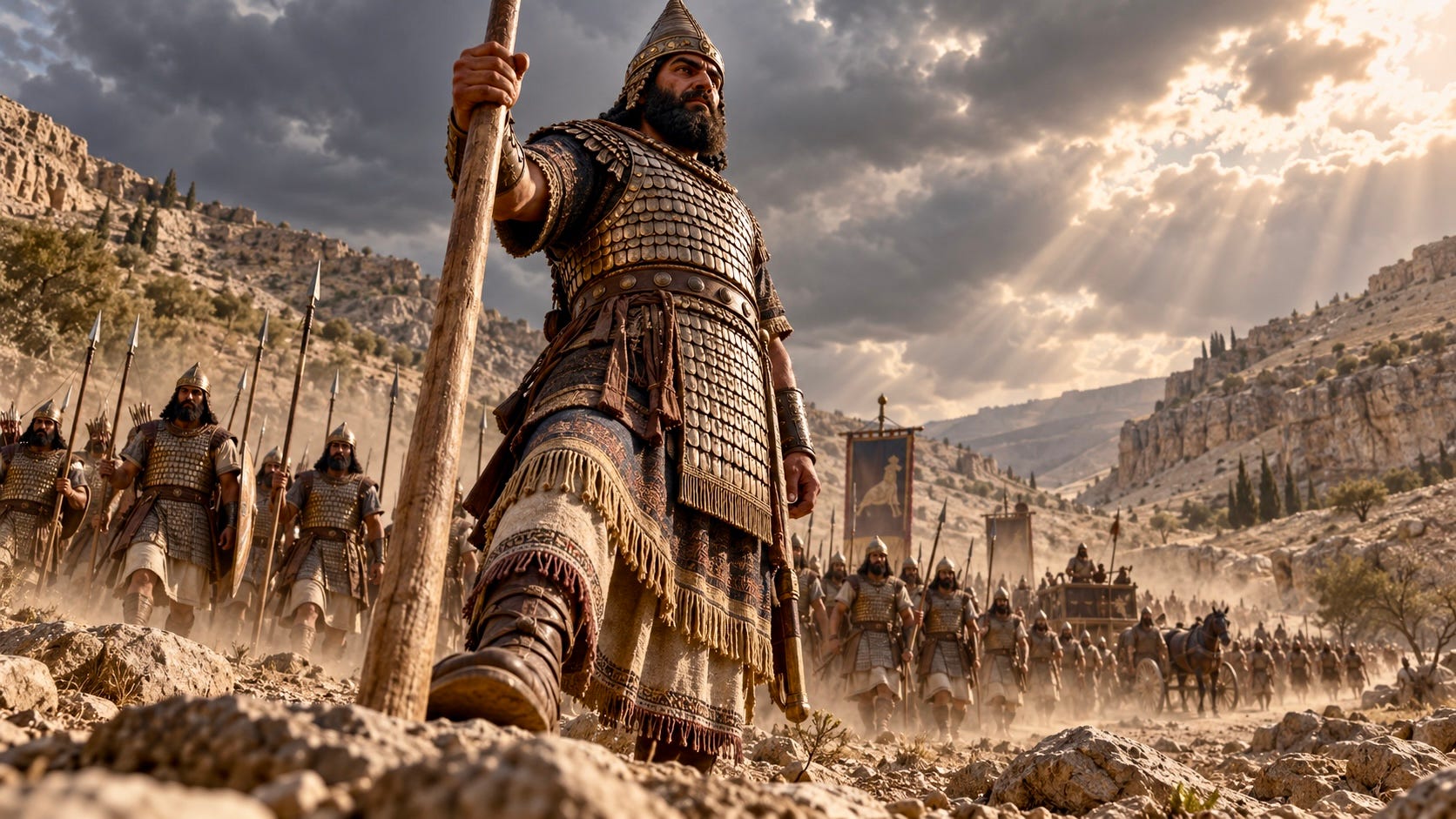
“Woe to Assyria, the rod of My anger
And the staff in whose hands is My indignation,
I send it against a godless nation
And commission it against the people of My fury
To capture booty and to seize plunder,
And to trample them down like mud in the streets.
Yet it does not so intend,
Nor does it plan so in its heart,
But rather it is its purpose to destroy
And to cut off many nations.”
Isaiah 10:5-7 NASB1995
The remaining verses of Isaiah 10 go into some detail about the Assyrians and how they are first used as a “rod of God’s anger” against Syria, Israel, and Judah and then how they themselves face God’s wrath. I’m taking this a little chunk at a time.
Here is what Enduring Word says about verses 5-7:
a. Woe to Assyria, the rod of My anger: In the previous section (Isaiah 7:1-10:4), the LORD revealed that He would use Assyria as an instrument of judgment against Syria, Israel, and Judah. But what about Assyria? Weren’t they even more wicked than Syria, Israel, or Judah? Yes, the Assyrians were wicked; yet the LORD could use them as the rod of My anger. At the same time, none of this excused Assyria, so the LORD says, “woe to Assyria.”
i. “A similar shift in the object of divine judgment occurred in the case of the Babylonians. God raised up the Babylonian armies between 605 and 586 B.C. to punish Judah (Habakkuk 1:6-11), and then He announced judgment on Babylon (Habakkuk 2:6-17; Isaiah 14:5).” (Wolf)
b. The rod of My anger…the staff in whose hand is My indignation: The rod and the staff were sticks used by shepherds to guide and correct their sheep. God is saying that Assyria was like a stick in His hand, used to correct Syria, Israel, and Judah.
c. I will send him against an ungodly nation, and against the people of My wrath: In this sense, Assyria was on a mission from God. They were doing the LORD’s will, running His errands when they came against Syria, Israel, and Judah. God gave them permission (I will give them charge) to seize the spoil, to take the prey, and to tread them down like the mire of the streets.
d. Yet he does not mean so, nor does his heart think so: Since Assyria was an instrument in God’s hand, since they were doing the will of the LORD, does this excuse their attack on Syria, Israel, and Judah? Not at all! Though they were instruments in God’s hand, they did not mean so, nor does his heart think so. They didn’t care at all about God’s will or glory in the matter. Instead, it is in his heart to destroy, and cut off not a few nations. Assyria didn’t care about the will or glory of God; they wanted to destroy and cut off many nations.
i. Psalm 76:10 says Surely the wrath of man shall praise You. God can use the wickedness and carnality of man to further His will, without ever approving of the wickedness or carnality. In fact, God is totally justified in judging the very wickedness and carnality that He used.
ii. The pattern is repeated over and over through the Scriptures. Joseph’s brothers sinned against Joseph, but God used it for His purpose, and disciplined Joseph’s brothers. Saul sinned against David, but God used it for His purpose, and judged Saul. Judas sinned against Jesus, but God used it for His purpose, and judged Judas.
iii. This should help with questions that trouble many people. The first question is “How can God bring any good through an evil thing that was done to me?” We can’t often know in advance exactly how God will bring the good, but we can trust that He will as we continue to yield to Him and seek Him. The second question is “Doesn’t God care about what they did to me?” He does care, and God will bring His correction or judgment according to His perfect will and timing.
God uses the ruthless Assyrians as His weapon against the Godless nation of Israel, but the Assyrians do their conquering without regard to God’s role in this action. God uses sinful and wicked people to further His will but He does not approve of their wickedness and will judge them, too! We need to trust God to always bring good out of a situation.
There are also some interesting eschatological connections in this prophecy, according to Precept Austin, with further connections to Micah and Ezekiel. Here are the details:
Henry Morris has an interesting comment on Assyria...
As in many of the prophecies, there is to be both a precursive fulfillment, in this case the coming invasion of Israel and Judah by the unspeakably cruel and wicked Assyrians, and a final fulfillment, the northern invaders of Israel in the last days, as described particularly in Ezekiel 38. The term “Assyrian” seems, in fact, to be a title of the coming Antichrist (Micah 5:5,6).
This One (Messiah) will be our peace (cp Prince of peace Isa 9:6). When the Assyrian invades our land, when he tramples on our citadels, then we will raise against him seven shepherds and eight leaders of men. 6 They will shepherd the land of Assyria with the sword, The land of Nimrod at its entrances; And He will deliver us from the Assyrian When he attacks our land And when he tramples our territory. (Mic 5:5-6).
[Precept Austin] Comment: While not everyone would agree that Micah’s prophecy describes the future Antichrist, Micah’s prediction of Israeli victory over Assyria has never been historically fulfilled and does leave open this fulfillment as a distinct possibility that it refers to the last days. Morris commenting on Micah’s prophecy writes
Since Assyria was the chief threat to Judah at the time Micah was writing, many expositors assume that “the Assyrian“ in this verse is simply a metaphor for all her enemies. The context in this passage, however, is strongly Messianic and prophetic, and Assyria was a dead nation long before even the first coming of Christ. With this context in mind, it seems most likely that “the Assyrian” here is a name for the Antichrist of the last days, the leader of the last great invasion of Israel before the second coming of Christ. He is an Assyrian not by nationality (the Assyrians of antiquity have long vanished from history) but by geography, since his capital will be at restored Babylon (Zechariah 5:5-11). In the last days, “the Assyrian” (or Antichrist, or the Beast) will be seeking to establish his world government and especially to eliminate the nation Israel and all Christians in every nation. At that time, this particular prophecy will become clear. There has been no historical fulfillment of this prophecy as yet, which makes it even more obvious that the major context of this whole section must relate to the future. At that time, the Lord will raise up leaders--perhaps from Israel--to organize escape routes and resistance to the Assyrian’s armies and death squads.

Let’s look at the prophecy in Micah (I’m including more than just the reference in the commentary above):
““Now muster yourselves in troops, daughter of troops;
They have laid siege against us;
With a rod they will smite the judge of Israel on the cheek.
But as for you, Bethlehem Ephrathah,
Too little to be among the clans of Judah,
From you One will go forth for Me to be ruler in Israel.
His goings forth are from long ago,
From the days of eternity.”
Therefore He will give them up until the time
When she who is in labor has borne a child.
Then the remainder of His brethren
Will return to the sons of Israel.
And He will arise and shepherd His flock
In the strength of the Lord,
In the majesty of the name of the Lord His God.
And they will remain,
Because at that time He will be great
To the ends of the earth.
This One will be our peace.
When the Assyrian invades our land,
When he tramples on our citadels,
Then we will raise against him
Seven shepherds and eight leaders of men.
They will shepherd the land of Assyria with the sword,
The land of Nimrod at its entrances;
And He will deliver us from the Assyrian
When he attacks our land
And when he tramples our territory.
Then the remnant of Jacob
Will be among many peoples
Like dew from the Lord,
Like showers on vegetation
Which do not wait for man
Or delay for the sons of men.
The remnant of Jacob
Will be among the nations,
Among many peoples
Like a lion among the beasts of the forest,
Like a young lion among flocks of sheep,
Which, if he passes through,
Tramples down and tears,
And there is none to rescue.
Your hand will be lifted up against your adversaries,
And all your enemies will be cut off.”
Micah 5:1-9 NASB1995
I have a confession to make. I probably haven’t looked at the book of Micah in years (since doing Bible in One Year studies), except now I’m getting sent there quite a bit during this Isaiah study. This prophecy is extraordinary! There has to be a better way to study Biblical texts than just doing a Genesis to Revelation top-level journey (perhaps I’ve stumbled across a better way by doing these in-depth studies of one book and all the ways it points to other books). We have a friend who is doing the books in chronological order, which might make more sense as well.
As we continue through the rest of Isaiah 10, it will become apparent that this passage in Isaiah may be what is referred to as a “double reference”, a prophecy with near and long-term implications. I will dig into this idea more later in upcoming Isaiah 10 devotionals. Meanwhile, here is some commentary from Enduring Word on the first part of the passage in Micah for us to ponder:
a. He has laid siege against us: Micah announced that Israel will be humbled by foreign powers, and even her judges will bear insults.
b. But you, Bethlehem Ephrathah…out of you shall come forth to Me the One to be Ruler in Israel: In the coming time of humiliation under foreign powers, God would raise up a great Ruler from a humble place – Bethlehem.
i. Bethlehem was well known as the hometown of David, Israel’s greatest king, yet it was never a great or influential city. It was truly little among the thousands of Judah. Yet God chose it as the birthplace of the Messiah, the Ruler in Israel.
ii. This passage from Micah 5 was quoted by the chief priests and teachers of the law when Herod asked about the birth of the Messiah (Matthew 2:5-6).
iii. Bethlehem means House of Bread, and Jesus is the bread of life (John 6:35). “And now for that word Ephrathah. That was the old name of the place which the Jews retained and loved. The meaning of it is, ‘fruitfulness,’ or ‘abundance.’ Ah! well was Jesus born in the house of fruitfulness; for whence cometh my fruitfulness and thy fruitfulness, my brother, but from Bethlehem? Our poor barren hearts never produced one fruit or flower, till they were watered with the Saviour’s blood.” (Spurgeon)
c. Whose goings forth are from of old, from everlasting: This glorious promise was fulfilled in Jesus Christ, and Micah’s prophetic voice declared that though Jesus came from Bethlehem, He did not begin there. His goings forth are from before the foundation of the world.
i. The Bible tells us that Jesus is the Alpha and the Omega, the Beginning and the End (Revelation 22:13). This means from the very beginning, Jesus was there. There was never a time when Jesus did not exist.
ii. Before Jesus was born in Bethlehem, He existed as the Second Person of the Trinity (John 17:5, 17:24). These passages tell us that there was a relationship of love, fellowship, and shared glory that the Father and the Son shared before the creation of all things. The name “Jesus” was not known as a name for the Second Person of the Trinity until the angel Gabriel announced it to Mary (Luke 1:31). But the eternal Son existed before He revealed Himself as “Jesus.”
iii. Before Bethlehem, Jesus was the creator of all things (Colossians 1:16-17, John 1:1-3). “He was before all things. As he is the Creator of all things, so he is the Eternal, and no part of what was created. [Every] being but God has been created. Whatever has not been created is God. But Jesus is the Creator of all things; therefore he is God; for he cannot be a part of his own work.” (Clarke)
iv. In the Old Testament, Jesus appeared as God made visible or the Angel of the LORD. There are many instances in the Old Testament where individuals are shown to have had a face-to-face encounter with the LORD (Genesis 16:7-13, Genesis 18, Genesis 32:24-32, Joshua 5:13-15, Judges 6:11-24, Judges 13:8-24, Daniel 3). In each situation, the Person is given different titles, but in all cases the person is plainly referred to as the LORD Himself but appearing in a human form.
v. From before the creation of all things, God’s plan of the ages included Jesus (1 Peter 1:20, Ephesians 1:4).
vi. Knowing that Jesus’ goings forth are from of old, from everlasting shows us some important things:
· It shows us the glory of Jesus, that He is far more than a man.
· It shows us the love of Jesus, that He would leave the glory of heaven for us.
· It shows us the nature of Jesus, that He would add humanity to His deity.
· It shows us the sympathy of Jesus, that He remains fully man and fully God.
…
a. He shall give them up, until the time: Micah anticipated a future time, one that was partially fulfilled in the Babylonian exile and return, but will be ultimately fulfilled in the great tribulation and restoration of Israel. In both those eras, the LORD will seem distant from Israel until the time for restoration is ready.
b. Then the remnant of His brethren shall return…. He shall stand and feed His flock in the strength of the LORD: After the time of Israel’s trial, the LORD will restore gloriously. The Ruler born in Bethlehem will tenderly care for His flock in the strength of the LORD.
c. They shall abide, for now He shall be great to the ends of the earth: The greatness of the Ruler from Bethlehem guarantees the standing of His people. They abide because of His greatness.
d. This One shall be peace: It isn’t just that the Ruler from Bethlehem brings peace; He is peace. As Paul wrote of Jesus in Ephesians 2:14, He Himself is our peace.
…
a. When the Assyrian comes into our land: After the pattern of the prophets, Micah blended near and distant ages in his prophecy. The threat of the Assyrian would come against both kingdoms shortly, but Micah also used the idea of the Assyrian for any pagan nation or empire set against God’s people.
b. We will raise against him seven shepherds and eight princely men: Though the enemies of God’s people would come against them, under God’s blessing leaders will raise against them mighty men. God often works this way to deliver us from our enemies.
My next devotional will examine Isaiah 10: 8-14 - The Boasting of Assyria.
Heaven on Wheels Daily Prayer:
Dear Lord - Thank you for helping me do exegetical studies of Isaiah, bringing into view so many other pieces of the tapestry of Your will and Your creation! Amen.
Citations and Credits:
Scripture quotations taken from the (NASB®) New American Standard Bible®, Copyright © 1960, 1971, 1977, 1995 by The Lockman Foundation. Used by permission. All rights reserved. www.Lockman.org.
Precept Austin was accessed on 10/22/2026 to review commentary for Isaiah 10:5-7
Biblehub.org was accessed on 10/22/2026 to review commentary for Isaiah 10:5-7.
Commentary from Enduring Word is used with written permission and without any alteration. ©1996-present The Enduring Word Bible Commentary by David Guzik – enduringword.com. At the link referenced, the bibliography used by David Guzik can be accessed.