


“The Lord will bring on you, on your people, and on your father’s house such days as have never come since the day that Ephraim separated from Judah, the king of Assyria.”
In that day the Lord will whistle for the fly that is in the remotest part of the rivers of Egypt and for the bee that is in the land of Assyria. They will all come and settle on the steep ravines, on the ledges of the cliffs, on all the thorn bushes and on all the watering places.
In that day the Lord will shave with a razor, hired from regions beyond the Euphrates (that is, with the king of Assyria), the head and the hair of the legs; and it will also remove the beard.
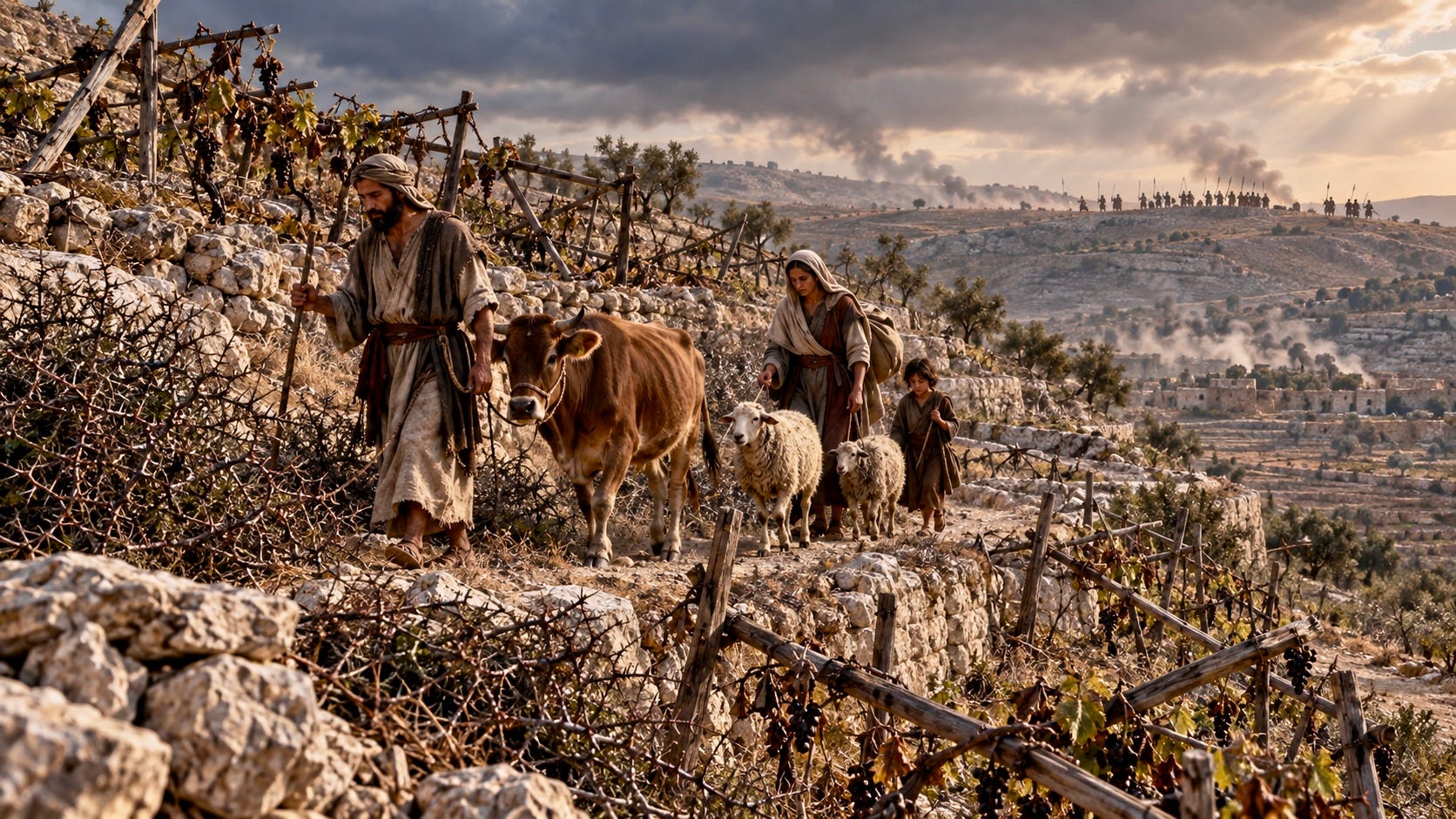
Now in that day a man may keep alive a heifer and a pair of sheep; and because of the abundance of the milk produced he will eat curds, for everyone that is left within the land will eat curds and honey.
And it will come about in that day, that every place where there used to be a thousand vines, valued at a thousand shekels of silver, will become briars and thorns. People will come there with bows and arrows because all the land will be briars and thorns. As for all the hills which used to be cultivated with the hoe, you will not go there for fear of briars and thorns; but they will become a place for pasturing oxen and for sheep to trample.”
Isaiah 7:17-25 NASB1995
Isaiah promises Ahaz that things will not go well for Judah. The phrase “in that day” occurs 40 times in Isaiah, according to Precept Austin. The context must always be carefully examined to determine the near-term or eschatological impacts (or both) of those phrases. This devotional has quite a bit of commentary to help us understand this passage.
Pastor and Biblical scholar Ron Teed (Village Church of Wheaton, Illinois) is quoted in Precept Austin about the Assyrian assault on Judah and Jerusalem:
Not only did God use the Assyrians to judge the Northern kingdom of Israel (Ephraim - defeating them in 722BC), He also used them to invade Ahaz’s domain in Judah. The desolation prophesied in this section began in the days of Ahaz and reached its climax when the Babylonians conquered Judah (586BC Jerusalem and the Temple destroyed). And its results will continue right up to the time Jesus will return to deliver Israel and establish His kingdom on earth (Time of Jacob's Distress or Trouble - Jer 30:7, 8, 9; Great Tribulation). (Isaiah 7 Teed Commentaries).
So the next two verses (Isaiah 7:18-19) describe how the Lord will “whistle” for the fly of Egypt and the bee of Assyria to descend on the land of Judah and they will come in covering the lands. Precept Austin has this to say about these circumstances:
The LORD will whistle - This is a vivid metaphor drawn from the everyday life of the ancient Near East. Shepherds, farmers, and beekeepers used a sharp sound, a whistle or hiss, to summon animals or insects that were under their control. Isaiah adopts this familiar image to declare a sobering truth that the nations may appear powerful and independent, but they move only at the signal of the Sovereign God (cf Pr 21:1). This whistle is not a casual sound; it is a royal summons. The Lord of hosts calls distant empires as easily as a shepherd calls his flock. Egypt and Assyria, the superpowers of Isaiah’s day, believed they were acting out of their own ambition, yet Scripture reveals that they were instruments in the hand of Yahweh. What looked like geopolitics was actually providence. The nations were not masters of history—they were servants of God’s purposes.
In Isaiah 5:26 Isaiah had described God as whistling for the distant nation to come and devastate his land. Now those nations are specified as Assyria from the north and Egypt from the south. The imagery also conveys speed and readiness. When the Lord whistles, the response is immediate. The armies will come swiftly, relentlessly, like a swarm of bees that cannot be restrained. Human defenses, alliances, and strategies will prove powerless against a movement initiated by God Himself. The same God who once called Israel out of Egypt can just as easily summon foreign powers to discipline His covenant people.
For the fly that is in the remotest part of the rivers of Egypt - The fly represents Egypt, numerous, persistent, and irritating, an apt symbol for a nation that would swarm into Judah not as a friend but as a nuisance and a scourge. Egypt was full of flies. In the ancient world the Nile River delta was infamous for clouds of biting flies that rose from its marshes. To an Israelite audience this image would immediately suggest something invasive, unclean, and impossible to control by human means. A single fly is trivial, but a swarm overwhelms. Isaiah’s point is that Egypt, though appearing weak compared with Assyria, would still be a torment to Judah.
The bee that is in the land of Assyria - The bee image completes Isaiah’s striking portrait of Judah’s coming judgment. If Egypt is pictured as the swarming fly, Assyria is depicted as the bee, organized, aggressive, and armed with a painful sting. The metaphor would have been instantly understood in the ancient world, where wild bees were known for their disciplined formations and relentless attacks. And Assyria was known for bee keeping. Unlike the irritating but relatively weak fly, the bee suggests military precision and deadly efficiency. Assyria was the most formidable empire of Isaiah’s day, famed for its iron weapons, siege tactics, and cruel punishment. The prophet’s imagery communicates that the Assyrian armies would not drift into Judah by accident but would come like a focused swarm, moving with purpose and irresistible force.
…
They will all come and settle on the steep ravines, on the ledges of the cliffs, on all the thorn bushes and on all the watering places - Isaiah's point is the enemy invaders will be everywhere! It follows that there will no place to hide from the forces of Egypt and Assyria which will "swarm" like a plague of insects throughout the land of Judah. The invading hosts will come in overwhelming swarms, leaving no corner of the land untouched. They will descend upon every steep ravine and rocky gorge where men once felt secure, clinging to the ledges of the cliffs that had seemed inaccessible and safe. No natural barrier will restrain them. They will spread across the countryside, settling even upon the thorn bushes that mark the neglected and desolate places, and they will gather at every watering place where life once flourished. What had been familiar and peaceful landscapes will be occupied and claimed by foreign powers. The picture is one of total penetration, so that every hiding place discovered, every refuge exposed, every source of sustenance controlled, showing that when God summons the instruments of His discipline, there is nowhere the nation can flee beyond His reach.

One thing I find to be so fascinating about the book of Isaiah is the use of such amazing metaphorical language. Let’s look at what Precept Austin says about Isaiah 7:20, with more metaphors:
The LORD will shave - In that solemn day of judgment the LORD Himself will act, employing a most humiliating instrument to accomplish His purpose. He will take up a razor hired from beyond the Euphrates which is a vivid picture of the king of Assyria and his ruthless armies, and with it He will “shave the land“ as a barber strips a man of his dignity. The shaving of the head, the hair of the legs, and even the beard was, in the ancient world, a sign of disgrace, captivity, and utter subjection. A man’s beard was a badge of honor and respect and thus this passage predicts Judah’s utterhumiliation at the hands of the Assyrian “barbers”! (cf Isa. 15:2; Jer. 47:5; 48:37; Ezek. 7:18; Amos 8:10; Micah 1:16; Also a sign of deep distress = Job 1:20) What King Ahaz and Judah considered to be the nation’s glory and strength would one day be scraped away, leaving the nation exposed and ashamed before its enemies.
The image underscores that Assyria was a tool in the hand of the sovereign God. The razor is hired or in effect summoned by the LORD to perform His work of judgment. What seemed to King Azah to be a wise political alliance with Assyria would become the very means of Judah’s shame. The nation that sought help from Assyria would discover that the helper had become the shaver, cutting away its independence, its resources, and its dignity!
Verses 21 and 22 are described by Precept Austin as follows:
A man may keep alive a heifer and a pair of sheep - Now in that day conditions will be so reduced and altered that a man will consider himself fortunate simply to keep alive a single heifer and a pair of sheep. What had once been a land of flourishing vineyards, abundant fields, and large herds will be diminished to the barest means of survival. Instead of prosperous estates with many cattle, the average household will possess only a few animals, just enough to sustain life. The picture reflects a dramatic reversal of fortune, with wealth and plenty giving way to scarcity and subsistence.
Yet even in this small remnant of livestock there is a hint of mercy. Though the nation will be stripped of its former prosperity, God will not allow His people to perish completely. A heifer and two sheep represent the fragile thread by which life continues, suggesting that the LORD’s discipline, severe as it is, stops short of total destruction. Families will return to a simple, pastoral existence, living from the milk of a few animals rather than from the rich produce of cultivated land.
The verse captures the humbling effect of judgment. Pride built on abundance will be replaced by dependence on the most modest provisions. What once would have been considered poverty will become the new normal, teaching Judah that life does not consist in the multitude of possessions but in the sustaining hand of God. Even a heifer and a pair of sheep, preserved in troubled times, will testify that the LORD still remembers His people and leaves them a means to begin again. Indeed, in the midst of wrath, God remembers mercy! (Hab 3:2b)
…
And because of the abundance of the milk produced he will eat curds, for everyone that is left (yathar; LXX - kataleipo = left behind) within the land will eat curds and honey - The scene here is both hopeful and sorrowful at the same time. The land, once filled with vineyards, grain fields, and bustling commerce, will lie largely uncultivated after the Assyrian devastation. With few people remaining to work the soil, open pastures will spread across former farmlands. The small remnant who survive will keep only a heifer and a pair of sheep (Isa 7:21), yet those few animals will roam freely on the overgrown countryside and produce more milk than their owners can consume.
Out of this unexpected “abundance of milk,” the people will eat curds—simple, pastoral food rather than the varied diet of a prosperous nation. What once symbolized the richness of the Promised Land will now mark a stripped-down existence of Curds and honey. The phrase echoes earlier descriptions of blessing, yet here it carries a somber tone: the land flows with honey not because it is thriving, but because it has returned to wilderness conditions. Judgment has reduced Judah from a cultivated garden to a grazing field.
We have no guarantees in this life other than the blessings that come from obedience to the Lord. Our abundance can turn to scarcity at any time, but we must trust in Him in all circumstances, like Isaiah.

Finally, verses 23-25 talk about the loss of beautiful vineyards that are replaced by briars and thorns. Here’s the commentary from Precept Austin:
In ancient Judah, vineyards were not merely crops but reflected the family inheritance and wealth. Symbolically, a flourishing vineyard meant peace, security, and God’s favor (Micah 4:4) To lose the vineyards was to lose the future. Isaiah’s prophecy reverses that ideal scene of Micah 4:4. Instead of men resting beneath fruitful vines, the land would sprout “briars and thorns,” recalling the curse in Eden (Ge 3:17–18). Judah’s spiritual rebellion would in effect bring the promised land into a land of mourning. The land that once testified to blessing would now testify to judgment.
…
As for all the hills which used to be cultivated with the hoe, you will not go there for fear of briars and thorns; Isaiah concludes the prophecy with a final picture of reversal. The hills once carefully worked with the hoe, would no longer be visited by their owners. Fear of briars and thorns would keep farmers away. What had demanded skill and daily attention would be abandoned as unsafe (cf need for bows and arrows, v. 24) and unprofitable.
As an aside there may be a touch of poetic justice here for evil King Ahaz had turned the hills into places of sacrifice and burning of incense (2Ch 28:4), the very next verse beginning with “wherefore” (conclusion of perverting use of the hills, etc) describes Yahweh delivering Ahaz into the hand of Aram. Here God turns them into a place of briars and thorns, to be trampled by oxen and sheep!
Ron Teed summarizes the lessons learned in this passage with this commentary, quoted in Precept Austin:
“Do I have your attention? Do I have your whole heart? Am I number one in your life? Can I count on you to serve Me in whatever way I ask? Will you seek My guidance every day by spending time in the Bible and praying?”
Or perhaps His question to you is more personal and He is speaking it deep in your heart.
And what is your response to the holiness of God and to His question to you? Will you be like Isaiah and obey humbly? Or will you be like Ahaz and give a response of false humility and disobedience?
Remember this, no matter how bad your sin, if you turn to God, give Him your heart and your love, and follow Him obediently, then He will bless you.
There are only two possible responses to an encounter with the Holy God of heaven: falling on your knees and receiving Him or rejecting Him and walking away. Which one do you choose? (Isaiah 7 Teed Commentaries).
What is your response to God?
My next devotional examines Isaiah 8:1-4 - The coming Syrian Invasion.
Heaven on Wheels Daily Prayer:
Dear Lord - Thank you for pointing me in the direction of the excellent commentary in Precept Austin for this devotional. The metaphorical language is beyond my amateurish Bible study capabilities and it is good to rely on others who have plowed those fields before me. Amen.
Citations and Credits:
Scripture quotations taken from the (NASB®) New American Standard Bible®, Copyright © 1960, 1971, 1977, 1995 by The Lockman Foundation. Used by permission. All rights reserved. www.Lockman.org.
Precept Austin was accessed on 09/25/2026 to review commentary for Isaiah 7:17-25.
Commentary from Enduring Word is used with written permission and without any alteration. ©1996-present The Enduring Word Bible Commentary by David Guzik – enduringword.com. At the link referenced, the bibliography used by David Guzik can be accessed.