


“But transgressors and sinners will be crushed together,
And those who forsake the Lord will come to an end.
Surely you will be ashamed of the oaks which you have desired,
And you will be embarrassed at the gardens which you have chosen.
For you will be like an oak whose leaf fades away
Or as a garden that has no water.
The strong man will become tinder,
His work also a spark.
Thus they shall both burn together
And there will be none to quench them.”
Isaiah 1:28-31 NASB1995
The last passage in Isaiah 1 once again warns the people of Judah that transgressors and sinners will be crushed together. Those who forsake the Lord will come to an end. Transgressors is translated from the Hebrew (פָּשַׁע pâshaʻ, paw-shahto) to also mean those in revolt or rebels.
Next there is a strange passage about being ashamed of the oaks that they desired and embarrassed at the gardens that were chosen. According to many commentaries I read, this is in reference to the fact that pagan idols and offerings were often placed beneath oak or terebinth (turpentine) trees, and gardens were put in place to appease these false gods. The idolatry in these groves and gardens led to many other sins. I’ve decided to bring commentary from Bible Hub into the mix because of the more limited commentary from my usual sources. Here is what Pulpit Commentary has to say as cited on Bible Hub:
Verse 29. - The oaks which ye have desired are, primarily, the "green trees" under which images were set up (2 Kings 17:10), but perhaps represent also any worldly attractions which draw the soul away from God - as wealth, or power, or honors. In the day of suffering, sinners are ashamed of having been led away by such poor temptations as those to which they have yielded (comp. Romans 6:21, "What fruit had ye then in those things whereof ye are now ashamed?"). The gardens. Kay suggests "idolatrous pleasure-gardens as those at Daphne, near Antioch, "which is a reasonable exegesis. Such were probably to be found wherever Astarte, or the "Dea Syra," was worshipped. Isaiah 1:29
David Guzik has this to say about the shame and embarrassment of sin and idol worship, as noted in Enduring Word:
e. They shall be ashamed of the terebinth trees which you have desired: These terebinth trees were sites of pagan worship which idol-loving Judah kept among them. When Zion is redeemed with justice, they would be ashamed of their former idolatries.
i. It is good to be ashamed and embarrassed over sin. There is something wrong with us when we are shameless or beyond embarrassment. God promised He would give Judah the gift of shame and embarrassment over sin again.
ii. “Sacred trees played an important part in the Canaanite fertility cult…for deciduous trees like the oak or terebinth may well have symbolized the death and rebirth of the god. The ‘gardens’ may be groves of these trees, or, alternatively, places of sacred springs or wells.” (Grogan)
f. As a terebinth tree whose leaf fades…as a garden that has no water…. The strong shall be as tinder…both will burn together: The LORD spoke here of the spiritual dryness of Judah. Though they continued their religious ritual and ceremony, they were still spiritually dry. And as dry trees, dry gardens, and dry tinder are ready to burn, so was an unrepentant Judah ready to feel the fires of God’s refining judgment.
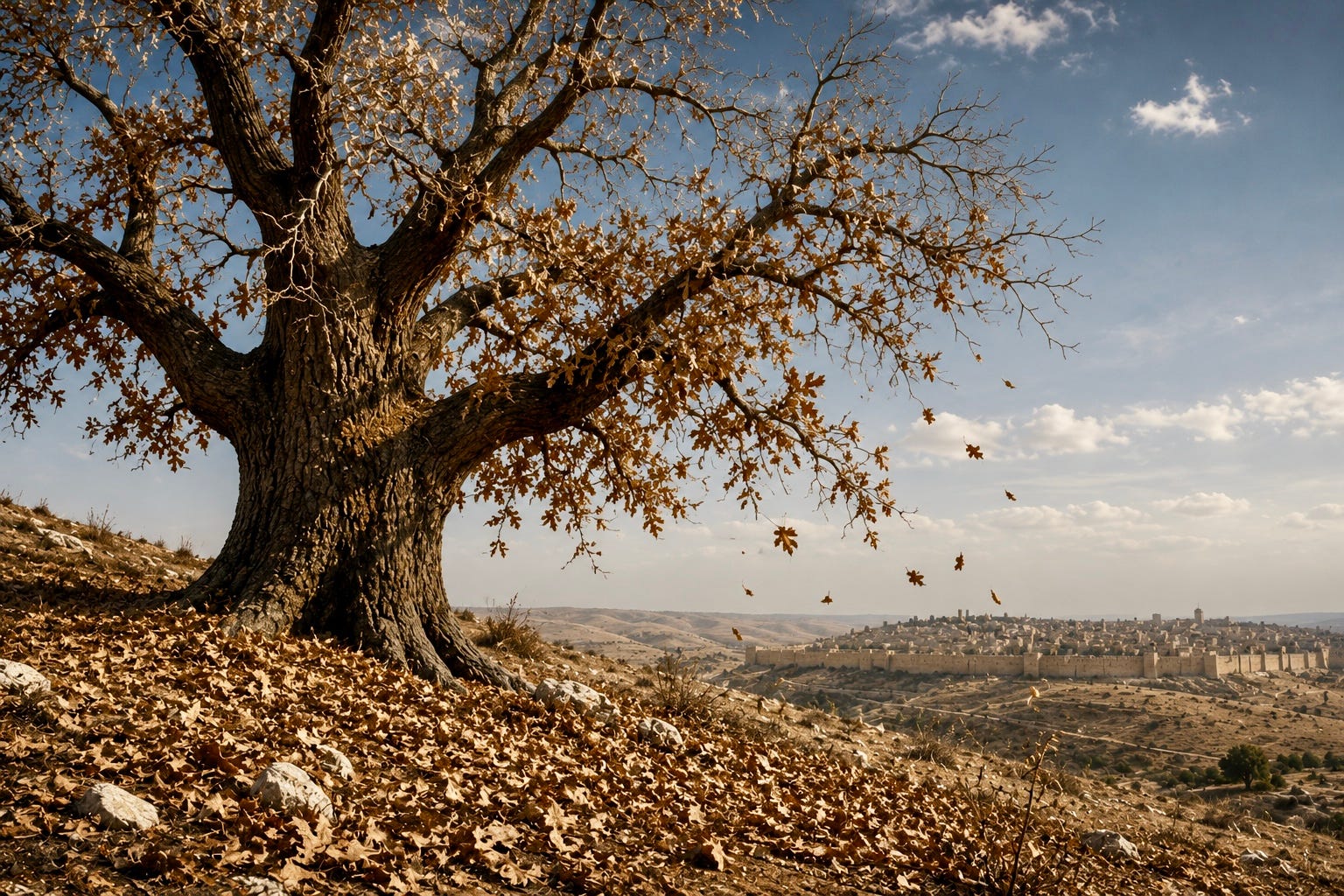
The AI image at the top shows a dry oak tree outside of Jerusalem that represents spiritual dryness. By the way, I love God’s creation, but a modern-day idolatry occurs when creation is worshipped and served above or instead of any consideration given to the Creator or to other human beings.
Precept Austin has a good quote from Alexander MacLaren on what sin does to humans:
Sin withers. We see the picture of a blasted tree in the woods, while all around are in full leaf, with tiny leaves half developed and all brown at the edges. The prophet draws another picture, that of a garden not irrigated, and therefore, in the burning East, given over to barrenness. Sin makes men fruitless and withered. It involves separation from God, the source of all fruitfulness (Ps. 1).
Think of how many pure desires and innocent susceptibilities die out of a sinful soul. Think of how many capacities for good disappear. Think of how dry and seared the heart becomes.
Think of how conscience is stifled. All sin, any sin, does this.
Not only gross, open transgressions, but any piece of godless living will do it.
Whatever a man does against his conscience—neglect of duty, habitual unveracity, idleness—in a word, his besetting sin withers him up.
And all the while the evil thing that is drawing his life-blood is growing like a poisonous, blotched fungus in a wine-cask. (Read full sermon - Isaiah 1:30, 31 What Sin Does to Men)

Precept Austin takes the admonitions in these verses in Isaiah a step further with a section in their commentary that points to a similar passage in Romans 1:
“For the wrath of God is revealed from heaven against all ungodliness and unrighteousness of men who suppress the truth in unrighteousness, because that which is known about God is evident within them; for God made it evident to them. For since the creation of the world His invisible attributes, His eternal power and divine nature, have been clearly seen, being understood through what has been made, so that they are without excuse. For even though they knew God, they did not honor Him as God or give thanks, but they became futile in their speculations, and their foolish heart was darkened. Professing to be wise, they became fools, and exchanged the glory of the incorruptible God for an image in the form of corruptible man and of birds and four-footed animals and crawling creatures.
Therefore God gave them over in the lusts of their hearts to impurity, so that their bodies would be dishonored among them. For they exchanged the truth of God for a lie, and worshiped and served the creature rather than the Creator, who is blessed forever. Amen.
For this reason God gave them over to degrading passions; for their women exchanged the natural function for that which is unnatural, and in the same way also the men abandoned the natural function of the woman and burned in their desire toward one another, men with men committing indecent acts and receiving in their own persons the due penalty of their error.
And just as they did not see fit to acknowledge God any longer, God gave them over to a depraved mind, to do those things which are not proper, being filled with all unrighteousness, wickedness, greed, evil; full of envy, murder, strife, deceit, malice; they are gossips, slanderers, haters of God, insolent, arrogant, boastful, inventors of evil, disobedient to parents, without understanding, untrustworthy, unloving, unmerciful; and although they know the ordinance of God, that those who practice such things are worthy of death, they not only do the same, but also give hearty approval to those who practice them.”
Romans 1:18-32 NASB1995
Charles Spurgeon agreed with Paul in Romans 1, but he had this to say about the passage (as noted in Enduring Word):
“This first chapter of the Epistle to the Romans is a dreadful portion of the Word of God. I should hardly like to read it all through aloud; it is not intended to be so used. Read it at home, and be startled at the awful vices of the Gentile world.” (Spurgeon).
Well, I think Romans 1 SHOULD be read aloud from the pulpit. Too many people are willing to throw out Paul’s epistles or avoid them because Paul refused to endorse their sins but rather he called those sins out in blazing and cringe-worthy honesty, just like Isaiah speaking for the Lord. The people had not improved by the time of Paul, but were doing their best to emulate the worst biblical examples of Sodom and Gomorrah or the pagan idolatry of the people of Judah and Israel. And now, in 2026, several mainstream denominations are embracing the very depravities that Paul warned against. That is not “loving” behavior but a serious risk to the souls of those who still attend those churches. They are exchanging the truth of God for a lie.
At our service this last Sunday at church, the sermon was a continuation of the series on the Biblical characters of Isaac, Jacob, Laban, Esau, Rachel, Rebekah, Leah and their various relations and woes and foibles and enemies. The sermon focused on Genesis 34. The pastor asked that parents might consider removing their children from the sanctuary as this passage talks about Dinah, one of Jacob’s daughters and what happened to her and how she was avenged. It was not a pretty picture. What I appreciate more and more about the Bible is how it contrasts the worst in humanity against the best that can be found looking at a pure, holy and righteous God. The stories and examples are not hidden or whitewashed but there for all to see that sin is indeed real and the enemy has not retreated. “Strong men” who reject the word of God are like the most flammable material you can imagine in a dry, desecrated world full of rebellion.
Well, now we will move on to Isaiah 2. My next devotional examines Isaiah 2:1-4, In the Last Days the Mountain of the House of the Lord is Established.
Heaven on Wheels Daily Prayer:
Dear Lord - Thank you for the insights into the first chapter of Isaiah. I have a long ways to go but the journey is exhilarating! Amen
Citations and Credits:
Scripture quotations taken from the (NASB®) New American Standard Bible®, Copyright © 1960, 1971, 1977, 1995 by The Lockman Foundation. Used by permission. All rights reserved. www.Lockman.org.
Precept Austin was accessed on 07/27/2026 to review commentary for Isaiah 1:28-31.
Bible Hub was accessed on 07/27/2026 to review commentary for Isaiah 1:28-31.
Commentary from Enduring Word is used with written permission and without any alteration. ©1996-present The Enduring Word Bible Commentary by David Guzik – enduringword.com. At the link referenced, the bibliography used by David Guzik can be accessed.