


“When a man lays hold of his brother in his father’s house, saying,
“You have a cloak, you shall be our ruler,
And these ruins will be under your charge,”
He will protest on that day, saying,
“I will not be your healer,
For in my house there is neither bread nor cloak;
You should not appoint me ruler of the people.”
For Jerusalem has stumbled and Judah has fallen,
Because their speech and their actions are against the Lord,
To rebel against His glorious presence.
The expression of their faces bears witness against them,
And they display their sin like Sodom;
They do not even conceal it.
Woe to them!
For they have brought evil on themselves.”
Isaiah 3:6-9 NASB1995
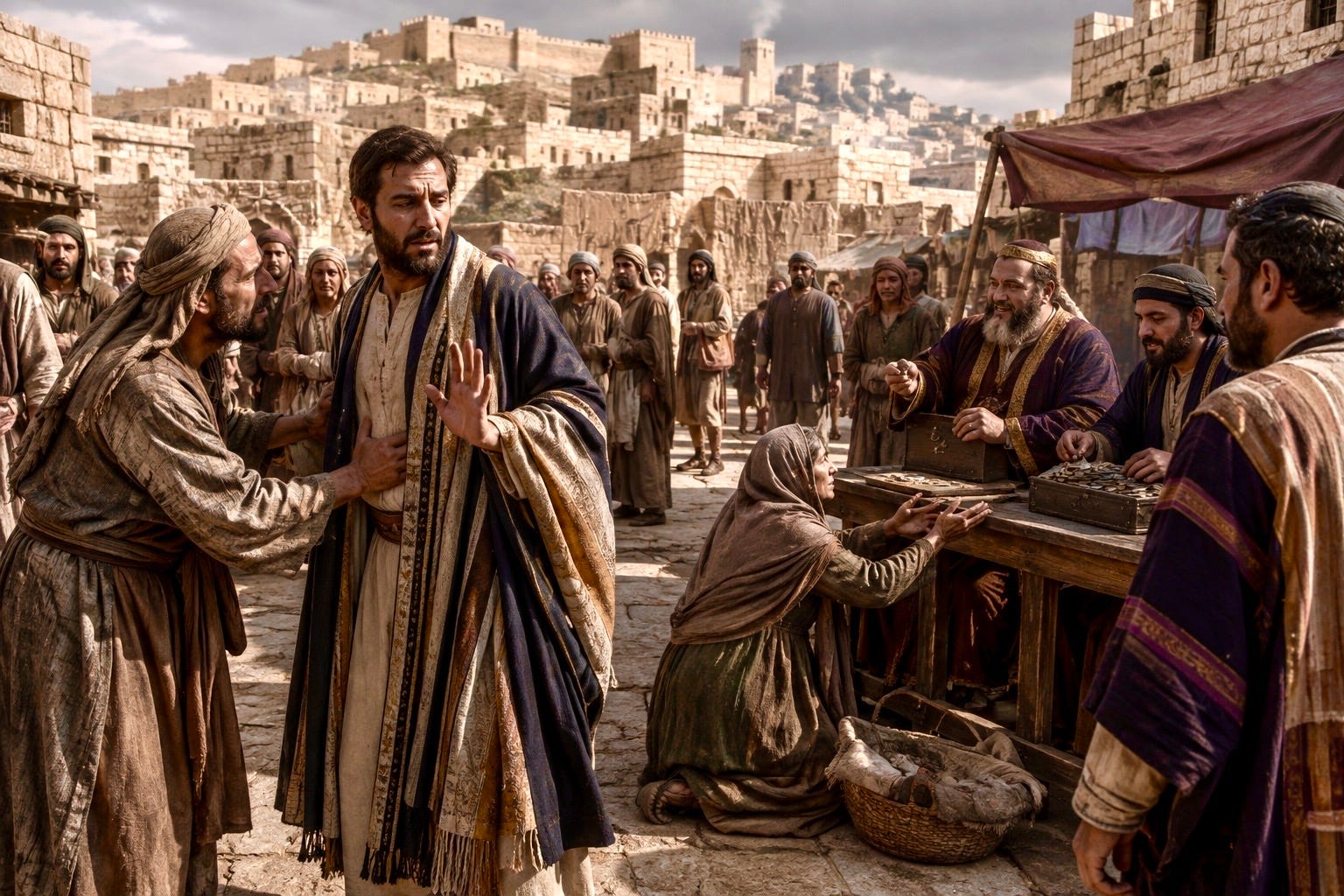
Society in Judah and Jerusalem has reached the point of near-anarchy, where anyone who actually has a decent cloak is grabbed to be a possible leader. Here is the description of the image at the top from ChatGPT:
The foreground shows the desperate appeal to the reluctant brother wearing the cloak. Around them, the public square is filled with people carrying on with open corruption and selfishness, completely unconcerned about their behavior.
The viewer immediately sees both halves of Isaiah’s message: society has become so broken that anyone with a cloak is considered leadership material;
the deeper reason is that the people’s hearts have become hardened and shameless before God.
The ruined buildings remain secondary, hinting at the “heap of ruins” without dominating the scene.
Precept Austin quotes John Constable from his Bible commentary on Isaiah:
Things would become so bad that the possession of a mere coat (an outer garment) would lead others to thrust its owner into leadership despite his protestations. Any type of superiority will seem like an indication that the possessor can provide desperately needed authority and power. Yet the chosen leader will refuse to take responsibility, even lying about his resources, because what he would rule is only a ruin and because he knows he lacks the qualifications to lead…
Note the stages in Israel’s degradation that Is 3:1-7 trace. Good leaders disappear (Is 3:1, 2, 3), and immature, capricious leaders (Is 3:4) who begin to oppress the populace (Is 3:5) take their place. Society becomes divided as age gaps open up and respect for the respectable breaks down (Is 3:5). Unqualified people get pressed into leadership, and a spirit of despair dominates elections (Is 3:6,7).
At least the man with the cloak has enough integrity to realize that he is not qualified to lead the country. There are many who assume the mantle of leadership who are eminently unqualified but the circumstances lead to their ascension.
Here is what Enduring Word has to say about parts of this passage:
a. Their tongues and their doings are against the LORD: Jerusalem and Judah have sinned in what they say and in what they do. In fact, what they say and what they do provoke the eyes of His glory.
i. It is much easier to think that what we do is offensive to God than to think that what we say can provoke the eyes of His glory. But we are commanded to glorify God by what we say just as much as by what we do. Jesus said, for every idle word men may speak, they will give account of it in the day of judgment. For by your words you will be justified, and by your words you will be condemned. (Matthew 12:36-37)
b. The look on their countenance witnesses against them: The very look on their faces is evidence of their guilt. Either they have the smirk of the reprobate or the downcast gaze of those under conviction.
i. “Impure propensities are particularly legible in the eyes: whoever has beheld the face of a debauchee or a prostitute knows this; of these it may be said, they wish to appear what they really are. They glory in their iniquity. This is the highest pitch of ungodliness.” (Clarke)
c. And they declare their sin as Sodom; they do not hide it: Their sin is openly displayed, and they have no sense of shame. The cultural dynamic in Isaiah’s day was probably much the same as in our time. In the name of “frankness” and “honesty” and “let’s not be hypocrites,” all kinds of sin are approved, and no one is “allowed” to proclaim a standard unless they live up to it perfectly.
i. Outward decency is important. It is important not to talk about many sins, even though they exist, and sometimes touch the church. It is through these means that God’s people declare a standard, even though they or the world do not perfectly measure up to a standard. Ephesians 5:12 matters here: For it is shameful even to speak of those things which are done by them in secret.
ii. One of the most destructive lies of our time is that it is wrong or hypocritical to have a standard that we don’t live up to. No one has always told the truth, yet it is right and good to teach our children, “Don’t lie.” It would be wrong, and destructive, for someone to answer, “You can’t tell your child not to lie. You have lied in the past. You are a hypocrite.” This attitude in our society translates into a certain result: a wholesale lowering of standards. Also, the charge of hypocrisy is false. It is not hypocritical to promote a standard you don’t perfectly meet. Hypocrisy is when you pretend to keep the standard but do not or when you do not keep the standard but think that others should.
iii. “The maintenance of external decency is at least some evidence of a conscience not altogether seared.” (Jennings)
d. Woe to their soul! For they have brought evil upon themselves: God did not have to do anything unique or special to bring this judgment on Jerusalem and Judah. All He had to do was leave them alone and allow them to have brought evil upon themselves.
i. When the LORD gives a nation the leadership they desire and deserve, it can be either a blessing or a curse. In Judah’s case in the time of Isaiah, it was a curse.
There are some key takeaways in this commentary:
What we do and what we say are both ways to provoke the “eyes of His glory”.
People wear their sin on their faces. They either have a countenance that is full of smirks and winks to show their joy in their debased minds or they have a downcast gaze that indicates a guilty conscience. That latter gaze is becoming very rare.
As in Biblical times since the days of Sodom and Gomorrah, our current culture celebrates sin and does not attempt to hide it. Those who are hesitant to praise sin or even condemn it are called hypocrites by society because they are not perfect. Have you ever noticed that the most debauched individuals are the quickest to mock the alleged downfall of someone who was previously a moral Christian leader? This mockery and hatred of God’s precepts results in a whole scale lowering of standards across the board. A century ago, people would have been aghast to see same-sex marriage and casual sex and drug usage and millions of elective abortions of the unborn. Now you are a “hypocrite” if you question these “norms” if your own life is not perfectly pure. Hold to the standard that He wants as much as possible!
When a society drenched in evil gets the leadership it deserves, it is a curse to them.
This was pretty short, but I think it addresses the gist of this passage. My next devotional examines Isaiah 3:10-12 - For the righteous, it will go well for them.
Heaven on Wheels Daily Prayer;
Dear Lord - Please help me to lean into Your precepts and standards and forgive me when I stumble. Amen.
Citations and Credits:
Scripture quotations taken from the (NASB®) New American Standard Bible®, Copyright © 1960, 1971, 1977, 1995 by The Lockman Foundation. Used by permission. All rights reserved. www.Lockman.org.
Precept Austin was accessed on 08/09/2026 to review commentary for Isaiah 3:6-9.
Commentary from Enduring Word is used with written permission and without any alteration. ©1996-present The Enduring Word Bible Commentary by David Guzik – enduringword.com. At the link referenced, the bibliography used by David Guzik can be accessed.