


“Let me sing now for my well-beloved
A song of my beloved concerning His vineyard.
My well-beloved had a vineyard on a fertile hill.
He dug it all around, removed its stones,
And planted it with the choicest vine.
And He built a tower in the middle of it
And also hewed out a wine vat in it;
Then He expected it to produce good grapes,
But it produced only worthless ones.”
Isaiah 5:1-2 NASB1995
Isaiah 5 begins with what is known as the parable or song of the vineyard. Many commentators praise this parable for its amazing use of language and poetry to set the tone. Here is what the late Geoffrey W. Grogan (Glasgow Bible College) says about this parable as quoted in Enduring Word:
“For exquisite beauty of language and consummate skill in effective communication, this parable is virtually peerless. One difficulty of a literary masterpiece is that a would-be translator who is not the literary equal of the author faces an impossible task…. It is in fact an outstanding example of the way the inspiring Spirit employed human language to convey the divine message.” (G.W. Grogan)
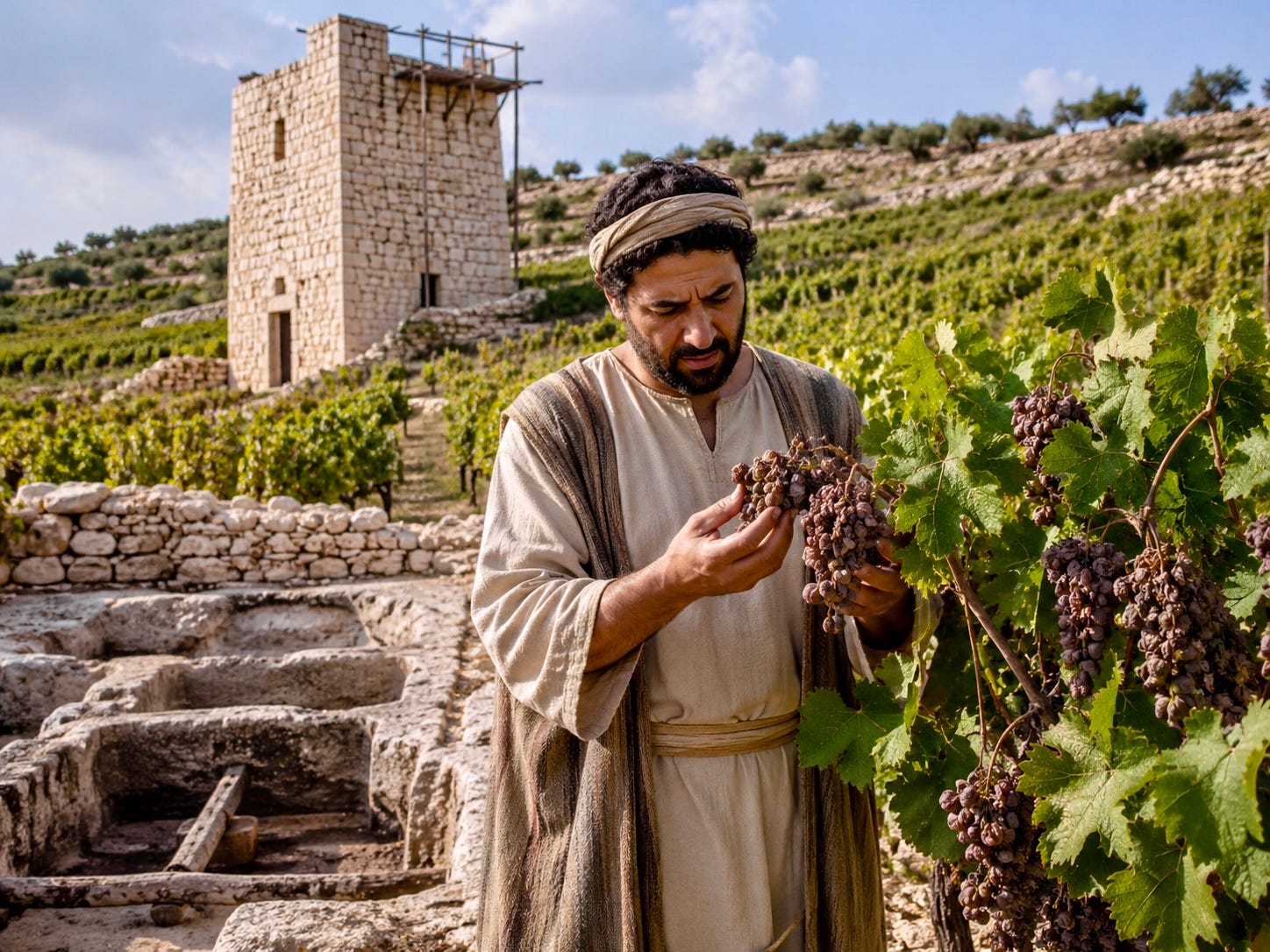
The AI image at the top shows a man who has gone to great efforts to build and maintain a beautiful vineyard, only to find that the grapes are worthless. Some translations describe the grapes as wild or bad or sour. The point is that all of the work done by the “well-beloved” to create a productive vineyard is in vain. Here is the Charles Spurgeon exposition on these two verses, as found through Precept Austin leading to this source:
The Song of the Vineyard is by no means a joyful song. It is, indeed, quite the reverse. It is pitched in the minor key and has a painful theme. This suffices to prove that all our hymns need not consist, as some affirm, of direct praise to God. Such a notion is not according to Scripture, for many of the Psalms are not of that character.
There are songs that can be sung to the edification of one another, and that is, in part, the design of sacred song. We speak to ourselves, as well as to God, in psalms and hymns and spiritual songs. “My well beloved hath a vineyard in a very fruitful hill.” The members of the church of God are placed in a position where they have very choice opportunities of glorifying God, they are like a vineyard in a very fruitful hill, most favorably placed for fruitfulness.
…
The vineyard was well chosen as to situation, the vine was carefully selected. Everything was done, by walling it, to protect it from intruders. Every preparation wag made for the gathering in of the fruits.
The winepress was there, yet when the time came for grapes sweet and luscious, it brought forth wild grapes. You know what that means. Has it been so with us? Have we rewarded the Well-beloved thus ungratefully for all His pains? Have we given Him hardness of heart, instead of repentance; unbelief, instead of faith; indifference, instead of love; idleness, instead of holy industry; impurity, instead of holiness?
Is that my case? Is it your case, dear friends? Has even our religion been a false thing? Has it been like wild grapes or poisonous berries? Have we been at times right only by accident, and have we never carefully and sedulously sought to serve our Lord, or to bring forth fruit to His praise? O Lord, thou knowest! Let us judge ourselves in this matter that we be not judged.
According to Spurgeon in a sermon on Isaiah 5 verse 1, the “well-beloved” is obviously Jesus. The people of Judah and Jerusalem as well as we sinners and believers, are His vineyard and we do not produce good fruit. Are we ungrateful? Do have hardness of heart, doubt and unbelief, indifference, idleness and impurity? Is our religion a false thing, as bad as poison? We will hear more in Isaiah 5 about the woes of those who produce only bad grapes.

Jesus had two parables about vineyards in Matthew 21 that echo Isaiah:
““But what do you think? A man had two sons, and he came to the first and said, ‘Son, go work today in the vineyard.’ And he answered, ‘I will not’; but afterward he regretted it and went. The man came to the second and said the same thing; and he answered, ‘I will, sir’; but he did not go. Which of the two did the will of his father?” They *said, “The first.” Jesus *said to them, “Truly I say to you that the tax collectors and prostitutes will get into the kingdom of God before you. For John came to you in the way of righteousness and you did not believe him; but the tax collectors and prostitutes did believe him; and you, seeing this, did not even feel remorse afterward so as to believe him.
“Listen to another parable. There was a landowner who planted a vineyard and put a wall around it and dug a wine press in it, and built a tower, and rented it out to vine-growers and went on a journey. When the harvest time approached, he sent his slaves to the vine-growers to receive his produce. The vine-growers took his slaves and beat one, and killed another, and stoned a third. Again he sent another group of slaves larger than the first; and they did the same thing to them. But afterward he sent his son to them, saying, ‘They will respect my son.’ But when the vine-growers saw the son, they said among themselves, ‘This is the heir; come, let us kill him and seize his inheritance.’ They took him, and threw him out of the vineyard and killed him. Therefore when the owner of the vineyard comes, what will he do to those vine-growers?” They *said to Him, “He will bring those wretches to a wretched end, and will rent out the vineyard to other vine-growers who will pay him the proceeds at the proper seasons.””
Matthew 21:28-41 NASB1995
The first parable shows how remorse leads to doing the will of the Father, even if you say “no” initially. If you pretend to do His will and then do not follow through and actually do it, then you are a false believer. Pharisees and seers were not even remorseful and certainly were not going to do His will. The second parable notes that the vine-growers who are allegedly working for the landowner (God) destroy those that the Lord has sent (His slaves, the prophets) to receive His produce and will even kill His Son. Jesus continues, to make things perfectly clear to His accusers:
“Jesus *said to them, “Did you never read in the Scriptures,
‘The stone which the builders rejected,
This became the chief corner stone;
This came about from the Lord,
And it is marvelous in our eyes’?
Therefore I say to you, the kingdom of God will be taken away from you and given to a people, producing the fruit of it. And he who falls on this stone will be broken to pieces; but on whomever it falls, it will scatter him like dust.”
When the chief priests and the Pharisees heard His parables, they understood that He was speaking about them. When they sought to seize Him, they feared the people, because they considered Him to be a prophet.”
Matthew 21:42-46 NASB1995
Precept Austin quotes Raymond C. Ortlund (author of Isaiah: God Saves Sinners (Preaching the Word), who has an interesting perspective on this passage and another one in 2 Corinthians:
In 2Corinthians 6:1 the Apostle Paul says a strange thing: “We appeal to you not to receive the grace of God in vain.” How can grace be received in vain? Isn’t grace God’s all-forgiving kindness to us? Doesn’t God’s grace compensate even for our half-hearted responses to God? Why then does Paul urge us not to receive the grace of God in vain? Because God’s grace not only accepts us, it also transforms us.
But if all we want out of God is acceptance without transformation, we are receiving his grace in vain and our Christianity is worthless. The power of grace is not automatic.
Each of us lives out of an inner world with its own moral and conceptual and emotional topography. The obstacles to God there are formidable. Our intuitive ways of thinking, the tilt of our very desires—these powerful internal structures can hinder the advance of God. (Isaiah - God Saves Sinners Preaching the Word) (Bolding added for emphasis by Precept Austin).
I could not say it better than the words of Ortlund. If we receive His grace in vain, if we are not transformed, our Christianity is worthless.
My next devotional examines Isaiah 5:3-6 - What the Lord will do with the vineyard.
Heaven on Wheels Daily Prayer:
Dear Lord - I pray that I am not a producer of useless or sour grapes, but that I am being transformed by Your Grace to overcome those obstacles to Your will. Amen.
Citations and Credits:
Scripture quotations taken from the (NASB®) New American Standard Bible®, Copyright © 1960, 1971, 1977, 1995 by The Lockman Foundation. Used by permission. All rights reserved. www.Lockman.org.
Precept Austin was accessed on 08/22/2026 to review commentary for Isaiah 5:1-2.
Commentary from Enduring Word is used with written permission and without any alteration. ©1996-present The Enduring Word Bible Commentary by David Guzik – enduringword.com. At the link referenced, the bibliography used by David Guzik can be accessed.
I am grateful and thankful for the heaven on wheels word and prayer, amen.