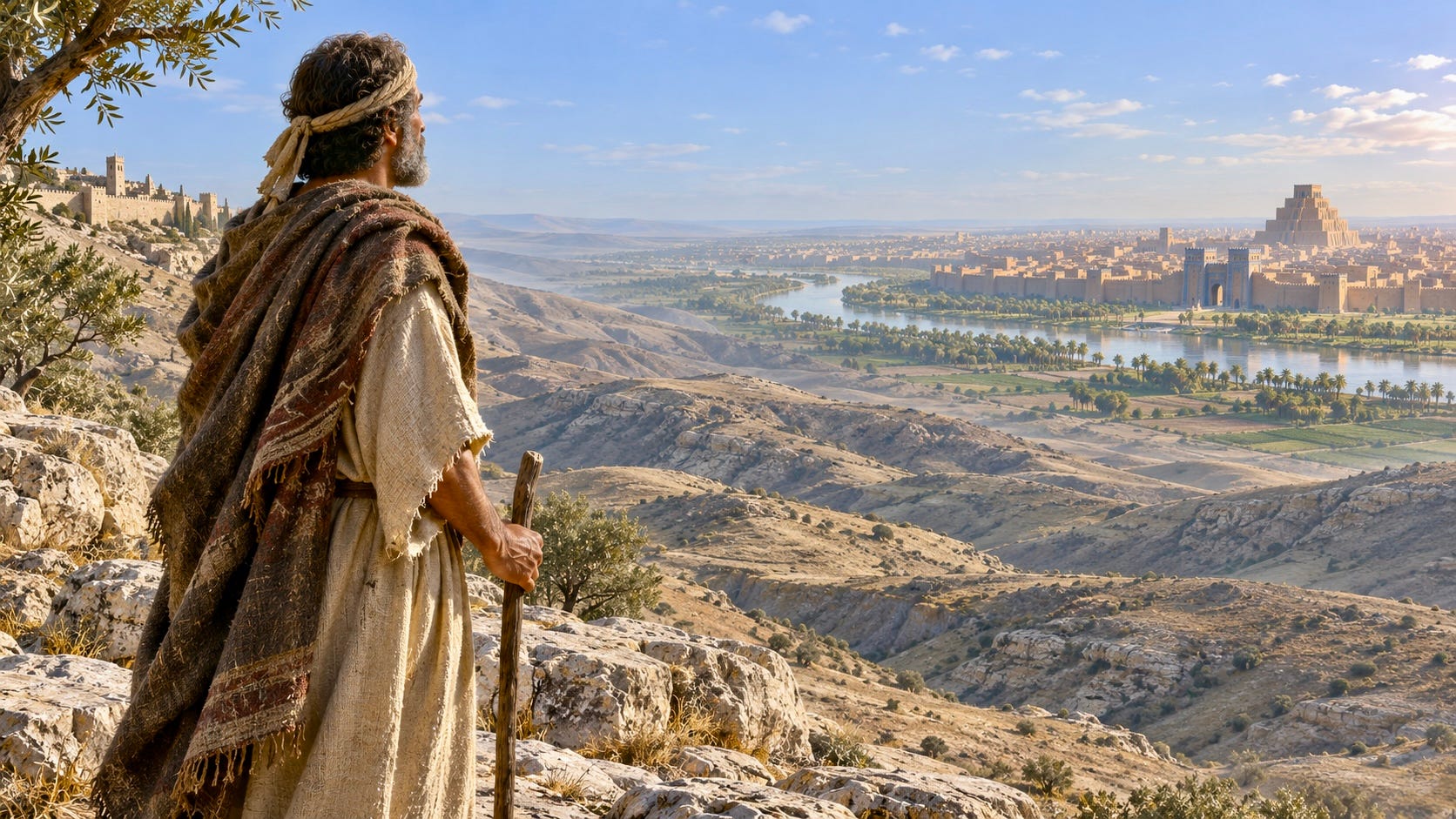
Image generated by ChatGPT (OpenAI) using the DALL·E model. Isaiah stands on a limestone ridge outside Jerusalem in the clear morning light. Beyond the familiar Judean hills, the landscape gives way to a broad river and the immense mudbrick walls of Babylon. The transition is subtle, as though Isaiah can see farther than the land itself allows.
“The oracle concerning Babylon which Isaiah the son of Amoz saw.”
Isaiah 13:1 NASB1995
The book of Isaiah now transitions into a section with God’s prophecies and warnings concerning 10 Gentile nations that surrounded Israel and Judah; there are more judgments for Judah and Jerusalem also recorded in these 15 chapters. As many scholars have noted (from my research) these warnings were likely never heard by the recipient nation but were intended for the people of Judah as a way to understand God’s care and concern for them and to give them comfort.
The first “oracle” (or burden) concerns Babylon, which Isaiah the son of Amoz saw. Let’s do a word study on oracle (H4853) from the Blue Letter Bible lexicon:
First, Strong’s definition: מַשָּׂאmassâʼ, mas-saw'; from H5375; a burden; specifically, tribute, or (abstractly) porterage; figuratively, an utterance, chiefly a doom, especially singing; mental, desire:—burden, carry away, prophecy, × they set, song, tribute.
Biblical usages (masculine noun):
load, bearing, tribute, burden, lifting
load, burden
lifting, uplifting, that to which the soul lifts itself up
bearing, carrying
tribute, that which is carried or brought or borne
utterance, oracle, burden
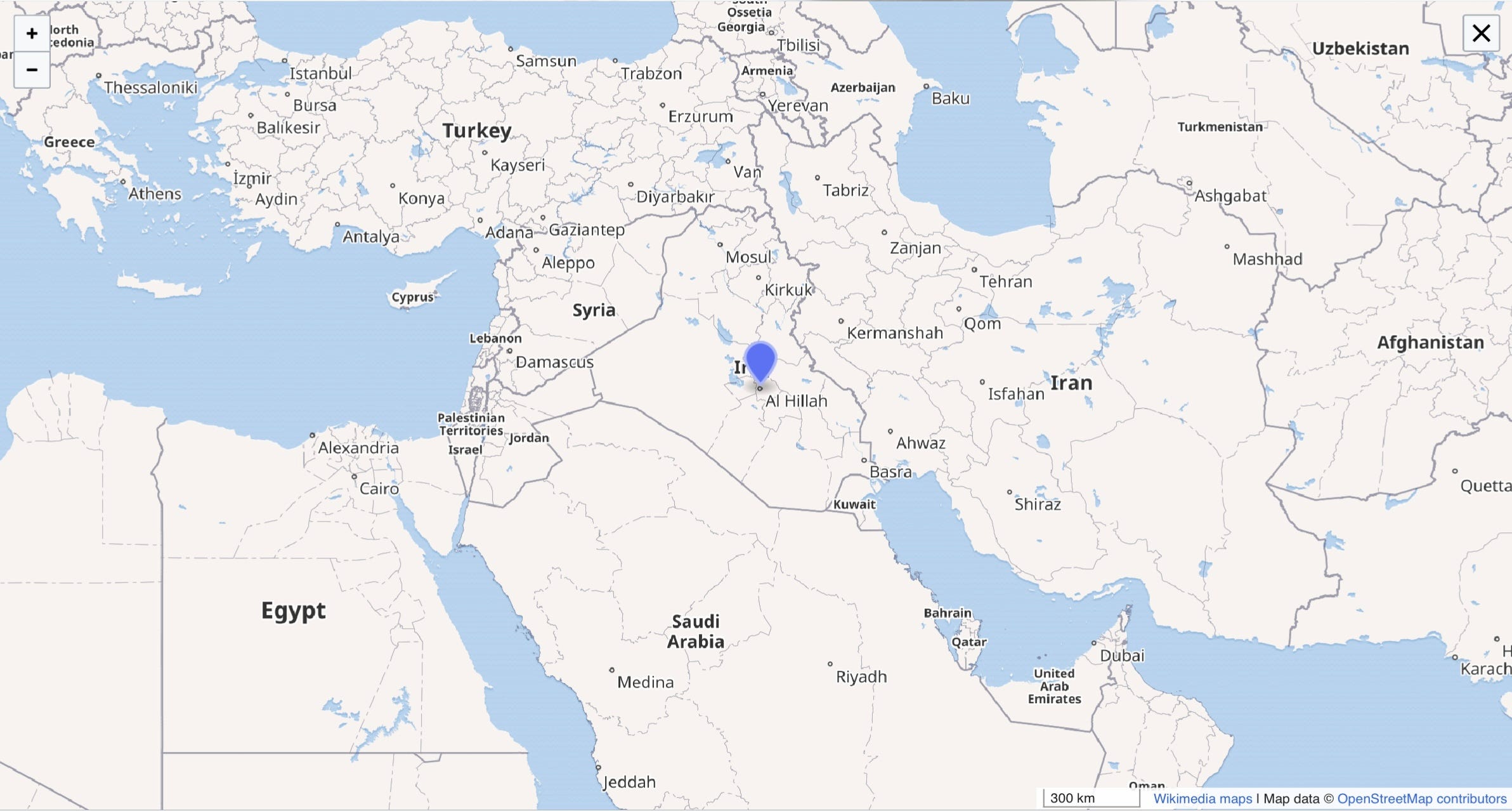
Here’s a map showing the present-day location of the ruins of Babylon in Iraq:
Babylon is mentioned more than any other city in the Bible except for Jerusalem. Here are some commentaries about Babylon from Precept Austin, including an admonition to those who would say that the “Babylon” mentioned in the NT is really supposed to be Rome:
Babylon (0894) (babel) means confusion. ." Babylon is the Greek spelling of the name which in Hebrew is uniformly Babel. The word occurs some 286 times and refers to an ancient city on the eastern bank of the Euphrates about twenty miles south of Bagdad, near the modern village of Hillah in Iraq. Genesis 11:9 gives the name as Babel (perhaps from balal "to confuse") but probably intended as a parody, a word play referring to what happened when the languages were confused. Even our derivative English word "babble" is an example of onomatopoeia, a word which imitates an actual sound, and thus is essentially the same in all languages.
…
Comment: Babylon clearly serves as a prototype or picture of man's rebellion against God and immediately precedes Genesis 12's introduction of God's plan to redeem fallen mankind through a man named Abraham who would be the father of the nation of Israel and ultimately of the Messiah (Gal 3:16). It is therefore not surprising that we see this conflict that begins in Genesis 11 (man's way of "salvation") and Genesis 12 (God's way of salvation) continuing to its final and dramatic culmination in the last book of the Bible, specifically in Revelation 17 and 18.
…
Babylon was indeed one of the greatest of ancient cities - The splendor of ancient Babylon was spectacular, covering over 1000 acres surrounded by a double-walled system of defense that encircled the city. These walls were over 85 feet thick and 11 miles long, with the outer walls being approximately 25 feet wide and reinforced with towers every 65 feet (cp Jeremiah 51:12, 58). There were eight major city gates named after various Babylonian deities (e.g., the famous Ishtar Gate).
The city was dominated by a seven-story ziggurat, 288 feet high, known as the Tower of Babylon. It was constructed from nearly 60 million fired bricks. On the top of it stood the temple of Marduk (Jer 50:2). The Greek historian Herodotus claimed that it contained a solid gold statue of Marduk weighing 52,000 pounds!
Whereas King Nebuchadnezzar envisioned the proud city that usurped Jerusalem’s headship as a head of gold (Da 2:32, Da 2:37), Daniel saw its true bestial character as a lion (Dan 7:4). Daniel based his prayer for Israel’s release on Jeremiah’s prediction that the captivity would last seventy years (Jer 25:11-12; Jer 29:10; Dan 9:2ff). But whereas Jeremiah predicted the length of the captivity, Isaiah foresaw the way of Israel’s exodus from Babylon through the conquest of Cyrus (Isa 41:1, 2, 3, 4; Isa 43:14; Isa 44:28, 45:1, 2, 3, 4, 5, 6, Isa 46:11 [”bird” = King Cyrus]).
…
Those who say that Babylon of the ancient world was utterly destroyed are choosing to ignore the truth that Babylon was still a literal city in the first century AD. Peter mentions Babylon in his first letter (see below). While some have said this was "code language" and that he really meant "Rome". A normally literal interpreter Dr Charles Ryrie chooses to jettison literal in 1Pe 5:13 and writes "She who is in Babylon" is the "church in Rome." He is guilty of doubly allegorizing the pronoun "she" and the location "Babylon!" Amazing! The ESV Study Bible actually goes so far as to say this description refers to the "church of Rome"!. This is simply not good hermeneutic technique! There is nothing in Peter's letter to suggest this is not the literal city of Babylon and thus there is no Scriptural support for interpreting this name symbolically. And note that Peter has already described the literal geographic areas of "Pontus, Galatia, Cappadocia, Asia, and Bithynia." (1Pe 1:1). Why would he suddenly switch to symbolic language in chapter 5? There is nothing in the context of chapter 5 which remotely supports that Babylon should be interpreted allegorically! If Peter had meant "Rome," he could have easily written the name "Rome." Paul was not afraid to use the name "Rome" (Ro 1:7, Ro 1:15, 2Ti 1:17)! (See related topics: The Art and Science of Interpretation, The Rise of Allegorical Interpretation and Understanding Symbols and Figures)
I think one more commentary is worth examining to set up the scene for this prophecy about Babylon in Isaiah 13 that continues in Isaiah 14, from Enduring Word:
a. Burden: In the prophets, a burden is a “heavy” message of weighty importance, heavy in the sense that it produces sorrow or grief.
i. “Massa comes from the verb ‘to lift up’ (nasa), and so it can mean ‘to carry’ or ‘to lift up the voice.’ From the first meaning comes the translation ‘burden,’ or ‘load’; and from the second meaning we get the translation ‘oracle,’ or ‘utterance.’” (Wolf)
ii. Grammatically, we may be able to translate the idea as “an oracle.” But since these are heavy oracles, we are justified in calling them burdens.
b. Against Babylon: Isaiah finished his prophetic career in 685 B.C., almost 100 years before Judah finally fell before the Babylonian Empire (586 B.C.). At the time of this prophecy, Babylon was a significant nation, but they were definitely behind the Assyrian Empire in status. Yet the LORD who knows the end of all things can speak of the judgment on the pride of Babylon hundreds of years before the judgment comes.
i. This burden against Babylon will last until the end of Isaiah 14. Adam Clarke says of this passage, “The former part of this prophecy is one of the most beautiful examples that can be given of elegance of composition, variety of imagery, and sublimity of sentiment and diction, in the prophetic style; and the latter part consists of an ode of supreme and singular excellence.”
ii. Why did God speak to Babylon? This prophecy was probably never published in Babylon, so it wasn’t really given as a warning to them. Instead, the reason was for the help of the people of God. First, by showing them that God was indeed just, and would judge the wicked nations around them. Israel and Judah were feeling the sting of God’s discipline, and in such times we wonder if God is unfairly singling us out. This is assurance to them that He isn’t. Second, Babylon (and other nations in this section) were nations that had come against Israel and Judah, and God showed His love to His people by announcing His vengeance against their enemies.
So now the tone is set and my next devotional will dive into the first part of the prophecy in Isaiah 13 (Isaiah 13:2-5) - The Lord of Hosts is mustering the army.
Heaven on Wheels Daily Prayer:
Dear Lord - I learn something new every day and now I can place in context Babylon in the time of Isaiah in addition to the lessons learned from studying Daniel. Thank you! Amen.