


“The word which Isaiah the son of Amoz saw concerning Judah and Jerusalem.
Now it will come about that
In the last days
The mountain of the house of the Lord
Will be established as the chief of the mountains,
And will be raised above the hills;
And all the nations will stream to it.
And many peoples will come and say,
“Come, let us go up to the mountain of the Lord,
To the house of the God of Jacob;
That He may teach us concerning His ways
And that we may walk in His paths.”
For the law will go forth from Zion
And the word of the Lord from Jerusalem.
And He will judge between the nations,
And will render decisions for many peoples;
And they will hammer their swords into plowshares and their spears into pruning hooks.
Nation will not lift up sword against nation,
And never again will they learn war.”
Isaiah 2:1-4 NASB1995
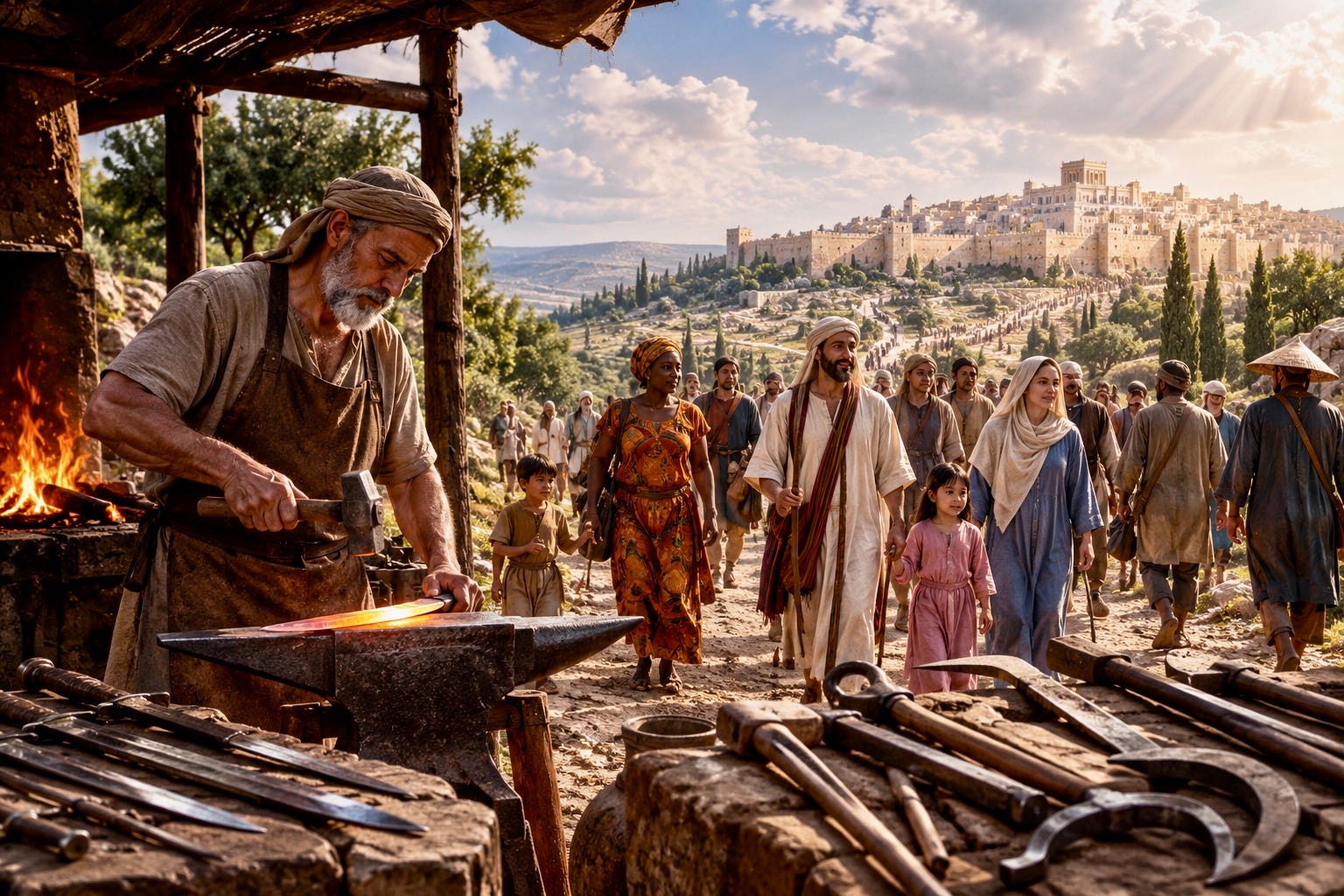
Chapter 2 of Isaiah begins with this beautiful prophecy, which is given to Isaiah concerning Judah and Jerusalem. The AI image shows people from many nations coming and going to the mountain of the Lord in Jerusalem; the blacksmith at the left is hammering swords into plowshares and pruning hooks because there will be no more war.
There is a nearly identical prophecy in Micah (the prophet Micah was a contemporary of Isaiah):
“And it will come about in the last days
That the mountain of the house of the Lord
Will be established as the chief of the mountains.
It will be raised above the hills,
And the peoples will stream to it.
Many nations will come and say,
“Come and let us go up to the mountain of the Lord
And to the house of the God of Jacob,
That He may teach us about His ways
And that we may walk in His paths.”
For from Zion will go forth the law,
Even the word of the Lord from Jerusalem.
And He will judge between many peoples
And render decisions for mighty, distant nations.
Then they will hammer their swords into plowshares
And their spears into pruning hooks;
Nation will not lift up sword against nation,
And never again will they train for war.”
Micah 4:1-3 NASB1995
So, what does this prophecy mean? From what I can glean reading through commentary, the most literal interpretation is that this is the time of the millennium rule of Christ on Earth after the second coming. One of the reasons I like the aggregated commentary on Precept Austin is that the author of that site, Bruce Hurt, tries to stick with more literal translations. He is not a dispensationalist, but he is certainly not a proponent of replacement theology (the idea that the church replaces the people of Israel). Here is a statement by him on the commentary that he cites for Isaiah 2:1-4:
My approach to Isaiah may be too simple and too literal, but it is the only way that I can logically interpret Isaiah's prophecies that he himself definitely states are given specifically to Judah and Jerusalem (Is 1:1-note, Isa 2:1). He does not state they are given to the New Testament Church. I should also state that I am not a dispensationalist, but a "simplistic literalist". So if the plain sense of Isaiah's words make good sense, I will not attempt to make some other sense out of his prophecies (eg, by allegorizing or spiritualizing) for fear that I may end up with comments that are essentially nonsense. I will make every attempt to avoid speculation, although there will be some speculative remarks because of the obscure nature of some of Isaiah's statements (I will try to identify any speculative remarks). Finally, non-literal works like those of [Ed] Young and [Raymond] Ortlund often have excellent application to the NT Church and it would be a serious mistake to discount their contributions to the body of Christ. For this reason, as stated earlier I will occasionally quote from these as well as other non-literal works. I realize that many of the writers I quote are dispensational (John Walvoord, H A Ironside, Dwight Pentecost, S Lewis Johnson, Thomas Constable, et al), and the primary reason that they are utilized is because they tend to interpret the Scriptures more literally.
Here is the commentary from Enduring Word on the passage in Isaiah (Precept Austin definitely likes the commentary of David Guzik):
a. In the latter days: In context, the term latter days refers to the “time of the Messiah,” when the Anointed of the LORD reigns over the earth. Broadly, this speaks of the time many refer to as the millennium, the thousand-year reign of Jesus on this earth (Psalm 72, Isaiah 11:4-9, Jeremiah 23:5-6, Luke 1:32-33 and 19:12-27, Matthew 5:18).
b. The mountain of the LORD’s house shall be established on the top of the mountains, and shall be exalted above the hills; and all nations shall flow to it: During the millennium, Israel will be the “superpower” of the world. It will be the leading nation in all the earth, and the center of Israel will be the mountain of the LORD’s house – the temple mount, which will be the “capital” of the government of the Messiah. All nations shall flow to the “capital” of the government of Jesus.
c. Come, let us go to the mountain of the LORD…He will teach us His ways, and we shall walk in His paths: During the millennium, the citizens of earth will acknowledge and submit to the Lordship of Jesus. It will be a time of perfectly administrated enforced righteousness on this earth.
…
a. They shall beat their swords into plowshares, and their spears into pruning hooks: During the reign of the Messiah, there will be no more war. There will still be conflicts between nations and individuals, but they will be justly and decisively resolved by the Messiah and those who reign with Him (He shall judge between the nations, and shall rebuke many people).
i. It isn’t the reign of the Messiah itself that will change the heart of man. Citizens of the earth will still need to trust in Jesus, and His work on their behalf, for their personal salvation during the millennium. But war and armed conflict will not be tolerated.
b. Nation shall not lift up sword against nation, neither shall they learn war anymore: It is important to see that this is not the peace of surrender. This is the peace of enforced righteousness. There would be no more war, and no more need for swords and spears, so it made sense to make them into plowshares and pruning hooks. But there will be no more war because there will be a new ruler on earth, Jesus Christ. Psalm 2:9 tells us what the Messiah will do to the disobedient in that day: You shall break them with a rod of iron; You shall dash them to pieces like a potter’s vessel.
i. We long for the day when there is no more need for a military budget, when the money that goes for weapons and armies can go to schools and parks. But we are only safe doing that when the Messiah reigns among us.
ii. “Men yearn for peace, but they will not acknowledge the hopelessness of their own efforts to achieve it. It is only when the word of the Lord goes forth from Jerusalem, when He Himself is reigning over the nations, that lasting peace will come.” (Martin)
It is intriguing that it appears that the cessation of war is because this is an enforced righteousness, not because people surrender. The Messiah will rule the nations with a rod of iron. Humans by themselves are incapable of living in peace, as we know all too well from history.

The prophet Zechariah has more to say about the city of the Lord:
“Then the word of the Lord of hosts came, saying, “Thus says the Lord of hosts, ‘I am exceedingly jealous for Zion, yes, with great wrath I am jealous for her.’ Thus says the Lord, ‘I will return to Zion and will dwell in the midst of Jerusalem. Then Jerusalem will be called the City of Truth, and the mountain of the Lord of hosts will be called the Holy Mountain.’ Thus says the Lord of hosts, ‘Old men and old women will again sit in the streets of Jerusalem, each man with his staff in his hand because of age. And the streets of the city will be filled with boys and girls playing in its streets.’ Thus says the Lord of hosts, ‘If it is too difficult in the sight of the remnant of this people in those days, will it also be too difficult in My sight?’ declares the Lord of hosts. Thus says the Lord of hosts, ‘Behold, I am going to save My people from the land of the east and from the land of the west; and I will bring them back and they will live in the midst of Jerusalem; and they shall be My people, and I will be their God in truth and righteousness.’”
Zechariah 8:1-8 NASB1995
The people will be safe in the streets, both the old and the young, with the Lord as their God in truth and righteousness. They will be brought to the land from the lands to the east and west to live in the midst of Jerusalem, as He will save His people.
This commentary about the Isaiah passage from John Walvoord is quite interesting, as quoted on Precept Austin; this has many Biblical references that you may find useful:
Jesus Christ (is) the supreme King of the millennial kingdom. In Psalm 2:6, in spite of the opposition of the kings of the earth, God declares His purpose: “Yet I have set my king upon my holy hill of Zion.” This purpose will be fulfilled in the millennial kingdom in the reign of Jesus Christ as the Son of David. As Lewis Sperry Chafer has succinctly stated: Every Old Testament prophecy on the kingdom anticipates His kingly office:
(a) Christ will yet sit on the throne as David’s heir (2Sa 7:16; Ps 89:20–37; Is 11:1-16; Je 33:19, 20, 21).
(b) He came as a King (Luke 1:32, 33).
(c) He was rejected as a King (Mk 15:12, 13; Lk 19:14; cf. Ge 37:8; Ex 2:14).
(d) He died as a King (Matt 27:37).
(e) When He comes again, it is as a King (Rev 19:16; cf. Lk 1:32–33)” (L. S. Chafer, Systematic Theology, VII, 233).
The fact that Christ will reign over the earth is of course imbedded in practically every prophecy concerning the millennial kingdom. The absolute character of His reign is indicated in Isaiah 11:3–5. This central prophecy is confirmed by the angel to Mary in announcing the coming birth of Christ in these words: “He shall be great, and shall be called the Son of the Most High: and the Lord God shall give unto him the throne of his father David: and he shall reign over the house of Jacob forever; and of his kingdom there shall be no end” (Luke 1:32–33). It should be clear from the details surrounding these predictions that these prophecies are not being fulfilled in the present age, nor are they a description of the sovereignty of God in the heavenly sphere. Many other Scriptures can be cited to substantiate the reign of Christ as King in the millennium of which the following are representative: Isaiah 2:1–4; 9:6, 7; 11:1, 2, 3, 4, 5, 6, 7, 8, 9, 10; 16:5; 24:23; 32:2; 40:1, 2, 3, 4, 5, 6, 7, 8, 9, 10, 11; 42:3, 4; 52:7, 8, 9, 10, 11, 12, 13, 14, 15; 55:4 ; Da 2:44; 7:27 ; Mic 4:1, 2, 3, 4, 5, 6, 7, 8; 5:2, 3, 4, 5 ; Zech 9:9; 14:16, 17 . These passages if interpreted in the ordinary literal meaning lead to the conclusion that Christ is the King who will reign over the earth in the millennial period. (The Doctrine of the Millennium — Part I The Righteous Government of the Millennium)
So we have many more passages coming in Isaiah that add to these prophecies. I’m always a bit trepidatious diving into eschatology, but I like the thought from Bruce Hurt to try and take these passages as literally as possible. I hope to learn as much as possible as we continue into the next passage in Isaiah.
My next devotional examines Isaiah 2:5-9 - Walk in the Light of the Lord.
Heaven on Wheels Daily Prayer:
Dear Lord - Help me to gain understanding of these prophecies as I continue my journey through Isaiah. I am so grateful for finding resources that resonate with my hope to understand scripture literally. Amen.
Scripture quotations taken from the (NASB®) New American Standard Bible®, Copyright © 1960, 1971, 1977, 1995 by The Lockman Foundation. Used by permission. All rights reserved. www.Lockman.org.
Precept Austin was accessed on 07/31/2026 to review commentary for Isaiah 2:1-4
Commentary from Enduring Word is used with written permission and without any alteration. ©1996-present The Enduring Word Bible Commentary by David Guzik – enduringword.com. At the link referenced, the bibliography used by David Guzik can be accessed.