


“And it will be against all the cedars of Lebanon that are lofty and lifted up,
Against all the oaks of Bashan,
Against all the lofty mountains,
Against all the hills that are lifted up,
Against every high tower,
Against every fortified wall,
Against all the ships of Tarshish
And against all the beautiful craft.
The pride of man will be humbled
And the loftiness of men will be abased;
And the Lord alone will be exalted in that day,
But the idols will completely vanish.
Men will go into caves of the rocks
And into holes of the ground
Before the terror of the Lord
And the splendor of His majesty,
When He arises to make the earth tremble.
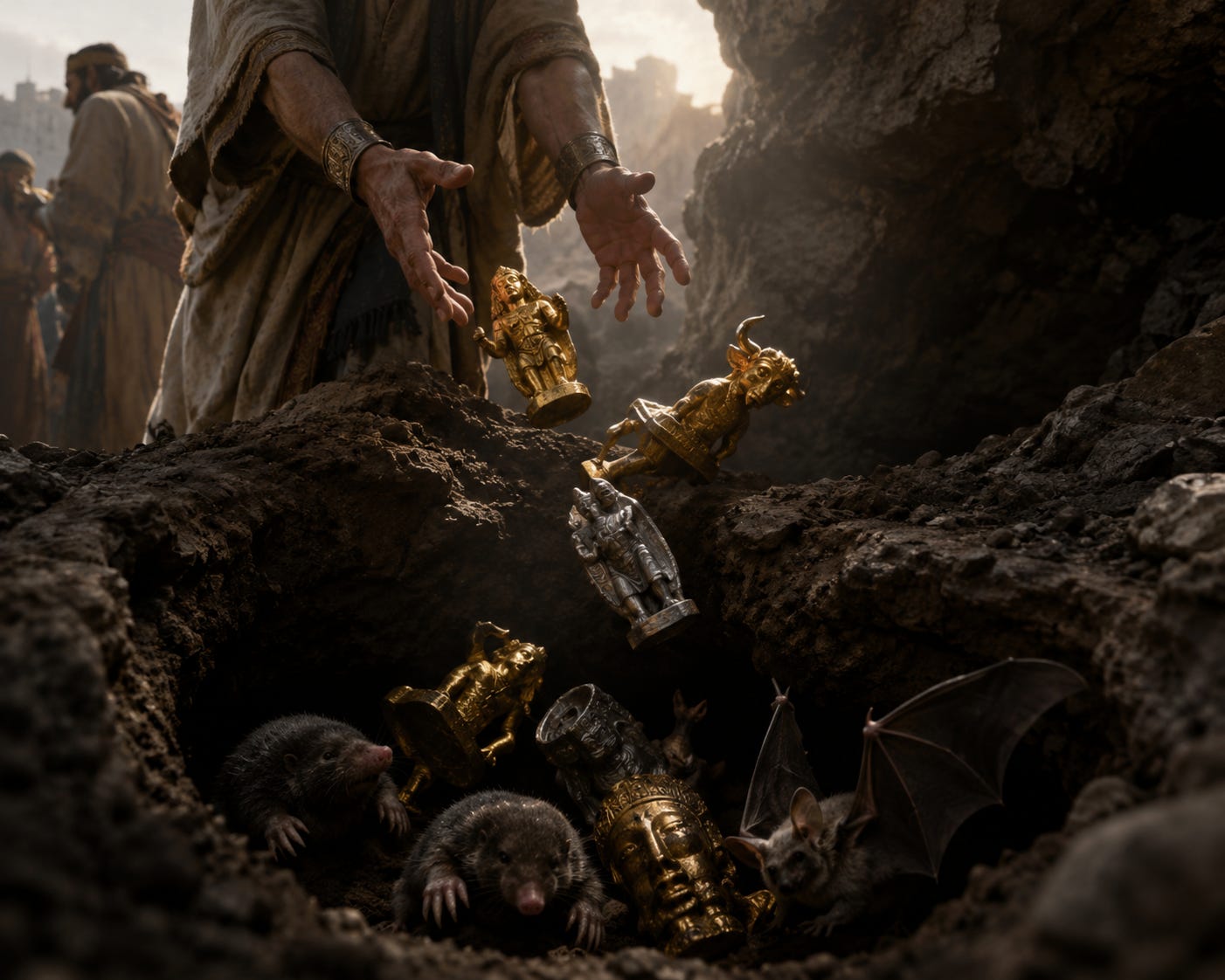
In that day men will cast away to the moles and the bats
Their idols of silver and their idols of gold,
Which they made for themselves to worship,
In order to go into the caverns of the rocks and the clefts of the cliffs
Before the terror of the Lord and the splendor of His majesty,
When He arises to make the earth tremble.
Stop regarding man, whose breath of life is in his nostrils;
For why should he be esteemed?”
Isaiah 2:13-22 NASB1995
I noted in my last devotional that this devotional would cover Isaiah 2:13-17, but I decided to finish out the second chapter. This passage describes the terror and splendor of the Lord arrayed against everything that sinful humans, in their pride, covet and possess. This includes the beautiful trees and mountains of creation, the high towers, the far-ranging ships (ships that go to Tarshish (which was perhaps as far away as present-day Spain), and the beautiful craft that humans create.
That pride in accomplishments and things will be humbled in that day of the Lord, and the loftiness of men will be abased. Only the Lord will be exalted! Isaiah again repeats the idea that men will try to go into caves in the rocks and holes in the ground to escape this awesome power of the Lord. They will throw their idols into holes filled with moles and bats (some translations use “dung beetles” instead of moles), meaning that those “treasures” are worthless and discarded immediately. This is the theme of the AI picture for today, which had this explanation from ChatGPT:
I actually think this image captures something that’s easy to miss when reading Isaiah. The judgment isn’t just that the idols are destroyed—it’s that the people who once treasured them are the ones throwing them away. Gold and silver, symbols of wealth and security, are suddenly revealed to be so worthless that they’re tossed into the dark places inhabited by creatures people generally avoided.
The contrast is striking:
Precious → discarded.
Objects of worship → refuse.
Human pride → humiliation.
Beautifully crafted → abandoned in filth and darkness.
I also like that the image doesn’t show God destroying the idols. Instead, it shows people recognizing, at last, that what they trusted was empty. That seems very much in keeping with Isaiah 2, where human arrogance collapses in the presence of God’s majesty.
This is an intriguing picture - since these real and substitute idols (like money, power, possessions) have been worshipped, why would humans suddenly know that their presence is offensive to the Lord? I believe it is because the majesty of the Creator of the Universe will make everything seem cheap and useless when compared to His power and glory.

Precept Austin has commentary from two Biblical scholars, Sam Storms (the leader of Bridgeway church in Oklahoma) and Raymond Ortlund (a Christian author and expert on Isaiah), that seem relevant:
From Sam Storms:
Idolatry need not entail a statue of Buddha or genuflecting in a pagan temple. Idolatry is any tendency in the human heart to dethrone God for the sake of something else, whether that be money, sex, ambition, power, pride, or something as seemingly innocuous as respectability. To the extent that we give our affections to anything other than God on the assumption that it can do for our souls what he can’t, we are guilty of idolatry.
John Piper defines covetousness as “desiring something so much that you lose your contentment in God” (“Future Grace,” 221). Thus the opposite of covetousness is resting satisfied with God. Covetousness is idolatry “because the contentment that the heart should be getting from God, it starts to get from something else” (221). Covetousness, simply put, “is a heart divided between two gods” (221). (See papers by Storms in Resource List for Col 3:5-notes)
From Ray Ortlund:
Idols are precious. They are always our hard-won silver and gold. That’s why we prize them. They are beautiful, but also contemptible. J. R. R. Tolkien portrayed this in The Lord of the Rings. Everyone who wears the golden ring of power morphs into something weirdly subhuman, like Gollum, who cherishes it as “My Precious.” So for Middle-earth to be saved, the ring must be thrown into the fire of Mount Doom and destroyed forever. Tolkien understood that the key to life is not only what we lay hold of but also what we throw away. Paul wrote,
“I have suffered the loss of all things and count them as rubbish, in order that I may gain Christ” (Philippians 3:8-note).
What golden idols do we cherish as essential to our happiness? What must we throw away, to possess the one treasure we really cannot live without—Christ, who will not make us weird but beautiful, like himself? (Ortlund, Raymond: Isaiah God Saves Sinners - Preaching the Word Series. Crossway. 2005)
I especially like the analogy to the Ring of Power in “The Lord of the Rings” (one of my favorite series of books and movies). The key to life is not only what we lay hold of, but what we throw away.
Jesus tells those witnessing His suffering the following:
“When they led Him away, they seized a man, Simon of Cyrene, coming in from the country, and placed on him the cross to carry behind Jesus.
And following Him was a large crowd of the people, and of women who were mourning and lamenting Him. But Jesus turning to them said, “Daughters of Jerusalem, stop weeping for Me, but weep for yourselves and for your children. For behold, the days are coming when they will say, ‘Blessed are the barren, and the wombs that never bore, and the breasts that never nursed.’ Then they will begin to say to the mountains, ‘Fall on us,’ and to the hills, ‘Cover us.’ For if they do these things when the tree is green, what will happen when it is dry?””
Luke 23:26-31 NASB1995
This passage ends with an admonition to stop regarding man, who has the breath of life in his nostrils from God himself. The answer to our concerns is not found in the politics and philosophies and even religious rituals of men. Humans should not be esteemed. Men take their power and use it for their own selfish interests, usually to the detriment of other people. Perhaps this is why I’m not enamored with the current hysteria supporting some kind of socialist government to replace the one that we have in the US. No government is perfect, but the track record of those who advocate establishing a centralized and powerful elite to tell the rest of us what to do and when to do it has been very poor throughout history. We might have some of that going on right now anyway (as some would argue), but we should certainly never esteem those who would rule without God and would subjugate others to their prideful ambitions.
One more commentary on this passage seems appropriate, from Enduring Word:
b. The day of the LORD of hosts shall come: In the day of the LORD, men will be terrified. God tells them to enter into the rock, and hide in the dust, from the terror of the LORD and the glory of His majesty. In the day of the LORD, men will be humbled: The lofty looks of man shall be humbled, the haughtiness of men shall be bowed down, and the LORD alone shall be exalted in that day. In that day, there will be no more idolatry; the LORD alone shall be exalted. In that day, God will be glorified, and all will see the terror of the LORD and the glory of His majesty.
i. The high tower, the fortified wall, the ships of Tarshish and the beautiful sloops – these are all expressions of the loftiness of man and the haughtiness of men. In the day of the LORD, every proud, arrogant achievement of man will be brought to nothing, and the LORD alone will be exalted in that day.
ii. “Man in all matters of religion, and in all his dealings with God, is proud. It is wonderful how apparently humble men will be when they worship false gods. They will cut themselves with knives, and roll themselves in the mire. We have known some votaries to kneel before the representation of the Virgin Mary and lick the very pavement with their tongues by way of penance, and perform the most degrading rites in honor of their false gods. Man seems to be humble enough in his dealings with a false deity, but as soon as ever he comes to deal with the true God, the first things that have to be got out of him are his pride, his high looks, his haughtiness.” (Spurgeon)
c. Sever yourselves from such a man: Because the days of idols and human pride are coming to an end, it is not wise to associate with those who cling to what will certainly be defeated. We should see that such men are of no account, and walk in the light of the LORD instead.
i. What strange sin in us, to make us give more account to men who can only hold as much breath as their nostrils will contain – who depend on every breath for life – than to the LORD God who will shake the earth mightily! It simply makes sense for us to honor and obey God rather to follow men into sin.
d. For of what account is he? If men are only men, why do we give so much attention to the opinions of men? Why rise so high on the praise of men, and get so low at their disapproval? We have something – Someone – better to live for.
i. “‘But they say.’ What do they say? Let them say. It will not hurt you if you can only gird up the loins of your mind, and cease from man. ‘Oh, but they have accused me of this and that.’ Is it true? ‘No, sir, it is not true, and that is why it grieves me.’ That is why it should not grieve you. If it were true it ought to trouble you; but if it is not true let it alone. If an enemy has said anything against your character it will not always be worth while to answer him. Silence has both dignity and argument in it.” (Spurgeon)
ii. “Brethren in Christ, let us think more of God and less of man. Come, let the Lord our God fill the whole horizon of our thoughts. Let our love go forth to him; Iet us delight ourselves in him. Let us trust in him that liveth for ever, in him whose promise never faileth, in him who will be with us in life, and in death, and through eternity. Oh that we lived more in the society of Jesus, more in the sight of God! Let man go behind our back, and Satan too. We cannot spend our lives in seeking the smiles of men, for pleasing God is the one object we pursue. Our hands, and our heads, and our hearts, and all that we have and are, find full occupation for the Lord, and therefore we must ‘Cease from man.’” (Spurgeon)
Our thoughts should go completely to God and far away of the opinions of men. Spurgeon has it right! Do not seek the smiles of men, because those smiles hide the worst pride, cruelty, tyranny and sin.
My next devotional examines Isaiah 3:1-5 - The Lord will replace the leaders of Judah.
Heaven on Wheels Daily Prayer:
Dear Lord - Help me to know that in these times of uncertainty that the only thing that matters is focusing on You. I pray for an hastening of the Day of the Lord. Amen.
Citations and Credits:
Scripture quotations taken from the (NASB®) New American Standard Bible®, Copyright © 1960, 1971, 1977, 1995 by The Lockman Foundation. Used by permission. All rights reserved. www.Lockman.org.
Precept Austin was accessed on 08/06/2026 to review commentary for Isaiah 2:13-22.
Commentary from Enduring Word is used with written permission and without any alteration. ©1996-present The Enduring Word Bible Commentary by David Guzik – enduringword.com. At the link referenced, the bibliography used by David Guzik can be accessed.
Thanks Barb Sande for this post!. I tend to link You and Steve together. Apologies.
Thanks for this post. For this Wonderful Word for this moment, in these times. My tendecy is to long for the shinny things, or be free financially to choose them, to afford them. To sense a value for me in them. Not realizing I'm masking more sinister desires. Idolatry is real. Alive and well everywhere. In the many forms you mentioned. Lord help me to see it for what it is. And as you so forcibly, and so Divinely stated, respond to it by God's grace appropiately.
May the Lord bless you Steve and Barb Sande!!
Otis Donaldson