


“The Lord arises to contend,
And stands to judge the people.
The Lord enters into judgment with the elders and princes of His people,
“It is you who have devoured the vineyard;
The plunder of the poor is in your houses.
What do you mean by crushing My people
And grinding the face of the poor?”
Declares the Lord God of hosts.”
Isaiah 3:13-15 NASB1995
The Lord God of hosts arises to contend, like a prosecuting attorney, and then stands to judge the people of Jerusalem and Judah, particularly the elders and the princes of the people.
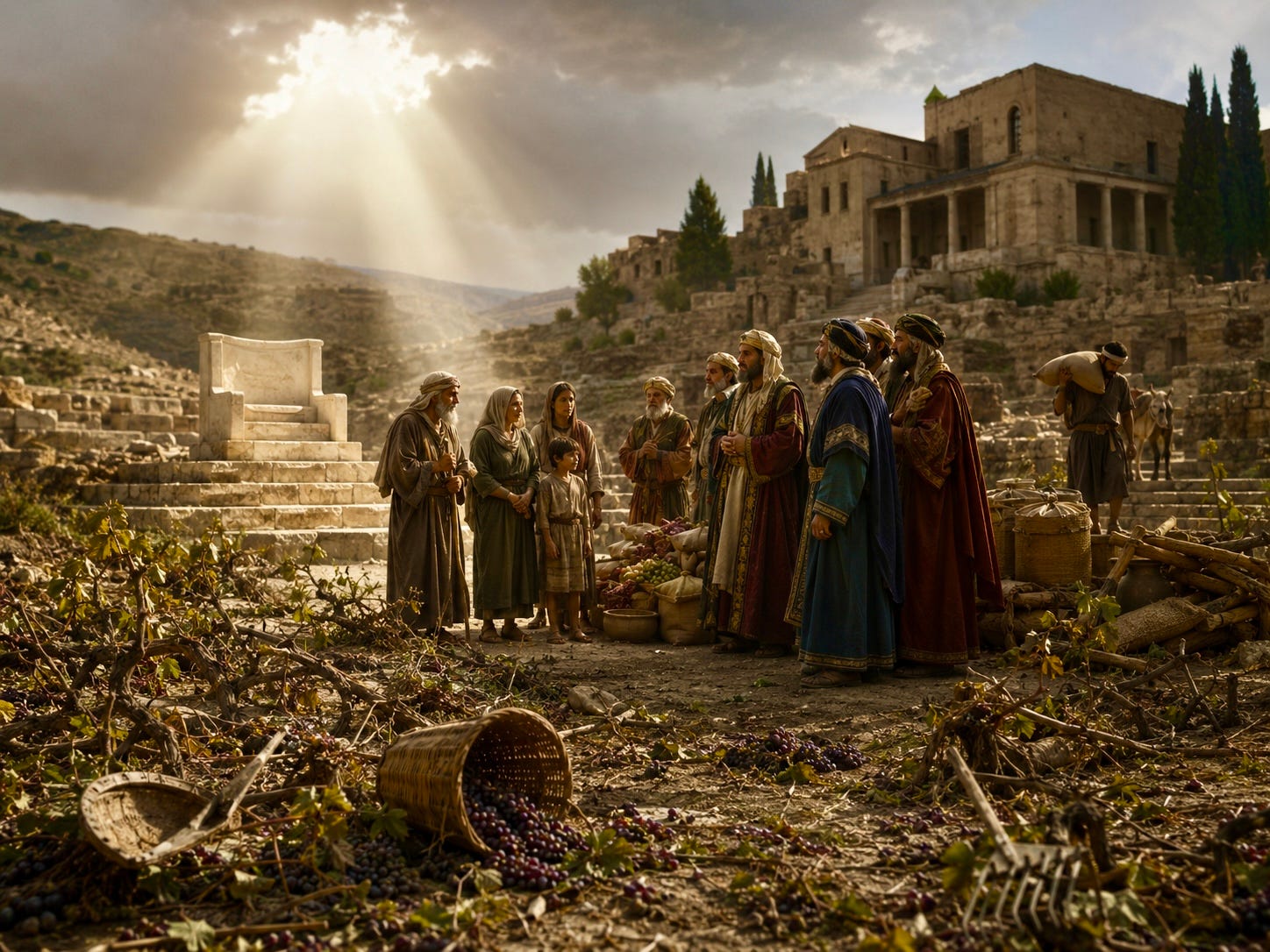
The description of the image at the top from ChatGPT is interesting:
The scene takes place at the edge of a devastated vineyard outside Jerusalem. The ruined vineyard effectively becomes the courtroom evidence.
In the foreground, several richly dressed elders and leaders stand together facing an empty but brilliantly illuminated judgment seat. Nearby are poor vineyard workers and their families.
Scattered between them are: uprooted and trampled vines, broken baskets, spilled grapes, confiscated farming tools, sacks of grain and jars of oil piled beside the leaders.
Behind the wealthy men, servants are carrying still more produce toward an impressive house.
The poor stand almost empty-handed.
And sunlight breaking dramatically through dark clouds illuminates the judgment seat and the ruined vineyard while the leaders remain partly in shadow.
The point of this passage is that the Lord sits in judgment of those who exploit and plunder the poor to enrich themselves. This admonition was clearly identified in Mosaic Law, as noted in these verses from Deuteronomy 24:
““You shall not oppress a hired servant who is poor and needy, whether he is one of your countrymen or one of your aliens who is in your land in your towns. You shall give him his wages on his day before the sun sets, for he is poor and sets his heart on it; so that he will not cry against you to the Lord and it become sin in you.
…
“You shall not pervert the justice due an alien or an orphan, nor take a widow’s garment in pledge. But you shall remember that you were a slave in Egypt, and that the Lord your God redeemed you from there; therefore I am commanding you to do this thing.
“When you reap your harvest in your field and have forgotten a sheaf in the field, you shall not go back to get it; it shall be for the alien, for the orphan, and for the widow, in order that the Lord your God may bless you in all the work of your hands. When you beat your olive tree, you shall not go over the boughs again; it shall be for the alien, for the orphan, and for the widow.
“When you gather the grapes of your vineyard, you shall not go over it again; it shall be for the alien, for the orphan, and for the widow. You shall remember that you were a slave in the land of Egypt; therefore I am commanding you to do this thing.”
Deuteronomy 24:14-15, 17-22 NASB1995
God reminds the people of Israel that they were once slaves, so they should be compassionate and generous to those who are impoverished. Instead, they were essentially robbing the poor and “grinding their faces” in their poverty.
Precept Austin has commentary from Roland Q. Leavell, a Baptist Evangelist who became known for his preaching on the OT prophets:
A social sin which was prevalent in Judah and Israel, a sin which aroused the prophets to indignant denunciation, was that of accursed greed for land and money. They were not inveighing against private ownership nor were they advocating socialism. They preached against an economic order which fostered mortgages and such heavy taxation that poor people were reduced to practical slavery. The merchants had two standards of measurement, a big measure to buy with and a small one to sell by. Worse than that, they put the bad wheat on the bottom of the bushel measure and the good on the top (Amos 8:5, 6). Isaiah was genuinely aroused. When greed of gain and covetousness were sapping the moral strength of the people and the nation, he thundered (the words in Isa 3:14, 15)
Greed was a serious problem with these elders and princes of the people. The two standards of measurement for merchants meant that the producer and the consumer both got the “short end of the stick” so to speak, so that the merchant made the most money.
Here is commentary from Enduring Word on this passage (pretty short):
a. The LORD stands up to plead, and stands to judge the people: Here, the LORD is both a prosecutor (stands up to plead) and a judge against Judah. When you are in court, and the prosecutor and the judge are the same person, you know you are going to be found guilty.
b. The plunder of the poor is in your houses. What do you mean by crushing My people, and grinding the faces of the poor?God’s charge against the elders and the princes of Israel is not that they have failed to help the poor. That would be bad in itself. But far worse than that, they have robbed the poor, and taken advantage of their poverty to enrich themselves.
We cannot withstand a sovereign God who is both prosecutor and judge, without the power of the defense attorney that Christians can take refuge in, our Savior Jesus Christ.
My next devotional examines Isaiah 3:16-23 - Judah’s women are denounced.
Heaven on Wheels Daily Prayer:
Dear Lord - Please help me to know that the abundance of blessings that I have should in turn be used to bless those who don’t have those blessings. Amen.
Citations and Credits:
Scripture quotations taken from the (NASB®) New American Standard Bible®, Copyright © 1960, 1971, 1977, 1995 by The Lockman Foundation. Used by permission. All rights reserved. www.Lockman.org.
Precept Austin was accessed on 08/14/2026 to review commentary for Isaiah 3:13-15.
Commentary from Enduring Word is used with written permission and without any alteration. ©1996-present The Enduring Word Bible Commentary by David Guzik – enduringword.com. At the link referenced, the bibliography used by David Guzik can be accessed.