


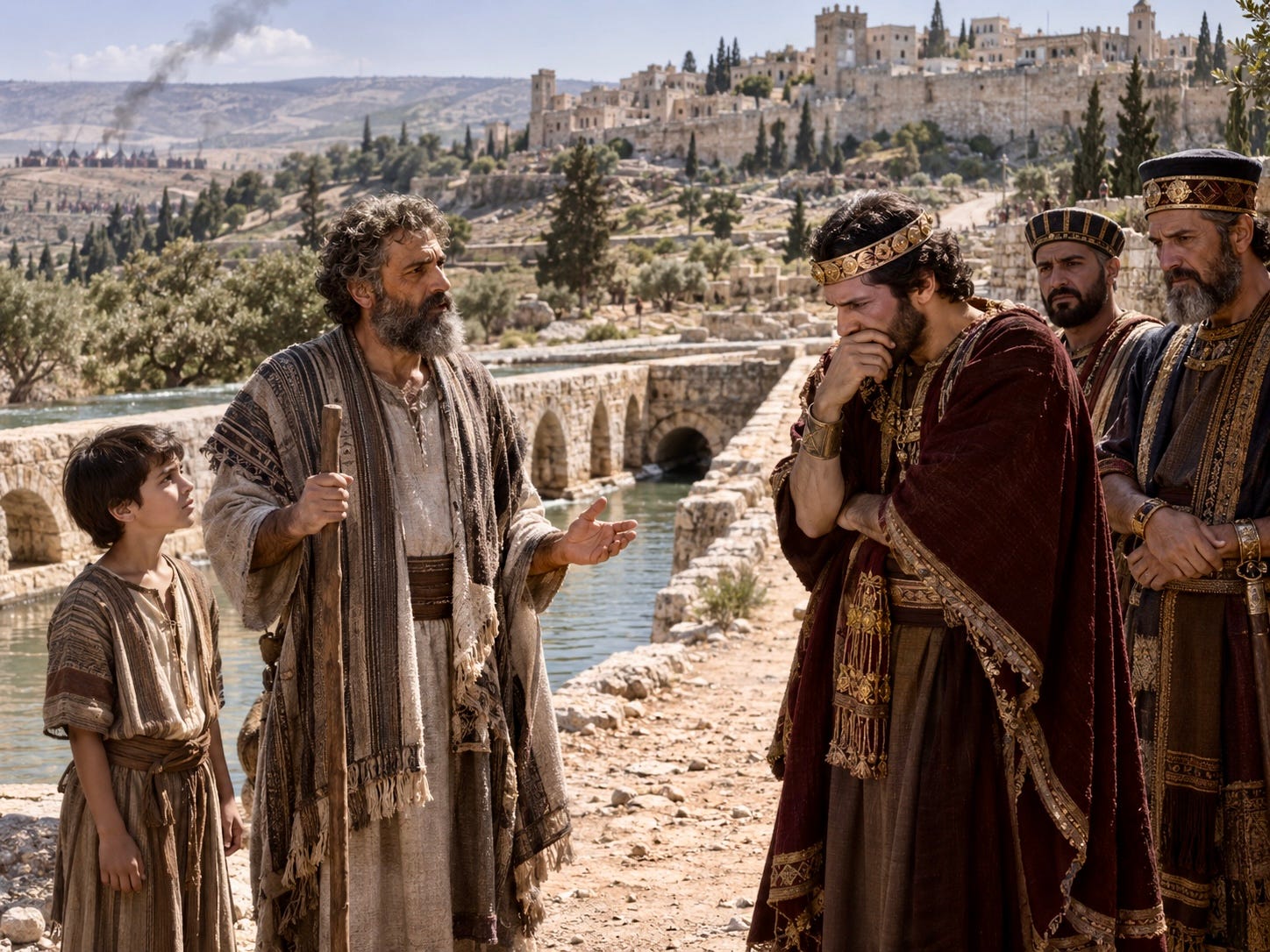
“Then the Lord said to Isaiah, “Go out now to meet Ahaz, you and your son Shear-jashub, at the end of the conduit of the upper pool, on the highway to the fuller’s field, and say to him, ‘Take care and be calm, have no fear and do not be fainthearted because of these two stubs of smoldering firebrands, on account of the fierce anger of Rezin and Aram and the son of Remaliah. Because Aram, with Ephraim and the son of Remaliah, has planned evil against you, saying, “Let us go up against Judah and terrorize it, and make for ourselves a breach in its walls and set up the son of Tabeel as king in the midst of it,” thus says the Lord God: “It shall not stand nor shall it come to pass. For the head of Aram is Damascus and the head of Damascus is Rezin (now within another 65 years Ephraim will be shattered, so that it is no longer a people), and the head of Ephraim is Samaria and the head of Samaria is the son of Remaliah. If you will not believe, you surely shall not last.” ’ ””
Isaiah 7:3-9 NASB1995
The Lord directs Isaiah to take his son, Shear-Jashub, and meet with Ahaz in a particular location. Isaiah is to tell Ahaz to take care and be calm and have no fear because of the threats from Aram and Rezin and Remaliah’s son (Pekah), among others. Their attack will not stand nor shall it come to pass. The Lord wants Ahaz to believe Him and believe in Him. If he does not believe, he will surely not last.
Here is commentary from Enduring Word on this passage:
a. You and Shear-Jashub your son: Isaiah was told to take his son, named Shear-Jashub, and bring a word from the LORD to Ahaz. He brought his son as a walking object lesson because the name Shear-Jashub means, “A Remnant Shall Return.”
b. At the end of the aqueduct from the upper pool, on the highway to the Fuller’s Field: These seemingly irrelevant details make an important point. All this happened to real people at a real time and in real places. This isn’t make-believe or fairy tales. This is real.
c. Take heed, and be quiet: Seemingly, Ahaz needed to pay attention (take heed) and stop his talking about the problem (be quiet). He needed to trust God and take courage in the LORD (do not fear or be fainthearted).
i. Perhaps also, the calamity and devastation that had wracked Judah so far had made Ahaz stop trusting in God. “If God loves me, why am I in this mess at all? Trust Him now, after all He has allowed to happen? Are you crazy?”
d. Do not fear or be fainthearted: It was hard for Ahaz to do this because he didn’t see the situation the way the LORD did. Ahaz looked at Israel and Syria and saw a terrible threat. God looked at Israel and Syria and saw two stubs of smoking firebrands. To the LORD, they were all smoke and no fire.
i. “One would think that they are endued with so great power that they could burn and destroy the whole world. To put down the excess of terror, the Lord declares that what we imagined to be a burning, and a perpetual burning, is but a slight smoke and of short duration.” (Calvin)
ii. “Calleth them in contempt a couple of firebrands, such as would do mischief but cannot, because smoking and not burning, and but the tails of smoking firebrands neither, such as are smoking their last, and shall shortly be utterly extinct. In a word, they have more pride than power, being a mere flash.” (Trapp)
e. It shall not stand, nor shall it come to pass: Certainly, the king of Israel and the king of Syria had their plans – they plotted evil against Judah. They wanted to attack Jerusalem, defeat the capital of Judah (make a gap in its wall), then depose Ahaz and set up their own king. But God was not worried about their plans. They looked like a big, flaming threat to Ahaz, but God looked and saw two stubs of smoking firebrands, and simply said, “It shall not stand, nor shall it come to pass.”
i. Their plans will not succeed because the nations are led by ungodly men (Rezin and Remaliah’s son), and not by the LORD. This is God’s promise, and Isaiah calls Ahaz to trust in the LORD and in His promise.
f. If you will not believe, surely you shall not be established: Here is the challenge to Ahaz. God has promised, now the king of Judah must believe. If he will not believe, it will not affect the outcome of the attack against Jerusalem. God has already decreed that their attack would not succeed. But it would affect the course of Ahaz’s life and reign as king (surely you shall not be established).
i. As it happened, Ahaz did not believe. He did not put his trust in the LORD. He put his trust in carnal methods and the king of Assyria. Jerusalem was spared, and Ahaz no doubt believed he was successful, and his plan had worked. But if he would have just trusted in the LORD, Jerusalem would have been spared, and Ahaz would have been blessed.
ii. Isaiah brought his son Shear-Jashub (Isaiah 7:3) because his name meant A Remnant Shall Return, and God wanted Ahaz to know that because of the kind of ungodly trust he put in the king of Assyria, Judah would eventually be taken into captivity, and only a remnant would return.
A few takeaways:
The name of Isaiah’s son is relevant. Shear-Jashub means “A remnant shall return”. I have an excerpt from Precept Austin below with more on this name and its meaning.
The location where Isaiah meets Ahaz is described in detail so that we, as readers of this prophecy, can have as much context as possible about the physical reality of this event.
The Lord through Isaiah tells Ahaz to calm down and be quiet and to not fear or be fainthearted. From all indications, Ahaz ignores this directive.
The attacking forces are described by the Lord as being like smoking torches that are about to be extinguished. They have more pride than power.
The Lord asks Ahaz to believe. Ahaz did not believe. He thought he was able to avoid the worst of the conflict himself and spare Jerusalem, but it changed the way the people saw him and he was not blessed.

Here is what Precept Austin says about Shear-Jashub; this is excellent:
The name Shear-jashub (שְׁאָר יָשׁוּב), mentioned in Isaiah 7:3, carries profound theological and prophetic significance. He was one of Isaiah’s sons whose very name served as a prophetic sign to King Ahaz (Isa 7:3; cf. Isa 8:18). Around 735 BC, Judah was threatened by the alliance of Israel (Ephraim) and Syria. Instead of trusting the LORD, Ahaz sought help from Assyria. Isaiah confronted Ahaz, bringing Shear-jashub with him, likely so that the child’s name would visibly embody God’s message before the fearful king.
The name Shear-jashub means “a remnant shall return,” and it carried a double-edged message of warning and of hope. On the one hand, it warned of judgment because King Ahaz had chosen to rely on Assyria rather than on the Almighty God. The result would be Judah would suffer devastation, and only a remnant of the people would survive. On the other hand Shear-jashub held out a promise and a hope (not hope so but hope sure) that despite the coming disaster, God would preserve a remnant faithful to His covenant promises.
Theologically, Shear-jashub’s name summarized Isaiah’s theology in miniature - judgment followed by restoration. Human rebellion would lead to severe loss, yet God’s mercy would ensure the survival and restoration of a believing remnant. Though judgment would come upon Judah and Israel for their apostasy, God promised that a faithful remnant would survive and return to Him. In a single sentence, Isaiah 7:3, Shear-jashub embodied the sober truth that judgment was coming because of Ahaz’s unbelief, yet God would preserve a faithful remnant and His Covenant would not fail.
This meaning comes into clearer focus later in Isaiah 10:21, which declares, “A remnant will return, the remnant of Jacob, to the mighty God” Only a remnant would survive the consequences of Ahaz’s choices, yet that remnant would be living proof that God had not abandoned His people and would remain faithful to His ancient promises. Significantly, Shear-jashub was born and named before Ahaz rejected God’s gracious offer of help, making his presence at the encounter a pre-announced warning of what unbelief would bring.
The concept of a faithful remnant aligns with God’s unchanging covenant nature. Despite human failure, the Lord remains steadfast, always preserving a people for Himself. Paul quotes Isaiah in Romans 9:27 affirming that “Though the number of the sons of Israel be like the sand of the sea, it is the remnant that will be saved”. This shows how the promise of a remnant in Isaiah points beyond Judah’s immediate context to God’s ultimate plan of redemption through Jesus Christ. Those who repent and trust in Christ become part of this spiritual remnant, restored and reconciled to the “Mighty God” foretold by Isaiah (Isaiah 9:6).
In summary, Shear-jashub is far more than a symbolic name for it is a declaration of God’s enduring mercy and faithfulness to keep His Covenant promises. Even in times of rebellion and judgment, His promise endures that those who return to Him in faith will find restoration. The remnant theme reminds all believers that God’s purposes are never thwarted by human failure and that He always preserves a people who “will truly rely on the LORD, the Holy One of Israel.” (Isaiah 10:20).
That is such a wonderful explanation. There are other scholars who disagree with this interpretation, but I’m willing to accept it as the best alternative.

Do you as a believer trust in God and His promises? Do you have faith? Precept Austin quotes a marvelous Charles Spurgeon devotional on God’s promises:
A PROMISE from God may very instructively be compared to a check payable to order. It is given to the believer with the view of bestowing upon him some good thing. It is not meant that he should read it over comfortably, and then have done with it. No, he is to treat the promise as a reality, as a man treats a check.
He is to take the promise, and endorse it with his own name by personally receiving it as true. He is by faith to accept it as his own. He sets to his seal that God is true and true as to this particular word of promise. He goes further, and believes that he has the blessing in having the sure promise of it, and therefore he puts his name to it to testify to the receipt of the blessing.
This done, he must believingly present the promise to the Lord, as a man presents a check at the counter of the bank. He must plead it by prayer, expecting to have it fulfilled. If he has come to heaven’s bank at the right date, he will receive the promised amount at once. If the date should happen to be further on, he must patiently wait till its arrival; but meanwhile he may count the promise as money, for the bank is sure to pay when the due time arrives.
Some fail to place the endorsement of faith upon the check (of promise), and so they get nothing; and others are slack in presenting it, and these also receive nothing. This is not the fault of the promise, but of those who do not act with it in a common-sense, business-like manner.
God has given no pledge which He will not redeem, and encouraged no hope which He will not fulfill. To help my brethren to believe this, I have prepared this little volume. The sight of the promises themselves is good for the eyes of faith: the more we study the words of grace, the more grace shall we derive from the words. To the cheering Scriptures, I have added testimonies of my own, the fruit of trial and experience. I believe all the promises of God, but many of them I have personally tried and proved. I have seen that they are true, for they have been fulfilled to me. This, I trust, may be cheering to the young and not without solace to the older sort. One man’s experience may be of the utmost use to another; and this is why the man of God of old wrote, “I sought the Lord, and he heard me”; and again, “This poor man cried, and the Lord heard him.”
All the promises of God are “Yea and Amen” in Christ Jesus; and as He is ours, every promise is ours if we will but lie down upon it in restful faith.
The firmest things in the universe are the promises and purposes of the unchanging God, and these are the safeguard of the obedient believer.
There is a promise prepared for your present emergencies; and if you will believe and plead it at the mercy-seat through Jesus Christ, you shall see the hand of the Lord stretched out to help you.
Everything else will fail,
but His word never will.He has been to me so faithful in countless instances that I must encourage you to trust Him. I should be ungrateful to God and unkind to you if I did not do so.
Seeing that it is the word of a God so true, so immutable, so powerful, so wise, I will and must believe the promise.” If we thus meditate upon the promises, and consider the Promiser, we shall experience their sweetness, and obtain their fulfilment.
A man prevails only as he believes (cp 1Jn 5:4). The Holy Spirit is the Author of faith, and strengthens it, so that we pray believing God’s promise.
This Spurgeon devotional is found at these links in Precept Austin: Faith's Checkbook (Pt 1 Pt 2 Pt 3 Pt 4).
The important message in this passage is not necessarily the historical detail about these various bad actors who are threatening Jerusalem. It is about the promises of God as spoken through the prophet Isaiah and how Ahaz refuses to believe. Yet those promises endure, as we will see in the next passage.
My next devotional examines Isaiah 7:10-16 - The Child Immanuel.
Heaven on Wheels Daily Prayer:
Dear Lord - I believe Your promises and have faith in You as the architect of my salvation. Thank You for the prophecies of Isaiah. Amen.
Citations and Credits:
Scripture quotations taken from the (NASB®) New American Standard Bible®, Copyright © 1960, 1971, 1977, 1995 by The Lockman Foundation. Used by permission. All rights reserved. www.Lockman.org.
Precept Austin was accessed on 09/21/2026 to review commentary for Isaiah 7:3-9.
Commentary from Enduring Word is used with written permission and without any alteration. ©1996-present The Enduring Word Bible Commentary by David Guzik – enduringword.com. At the link referenced, the bibliography used by David Guzik can be accessed.