


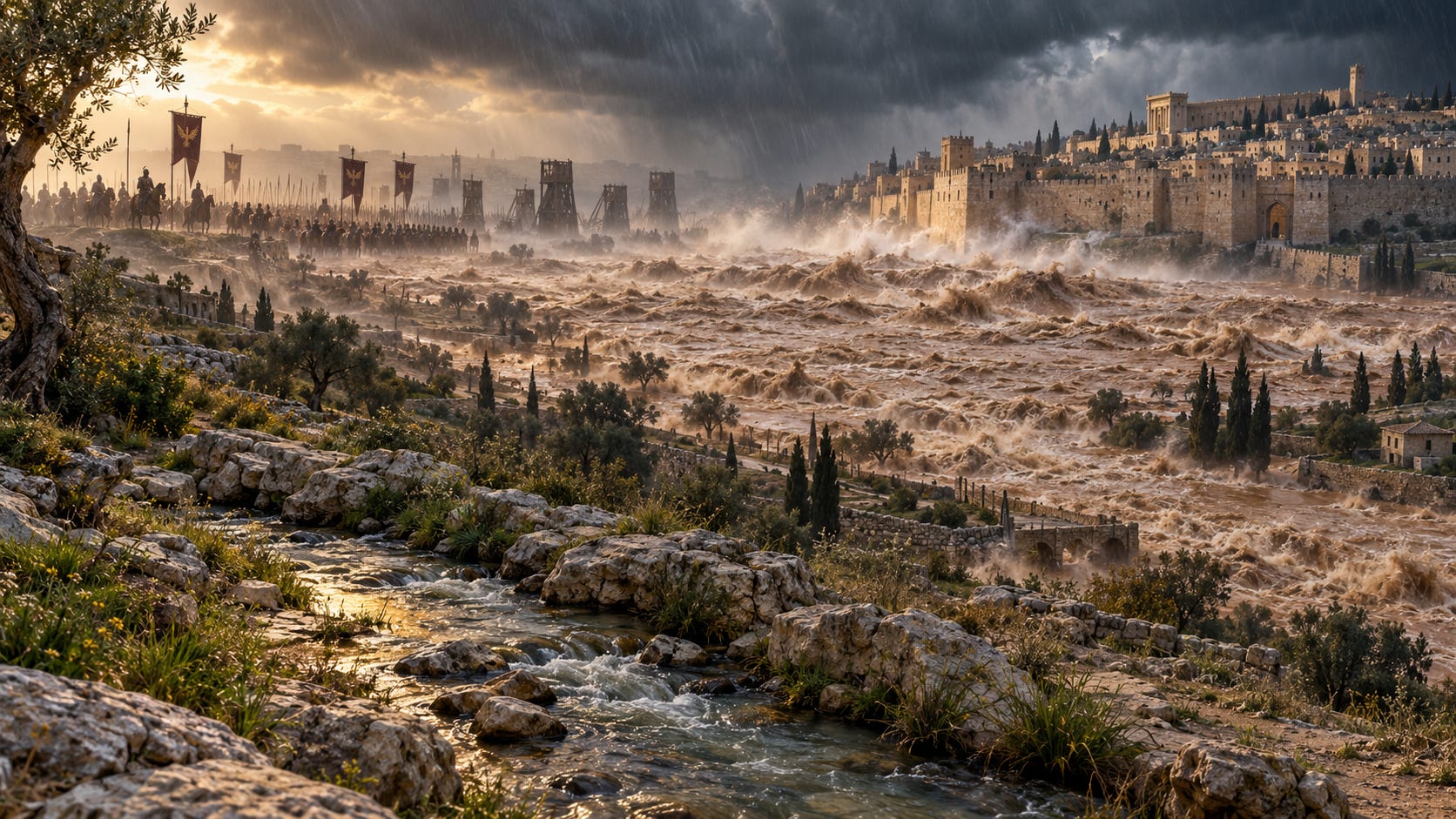
“Again the Lord spoke to me further, saying,
“Inasmuch as these people have rejected the gently flowing waters of Shiloah
And rejoice in Rezin and the son of Remaliah;
Now therefore, behold, the Lord is about to bring on them the strong and abundant waters of the Euphrates,
Even the king of Assyria and all his glory;
And it will rise up over all its channels and go over all its banks.
Then it will sweep on into Judah, it will overflow and pass through,
It will reach even to the neck;
And the spread of its wings will fill the breadth of your land, O Immanuel.”
Isaiah 8:5-8 NASB1995
The Lord speaks to Isaiah again. The people have rejected the simple and gently flowing waters of the Shiloah river in their own land and want to rejoice in the foreigners that they have placed their faith in, instead of God. The trouble will come but it will end before Jerusalem and Judah are fully destroyed, at least this time. The flood of invaders will be large, but will not succeed at this time (Judah does eventually fall to Babylon).
I thought this commentary, from the expositions of Scottish preacher Alexander Maclaren on Biblehub was really intriguing:
SHILOAH AND EUPHRATES
Isaiah 8:6 - Isaiah 8:7.
The kingdom of Judah was threatened with a great danger in an alliance between Israel and Damascus. The cowardly King Ahaz, instead of listening to Isaiah’s strong assurances and relying on the help of God, made what he thought a master-stroke of policy in invoking the help of the formidable Assyrian power. That ambitious military monarchy was eager to find an excuse for meddling in the politics of Syria, and nothing loath, marched an army down on the backs of the invaders, which very soon compelled them to hasten to Judah in order to defend their own land. But, as is always the case, the help invoked was his ruin. Like all conquering powers, once having got its foot inside the door, Assyria soon followed bodily. First Damascus and Israel were ravaged and subdued, and then Judah. That kingdom only purchased the privilege of being devoured last. Like the Spaniards in Mexico, the Saxons in England, the English in a hundred Indian territories, the allies that came to help remained to conquer, and Judah fell, as we all know.
This is the simple original application of these words. They are a declaration that in seeking for help from others Judah was forsaking God, and that the helper would become ruler, and the ruler an oppressive tyrant.
The waters of Shiloah that go softly stand as an emblem of the Davidic monarchy as God meant it to be, and, since that monarchy was itself a prophecy, they therefore represent the kingdom of God or the Messianic King. The ‘waters strong and many’ are those of the Euphrates, which swells and overflows and carries havoc, and are taken as the emblem of the wasting sweep of the Assyrian king, whose capital stood on its banks.
But while thus there is a plain piece of political history in the words, they are also the statement of general principles which apply to every individual soul and its relations to the kingdom, the gentle kingdom, of our Lord and Saviour Jesus Christ.
I. The Gentle Kingdom.
That little brooklet slipping quietly along; what a striking image of the Kingdom of Jesus Christ!
It suggests the character of the King, the ‘meek and lowly in heart.’ It suggests the manner of His rule as wielded in gentleness and exercising no compulsion but that of love. It suggests the blessed results of His reign under the image of the fertility, freshness, and beauty which spring up wherever ‘the river cometh.’ That kingdom we are all summoned to enter.
II. The Rejection of the Kingdom.
Strange and awful fact that men do turn away from it and Him.
In what does rejection consist?
In not trusting in His power to help and deliver.
In seeking help from other sources. This rejection is often unconscious on the part of men who are guilty of it.
III. The Allies who are preferred to the gentle King.
The crowd of worldly things.
What is to be noticed is that at first the preference seems to answer and be all right.
IV. The Allies becoming Tyrants.
The swift Euphrates in spate. That is what the rejecters have chosen for themselves. Better to have lived by Shiloah than to have built their houses by the side of such a raging stream. Mark how this is a divine retribution indeed, but a natural process too.
{a} If Christ does not rule us, a mob of tyrants will.
Our own passions. Our own evil habits. The fascinating sins around us.
{b} They soon cease to seem helpers, and become tyrants.
How quickly the pleasure of sin disappears-like some bird that loses its gay plumage as it grows old.
How stern becomes the necessity to obey; how great the difficulty of breaking off evil habits! So a man becomes the slave of his own lusts, of his indulged tastes, which rise above all restraints and carry away all before them, like the Euphrates in flood. Fertility is turned to barrenness; a foul deposit of mud overlays the soil; houses on the sand are washed away; corpses float on the tawny wave. The soul that rejects Christ’s gentle sway is harried and laid waste by a mob of base-born tyrants. We have to make our choice-either Christ or these; either a service which is freedom, or an apparent freedom which is slavery; either a worship which exalts, or a worship which embrutes. ‘If the Son make you free, ye shall be free indeed.’
‘There is a river, the streams whereof make glad the city of God.’ It is peaceful to pitch our tents beside its calm flow, whereon shall go no hostile fleets, and whence we shall but pass to the city above, in the midst of the street whereof the ‘river of water of life, clear as crystal, proceeds out of the throne of God and of the Lamb.’
I thought this was quite good. There is the simple historical explanation for the Lord’s words to Isaiah found in the Assyrians and Ahaz’s desire to partner with them, but you can also look ahead to a metaphor of a gentle river like the Shiloah representing Christ. We look everywhere but at Him and seek help from other sources that appear more powerful. The bottom line in this thought-provoking commentary is that if Christ does not rule us, a mob of tyrants will!! The tyrants may be others who claim authority over us and reject Christ or they may be our sins that keep us in slavery.
I also liked the commentary from Enduring Word:
a. These people refused the waters of Shiloah that flow softly: The people of the northern kingdom of Israel did not appreciate their humble streams (the waters of Shiloah). Instead, they rejoiced in wicked leaders (in Rezin and Remaliah’s son). So, God will give them a different kind of river – the waters of the River, strong and mighty.
i. “The little stream of Shiloah sprung from Mount Zion on the southwesterly side of Jerusalem. It flowed as softly as oil without any murmur. Jerusalem’s existence and continuation depended on it.” (Bultema)
ii. The capital of the Assyrian Empire was Nineveh, and the city of Nineveh was founded on a great river: the Tigris. The Assyrian Empire was also centered across another mighty river: the Euphrates. The whole land of Israel simply did not have a river like the Euphrates or the Tigris. God is using the difference between the small, humble, yet adequate waters of Israel and the mighty, yet uncontrolled rivers of Assyria to make a point. It is as if God is saying, “You don’t like what I have given you? You persist in rejecting what I give you? Then I will give you something different, but you won’t like it either.”
iii. “The small and gentle waters should be more highly valued by us than the large and rapid rivers of all the nations, and we ought not to envy the great power of the ungodly.” (Calvin)
b. He will go up over all his channels and go over all his banks: Like a large river in a flood, the Assyrian army will not stay confined to its “banks.” Instead, they will “flow over” their attack on Israel and Syria, and “flood” Judah with violence and destruction (He will pass through Judah).
c. He will reach up to the neck: Assyria would completely conquer the northern nation of Israel. The ten northern tribes would cease to be a nation after the Assyrians conquered them. But the Assyrians would not conquer the southern nation of Judah. They would “flood” them (fill the breadth of Your land), and reach up to the neck, but not over their heads. Judah would survive the Assyrian invasion but suffer much destruction from the Assyrians.
i. Indeed, 2 Kings 18:13 describes the extent of the Assyrian invasion against Judah: And in the fourteenth year of King Hezekiah, Sennacherib king of Assyria came up against all the fortified cities of Judah and took them. Yet, Hezekiah was able to keep the king of Assyria away from Jerusalem, and barely able to survive, by buying his favor with riches from the temple – even stripping gold from the temple doors to appease the pagan king.
ii. “The sacred history assures us that these things were fulfilled…for the Assyrians, whom the Jews called to their assistance, destroyed them. This was the just punishment of their distrust; and we see in it a striking instance of the wicked greediness of men, who cannot be satisfied with the promise and assistance of God.” (Calvin)
d. Your land, O Immanuel: This refers back to the “Immanuel” prophecy of Isaiah 7:14. The land the Assyrians will invade doesn’t really belong to Judah or to King Ahaz. It belongs to the LORD God, to the coming Messiah, to Immanuel.
A good quote by John Calvin in this commentary is that we should never envy the power of the ungodly. And once again, the prophecy refers to Immanuel.
My next devotional examines Isaiah 8:9-10 - Be broken, oh peoples - but God is with us.
Heaven on Wheels Daily Prayer:
Dear Lord - Thank You for pointing me in the direction of the marvelous commentary by Alexander Maclaren. Although we are cautioned (like the Bereans) to not read too much into scripture and prophecy that isn’t there, I found the analogy to Christ to be quite useful. Amen.
Citations and Credits:
Scripture quotations taken from the (NASB®) New American Standard Bible®, Copyright © 1960, 1971, 1977, 1995 by The Lockman Foundation. Used by permission. All rights reserved. www.Lockman.org.
Precept Austin was accessed on 09/29/2026 to review commentary for Isaiah 8:5-8.
Biblehub.org was accessed on 09/29/2026 to review commentary for Isaiah 8:5-8.
Commentary from Enduring Word is used with written permission and without any alteration. ©1996-present The Enduring Word Bible Commentary by David Guzik – enduringword.com. At the link referenced, the bibliography used by David Guzik can be accessed.