


“For seven women will take hold of one man in that day, saying, “We will eat our own bread and wear our own clothes, only let us be called by your name; take away our reproach!”
In that day the Branch of the Lord will be beautiful and glorious, and the fruit of the earth will be the pride and the adornment of the survivors of Israel. It will come about that he who is left in Zion and remains in Jerusalem will be called holy—everyone who is recorded for life in Jerusalem. When the Lord has washed away the filth of the daughters of Zion and purged the bloodshed of Jerusalem from her midst, by the spirit of judgment and the spirit of burning, then the Lord will create over the whole area of Mount Zion and over her assemblies a cloud by day, even smoke, and the brightness of a flaming fire by night; for over all the glory will be a canopy. There will be a shelter to give shade from the heat by day, and refuge and protection from the storm and the rain.”
Isaiah 4:1-6 NASB1995
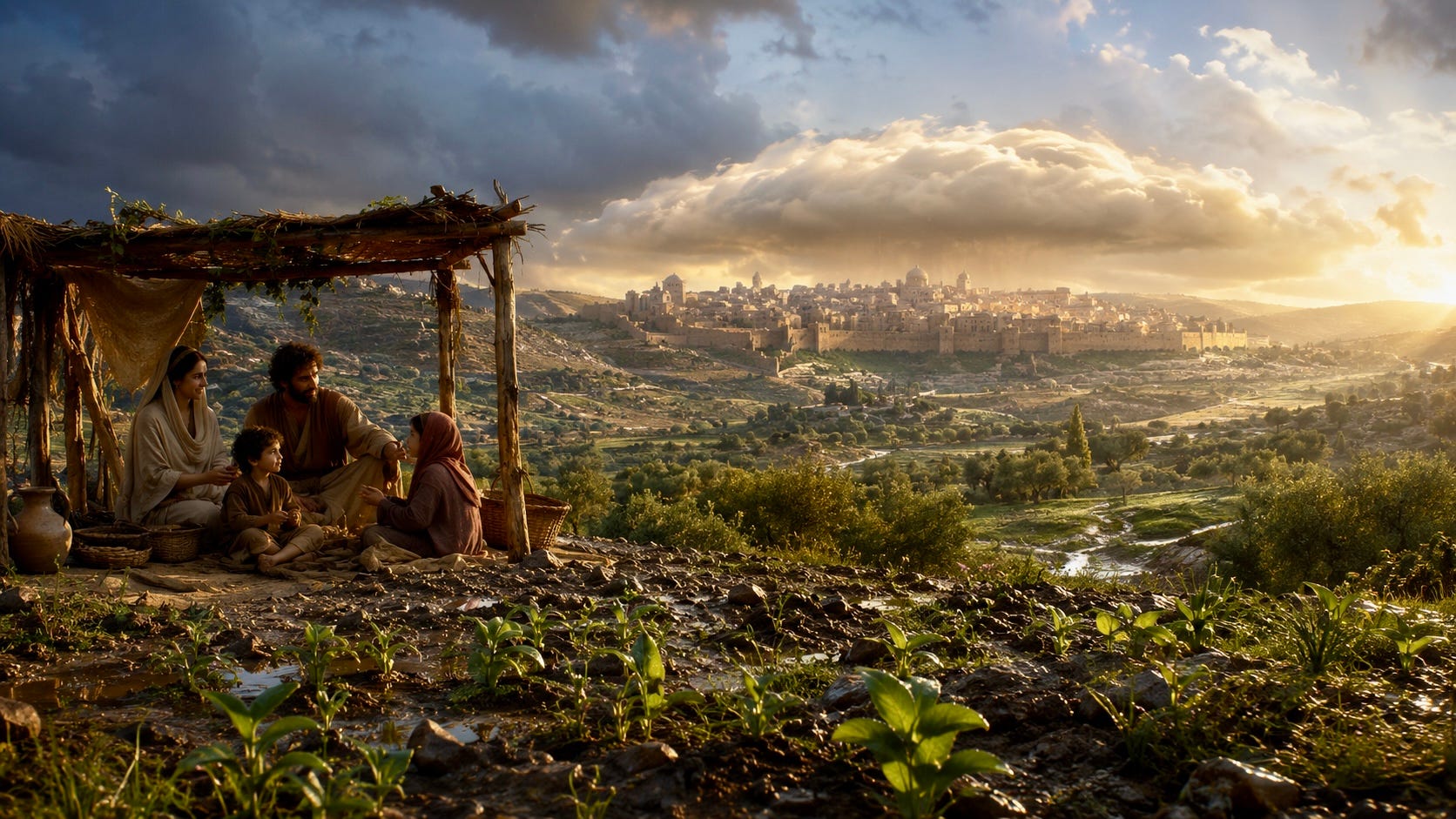
The image at the top had this description from ChatGPT:
In the foreground, new green growth emerges from previously damaged ground. Slightly farther back, a family rests beneath the shade of a simple shelter. Beyond them lies a renewed, fertile landscape leading toward Jerusalem, while a broad protective cloud hangs over Zion. Sunlight breaks around it rather than making the scene gloomy.
That last concept could tell nearly the whole chapter without becoming cluttered: judgment has passed, cleansing has occurred, new life is emerging, God’s people have refuge, and Zion is under His protection.
Before we can get to this restoration, the short chapter of Isaiah 4 begins with a verse that actually belongs with the last part of Isaiah 3. There are so few men left after the conflicts that seven women will pursue one man to be called by his name and avoid reproach for not being married and bearing children, even promising to provide for themselves as long as they have a husband. Here is what Enduring Word says about verse 1:
a. And in that day: As a result of the judgments of the LORD detailed in Isaiah 3:16-26, the daughters of Zion will have few men to choose from as husbands.
b. Seven women shall take hold of one man: So many men shall fall by the sword (Isaiah 3:25), that seven women would chase after one man. They would be so desperate for marriage that would not expect their husbands to provide for them at all (We will eat our own food and wear our own apparel).
c. Only let us be called by your name: Instead, it would be enough to simply take the name of a husband so that it would take away the reproach of being unmarried and childless.
i. In a broader sense, this shows that it is not good for women to be too desperate for marriage. They may marry unwisely, and for the wrong reasons. It is also bad when women do not expect their husbands to provide for the household.
The desperate situation for the women of Judah and Jerusalem probably echoes the tragedy that beset Europe after WWI, when over 10 million military deaths from all causes were recorded on both sides during that conflict (obviously, the vast majority of those deaths were young men). Over a million military members died in France and from the British Empire, while over 2 million died in Russia. Germany lost over 2 million. This was followed by the even greater decimation of younger men during WWII; it is estimated the military deaths ranged up to 25 million total across the Allies and Axis countries. WWII had a total death toll estimated between 70 and 85 million, depending on the source (these figures come from Wikipedia). War and the actions of conquering nations do not benefit marriage and families and peaceful lives.
Of course in this “enlightened” age, many women will claim that they need a man about as much as a fish needs a bicycle, to quote one of the feminist t-shirts that was popular when I was younger. I bought into that falsehood, although I did get married in a fairly traditional way. But we (Steve and I) never fulfilled our destiny as a married couple by having a family. Let me tell you in no uncertain terms that sometimes a way seems to be right at the time, but it only leads to sorrow and regret.

Isaiah now speaks a messianic prophecy in the remaining verses in Isaiah 4. I think the commentary in Enduring Word is pretty good for helping us understand this prophecy:
a. In that day the Branch of the LORD shall be beautiful and glorious: The Branch of the LORD is a Messianic title, speaking of Jesus Christ.
i. This image is repeated in Isaiah 11:1: There shall come forth a Rod from the stem of Jesse, and a Branch shall grow out of his roots. It is repeated in Jeremiah 23:5: “Behold, the days are coming,” says the LORD, “That I will raise to David a Branch of righteousness; a King shall reign and prosper, and execute judgment and righteousness in the earth.” It is repeated in Jeremiah 33:15: In those days and at that time I will cause to grow up to David a Branch of righteousness; He shall execute judgment and righteousness in the earth. It is repeated in Zechariah 3:8: For behold, I am bringing forth My Servant the BRANCH.
ii. The ideas behind the title Branch of the LORD are those of fruitfulness and life. Jesus used the same image when He said I am the vine, you are the branches (John 15:5).
b. In that day: This does not mean that the Messiah would appear when these judgments were taking place on the daughters of Zion. It means that the promise of the Messiah would be all the more beautiful and glorious to them in the midst of their suffering.
c. And the fruit of the earth shall be excellent and appealing for those of Israel who have escaped: For the remnant preserved through judgment, the promise of the Messiah would be all the more beautiful, dear, and life-giving. Fruit would sprout and grow from the Branch of the LORD, even as they simply trusted in the promise of the Messiah before He came.
…
a. Will be called holy: In the days of the sinful daughters of Zion, they were called beautiful, they were called delicate, they were called attractive, they were called fashionable, and they were called sexy. But they were not called holy.
i. “Christ’s holiness shall be both imputed and imparted unto them: he shall both expiate their sins and heal their natures, pay their debts, and give them a stock of grace and holiness, so that men shall call them a ‘holy people.’” (Trapp)
b. Everyone who is recorded: In the days when the Branch of the LORD reigns, the distinguishing mark of all, including the daughters of Zion, will be that they will be called holy.
i. Holy does not mean “super-spiritual.” It does not mean sinless perfection. It does not mean spiritually superior and obnoxious. It means a life, a heart, a mind, and a body that is genuinely separated to the LORD. It is a life lived apart from the thinking and heart of this world, this flesh, and the devil, and lived apart to the LORD.
…
a. The Lord has washed away the filth of the daughters of Zion: When the Branch of the LORD reigns, there will be cleansing. The cleansing will not come easily; it will come by the spirit of judgment and the spirit of burning. But it will be worth it.
i. “Sin is the excrement of the soul, the superfluity or garbage of naughtiness, the devil’s vomit. From this abominable filth Christ hath ‘loved and washed his with his own blood, that he may make them kings and priests unto God and his Father.’” (Trapp)
ii. “He not only washeth his people from their sins, but taketh away their swinish natures, whereby they would else return to their former wallowing in the mire.” (Trapp)
b. A cloud and smoke by day and the shining of a flaming fire by night: When the Branch of the LORD reigns, there will be the tangible presence of the LORD. Just as in the days of the Exodus, God will be as real as a pillar of cloud by day and a pillar of fire by night (Exodus 13:21-22).
c. And there will be a tabernacle for shade…a place of refuge, and for a shelter from storm and rain: When the Branch of the LORD reigns, there will be protection that comes from the LORD. The LORD’s people will be safe and secure, washed, and in the abiding presence of the LORD.
i. “Nothing is more necessary than that we follow our calling, and perform our duty faithfully. It belongs equally to the condition of the good and of the bad that they suffer many inconveniences; but bad men have no refuge, no place of concealment in which they may hide themselves, and they must be utterly overwhelmed. But blessed is the condition of the godly; for although they endure heat and cold, still they have a safe refuge in God.” (Calvin)
ii. If we are really born again, we want to be washed, have the presence of the LORD, and enjoy His protection. Many people only want the LORD’s constant presence and protection. But He doesn’t grant those apart from His cleansing.
Some key takeaways:
Jesus is the vine and we are the branches. His promises make the future all that more glorious and beautiful in the midst of suffering and turmoil.
If one doesn’t buy into the prophecies of Isaiah concerning Jesus for some reason, one can always turn to Jeremiah and Zechariah and have more of the same prophecies, in similar language.
The daughters of Zion were called many things, but never holy. When the Branch of the Lord reigns, the remnant will be called holy.
Holiness should never be an attitude of smug superiority, but is a directional marker for what we focus on (Him and Him only). We are separated to the Lord.
Our refuge is in Him and He shelters us in His presence. He is the tabernacle!
G. Campbell Morgan is also quoted in Precept Austin with this excellent commentary on this passage and the idea of the “Spirit of justice and the spirit of burning“:
In the oracle concerning the women, the prophet had foretold the destruction of the city by reason of the corruption in which these women were involved, both as to cause and course. As ever, this messenger of God saw that the retribution resulting from Divine judgment would issue in restoration; and in the brief but beautiful utterances contained in verses 2 to 6 of this chapter he described the new order. In the process of that judgment, evil will be eliminated, and those left in Jerusalem will be holy; the daughters of Jerusalem will be washed from their filth and the city cleansed of its blood. The words we have stressed are those in which the prophet described the agency by which this process of cleansing will be carried out. It is a remarkable description: "The spirit of justice and the spirit of burning." Justice is government in action, and in strict and impartial justice, it is discriminative and irresistible. Burning is a process which exterminates the things that are base and unworthy, and purifies to freedom from all alloy the things which are noble and worthy. [my emphasis]. This conception of God as a Spirit of justice and of fire, recurs again and again in these Old Testament writings, and passes over into the New Testament with its interpretation of the age of the Spirit. While there are senses in which the Spirit as fire is now available and at work in special ways, as the result of the perfected work of the Son of God, there are senses in which all human history has known the presence and power of "the spirit of justice," and "the spirit of burning." That spirit ever blasts the evil, and establishes the good. (Life Applications from Every Chapter of the Bible).
My next devotional examines Isaiah 5:1-2, the unproductive vineyard.
Heaven on Wheels Daily Prayer:
Dear Lord - Thank You for being the Spirit of justice and of fire. Thank You for being the vine that shelters the branches. Help me to continue to point towards You and grow in holiness. Amen.
Citations and Credits:
Scripture quotations taken from the (NASB®) New American Standard Bible®, Copyright © 1960, 1971, 1977, 1995 by The Lockman Foundation. Used by permission. All rights reserved. www.Lockman.org.
Precept Austin was accessed on 08/20/2026 to review commentary for Isaiah 4:1-6.
Commentary from Enduring Word is used with written permission and without any alteration. ©1996-present The Enduring Word Bible Commentary by David Guzik – enduringword.com. At the link referenced, the bibliography used by David Guzik can be accessed.