


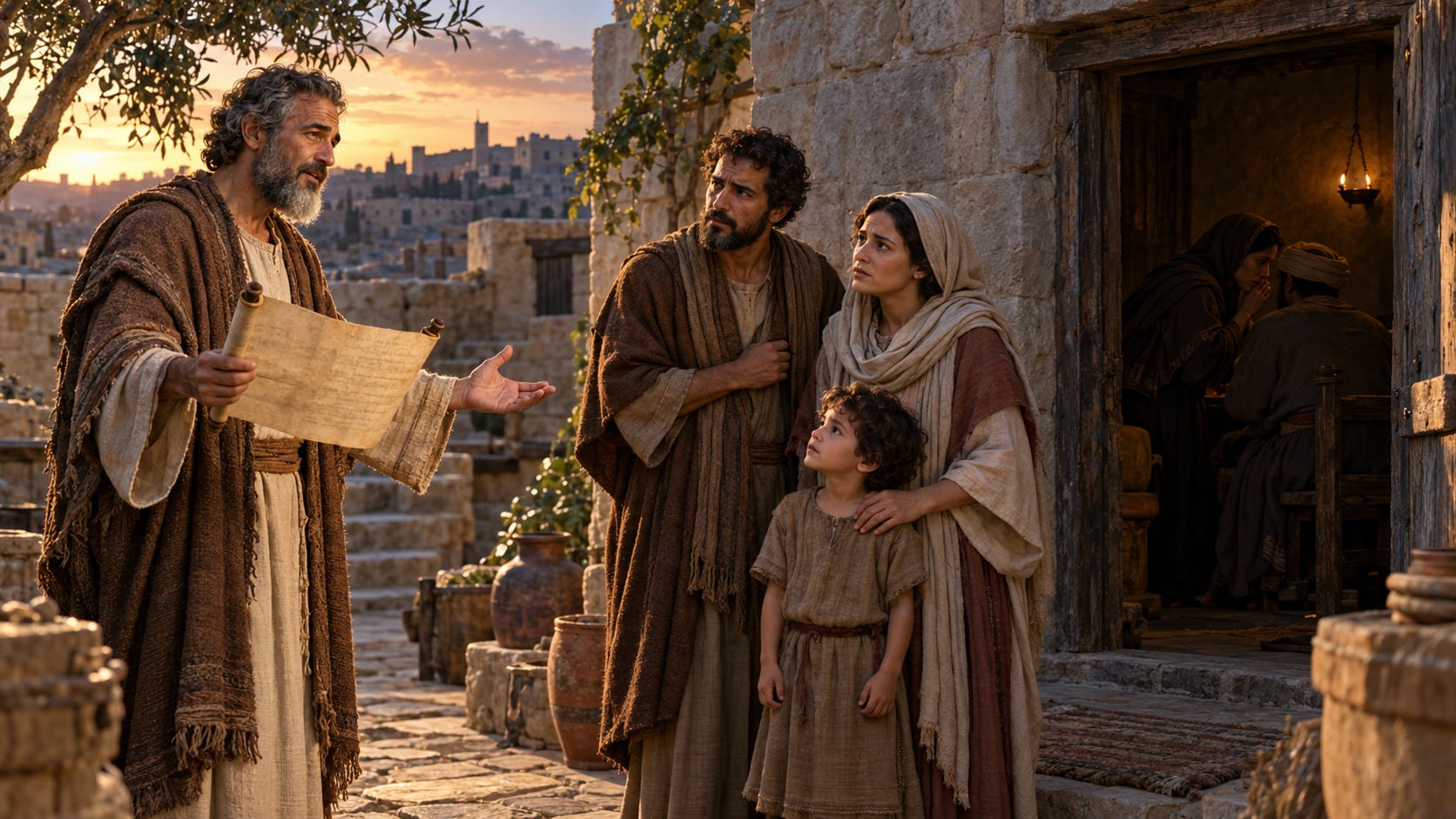
“When they say to you, “Consult the mediums and the spiritists who whisper and mutter,” should not a people consult their God? Should they consult the dead on behalf of the living? To the law and to the testimony! If they do not speak according to this word, it is because they have no dawn. They will pass through the land hard-pressed and famished, and it will turn out that when they are hungry, they will be enraged and curse their king and their God as they face upward. Then they will look to the earth, and behold, distress and darkness, the gloom of anguish; and they will be driven away into darkness.”
Isaiah 8:19-22 NASB1995
Isaiah saw that the people of Judah and Jerusalem were consulting mediums and “spiritists” to try and explain events and suffering, rather than consulting God. I think the best commentary I read about this forbidden practice is in Gotquestions.org:
Praying to the dead is strictly forbidden in the Bible. Deuteronomy 18:11 tells us that anyone who “consults with the dead” is “detestable to the Lord.” The story of Saul consulting a medium to bring up the spirit of the dead Samuel resulted in his death “because he was unfaithful to the Lord; he did not keep the word of the Lord and even consulted a medium for guidance” (1 Samuel 28:1-25; 1 Chronicles 10:13-14). Clearly, God has declared that such things are not to be done.
Consider the characteristics of God. God is omnipresent—everywhere at once—and is capable of hearing every prayer in the world (Psalm 139:7-12). A human being, on the other hand, does not possess this attribute. Also, God is the only one with the power to answer prayer. God is omnipotent—all powerful (Revelation 19:6). Certainly this is an attribute a human being—dead or alive—does not possess. Finally, God is omniscient—He knows everything (Psalm 147:4-5). Even before we pray, God knows our genuine needs and knows them better than we do. Not only does He know our needs, but He answers our prayers according to His perfect will.
So, in order for a dead person to receive prayers, the dead individual has to hear the prayer, possess the power to answer it, and know how to answer it in a way that is best for the individual praying. Only God hears and answers prayer because of His perfect essence and because of what some theologians call His “immanence.” Immanence is the quality of God that causes Him to be directly involved with the affairs of mankind (1 Timothy 6:14-15); this includes answering prayer.
Even after a person dies, God is still involved with that person and his destination. Hebrews 9:27 says so: “…Man is destined to die once, and after that to face judgment.” If a person dies in Christ, he goes to heaven to be present with the Lord (2 Corinthians 5:1-9, especially verse 8); if a person dies in his sin, he goes to hell, and eventually everyone in hell will be thrown into the lake of fire (Revelation 20:14-15).
God has provided His Son, Jesus Christ, to be the mediator between man and God (1 Timothy 2:5). With Jesus Christ as our mediator, we can go through Jesus to God. Why would we want to go through a sinful dead individual, especially when doing so risks the wrath of God?
So, an interesting (and likely controversial) question could be asked: What about those who offer up prayer to someone other than Jesus? Perhaps they pray to Mary or to other departed Saints. Isn’t this the same thing as trying to get a dead person to answer prayer? Folks may not like this, but Mary is not our savior and intercessor, nor are the many Saints who supposedly answer prayers for certain concerns; they were good believers but they were also all sinners and are not omnipotent and omniscient.
So I found a website that lists those Saints and supposedly who you pray to for various things; I’m not providing a link, but suffice to say that this particular list had 55 specific names for various concerns, like strength, relationships, school, career, health, travel, big decisions, creativity, friendship, mental wellness, and grief. Apparently, the “55” is but a drop in the bucket for the complete list of Saints prayed to and commemorated in feast days.
The last section of this list appears as follows:
For When You Just Don’t Know Where to Start
Mary, Mother of God – Always a sure and loving intercessor
All Saints – When in doubt, ask the whole communion to pray for you!
Your Confirmation Saint – You chose them for a reason—reconnect
Your Guardian Angel – Given specifically to you for life-long help
The Holy Spirit – Ask for wisdom, clarity, peace, and direction
I don’t claim to understand where this theology came from, considering the admonitions in Scripture against praying to dead people (and, yes, every single one of 55+ imperfect saints physically died and were not resurrected; only Jesus did that. They were canonized as ‘Saints’, through the works of man). I also noticed that a prayer to Jesus is nowhere on the list, even in that last section! The Holy Spirit is there, which I guess is kind of a mulligan, but where is Jesus (and God, for that matter)? We, the living believers, are saints, by the way (Romans 1:7).
Gotquestions.org has a good explanation, again:
Let us examine the claim that praying to Mary and the saints is no different than asking someone here on earth to pray for us:
1) Asking other believers (on earth) to pray for us is certainly biblical (2 Corinthians 1:11; Ephesians 1:16; Philippians 1:19; 2 Timothy 1:3). For example, the apostle Paul asks other Christians to pray for him as he sought to preach the gospel effectively (Ephesians 6:19).
2) The Bible never mentions a believer asking someone in heaven to pray for him or her. It also never describes anyone in heaven praying for anyone on earth.
3) The Bible never says Mary or other saints can hear the prayers of people on earth. Mary and the saints are not omniscient. Even glorified in heaven, they are still finite beings with limitations. How could they hear the prayers of millions of people on earth?
4) Whenever the Bible mentions praying to or speaking with those who have died on earth, it is in a negative context involving activities the Bible strongly condemns (Leviticus 20:27; Deuteronomy 18:10–13; 1 Samuel 28:7–19).
Praying to Mary or the saints is different from asking a friend on earth to pray for us. Asking fellow believers to pray for us has a clear biblical basis; asking Mary or the saints to pray for us does not. Scripture gives no basis for praying to anyone other than God alone, nor is there any need to do so.
Jesus Christ is our only mediator and intercessor, and through Him believers have direct access to the Father. Because the temple veil was torn in two (Hebrews 10:19–20), every child of God can "approach the throne of grace with confidence" (Hebrews 4:16). Only God hears and answers prayer, and no one in heaven mediates on our behalf except Jesus Christ.
Sorry about the bunny trail, but this seemed to be quite revealing to me. At one time after we came back to faith, we considered possibly becoming Catholics or even toyed with the idea of the Orthodox Church, as those faith traditions seemed appealing in a mystical, structured way. Fortunately, we have learned a lot more about God and His precepts since then. I’m not in any position to condemn those who follow these practices, but scripture is quite clear that we don’t pray to the dead.

Back to Isaiah - rather than go down these paths into darkness and disobedience by consulting the dead, we should turn to the law and testimony. If they (mediums and false prophets) do not speak according to this word, it is because they have no dawn (light).
I like the Enduring Word commentary for this passage:
a. Seek those who are mediums and wizards: In the present danger from Syria and Israel, and in the coming danger from Assyria, Judah will be tempted to seek guidance and comfort from those who are mediums and wizards. Isaiah exposes the foolishness of this, when he says, “Should not a people seek their God? Should they seek the dead on behalf of the living?”
i. When you are in trouble, shouldn’t you seek your God? If you can’t rely on your God when you are in trouble, then what good is your God?
ii. What sense does it make to seek the dead on behalf of the living? The dead are the dead, the living are the living. The living God speaks through His living Word and His living people to guide us. There is no reason to seek the dead.
iii. This passage also exposes the foolishness of praying to the saints. The exact same question should be asked: Should they seek the dead on behalf of the living?
b. To the law and to the testimony: Forget about mediums and wizards and the dead. Instead of all that deception and foolishness, To the law and to the testimony! Go to God’s word.
i. Law and testimony each refer to God’s word. We might say that law refers to God’s holy commands, and testimony refers to His dealings with His people as recorded in His Word. But that may be slicing it too thin, because often similar terms for God’s word are repeated, not for the sake of distinction, but for the sake of emphasis.
ii. How it needs to be proclaimed to our preachers today: To the law and to the testimony! Enough with the over-use of anecdotes and jokes. Enough with the emphasis on entertainment and sappy stories. Enough with the catering to itching ears. Enough with the hobbyhorses and pet peeves. To the law and to the testimony!
iii. “Let us remember, as ministers of the Gospel, what M’Cheyne beautifully said; ‘Depend upon it,’ said he, ‘it is God’s Word not man’s comment upon God’s Word, that saves souls;’ and I have marked, that if ever we have a conversion at any time, in ninety-nine cases out of a hundred, the conversion is rather traceable to the text, or to some Scripture quoted in the sermon, than to any trite or original saying by the preacher. It is God’s Word that breaks the fetters and sets the prisoner free, it is God’s Word instrumentally that saves souls, and therefore let us bring everything to the touchstone.” (Spurgeon)
c. If they do not speak according to this word, it is because there is no light in them: If there is a disagreement between God’s word and the word of the messenger, it isn’t hard to figure out who is wrong. The messenger is wrong. The word judges the messenger; the messenger doesn’t judge the word.
d. They will be driven into darkness: When they forsake God’s word and trust in mediums and wizards and the dead, they are courting darkness, not light.
I want to focus in on the second-to-last item in this commentary. The word judges the messenger; the messenger doesn’t judge the word. Many mainstream churches are now trying to outdo each other reading things into scripture that are just not there, to justify their embrace of social issues like transgenderism and abortion (to name a few). I debated putting a huge list of things I’ve seen lately from alleged pastors of the Christian faith that would just make believers cringe, but this devotional is already getting too long. Just keep in mind the focus should always be on the law and the testimony and He will judge the messenger.
Oh, and we like the sermons our pastor gives, but he does have a tendency to do too many anecdotes and jokes and funny gestures because he can get a laugh out of the congregation.
My next devotional examines Isaiah 9:1-2 - The people who walk in darkness will see a great light.
Heaven on Wheels Daily Prayer:
Dear Lord - I pray that people understand the law and testimony of Scripture so that they know who the one, true intercessor of our faith is - You, Lord Jesus! Amen
Citations and Credits:
Scripture quotations taken from the (NASB®) New American Standard Bible®, Copyright © 1960, 1971, 1977, 1995 by The Lockman Foundation. Used by permission. All rights reserved. www.Lockman.org.
Precept Austin was accessed on 10/07/2026 to review commentary for Isaiah 8:19-22.
Biblehub.org was accessed on 10/07/2026 to review commentary for Isaiah 8:19-22.
Commentary from Enduring Word is used with written permission and without any alteration. ©1996-present The Enduring Word Bible Commentary by David Guzik – enduringword.com. At the link referenced, the bibliography used by David Guzik can be accessed.
Gotquestions.org was accessed on 10/07/2026 to answer the question,What does the Bible say about praying to the dead?
Gotquestions.org was accessed on 10/07/2026 to answer the question, Is prayer to saints / Mary biblical?
Gotquestions.org © COPYRIGHT 2002-2026 GOT QUESTIONS MINISTRIES. ALL RIGHTS RESERVED