


“Then I said, “Lord, how long?”
And He answered,
“Until cities are devastated and without inhabitant,
Houses are without people
And the land is utterly desolate,
The Lord has removed men far away,
And the forsaken places are many in the midst of the land.
Yet there will be a tenth portion in it,
And it will again be subject to burning,
Like a terebinth or an oak
Whose stump remains when it is felled.
The holy seed is its stump.””
Isaiah 6:11-13 NASB1995
After Isaiah hears that he will have the “joy” of preaching to a people that refuse to listen and have hardened their hearts, he asks a question of the Lord on how long this situation is expected to last. I think that question is understandable on his part and the Lord responds that Isaiah will do this until the cities are devastated and without inhabitants, houses are without people and the land is utterly desolate. Men will be removed to far away and there will be many forsaken places. Yet there is the faint hope of a remnant, but yet again that remnant will not have learned its lesson and will be subject to burning. But the holy seed is planted from this stump.
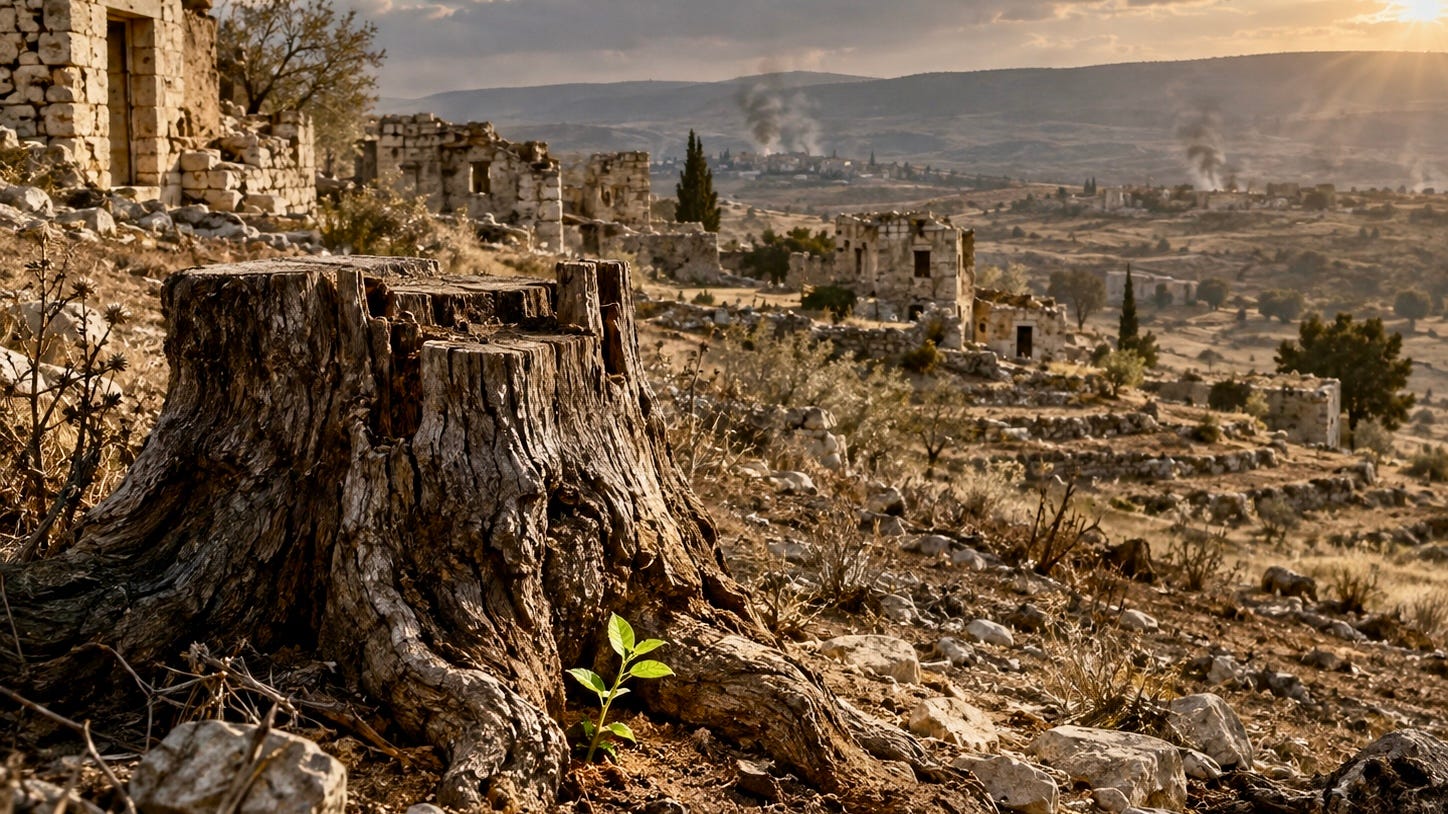
The AI image at the top had this description:
A devastated Judean landscape after judgment: abandoned stone homes, ruined fields, perhaps smoke lingering far in the distance. Dominating the foreground is a large oak or terebinth that has been cut down, leaving a weathered stump. From near its base, a tiny fresh green shoot emerges into the sunlight. No people are necessary. The contrast between destruction and that fragile sign of life beautifully captures verses 11–13: almost everything is gone, yet God’s purposes are not finished.
Precept Austin cautions readers of this passage to not get carried away with the interpretation of the holy seed from the stump of the remnant, but there are a few commentators who believe this points to the Messiah. There are others who believe that this holy seed is a holy remnant of the people of Israel (Judah) in the far future after the Babylonian captivity. Whatever the case, Isaiah has a long slog ahead of him, probably lasting after his lifetime. But there is hope!
Here’s the commentary from Enduring Word from this last passage in Isaiah 6:
a. Lord, how long? This is a logical question from anyone who is given such a difficult commission. “Do I have to preach to those who won’t hear, and their rejection of my message will ultimately seal their doom? How long will I have to serve in that kind of ministry?”
b. Until the cities are laid waste and without inhabitant: This answered the question of how long Isaiah was to preach. He should preach until destruction comes. He should preach in hope of the restoration of a remnant (yet a tenth will be in it, and will return). Even though Isaiah’s ministry was difficult, it was not without hope.
c. And be for consuming: The remnant will indeed return, but even the remnant will eventually be judged. Israel was not done being disobedient when they returned from the Babylonian captivity, and God was not done bringing His judgment on a disobedient Israel.
i. “The devastation, great as it was to be, would not be total; but even its survivors would have to submit to further judgment. The illustration from nature, however, introduces an element of hope.” (Grogan)
ii. We would expect this dramatic call of Isaiah to open the book. But the Bible clearly states that the message is more important than the messenger. Isaiah’s message was more important than Isaiah the messenger.
iii. When Isaiah saw the LORD, who did he see? He saw God in the Second Person of the Trinity, he saw Jesus before He added humanity to His deity. We know this because the Apostle John quotes Isaiah 6:10, and under the inspiration of the Holy Spirit, adds: These things Isaiah said when he saw His glory and spoke of Him (John 12:41).
Two important takeaways:
The message is more important than the messenger. Although Isaiah is one of the greatest prophets, his message is what we should focus on.
The Apostle John refers to this passage in the Gospel that he wrote. Isaiah saw Jesus as part of the Triune God before He added humanity to His deity. Let’s look at that passage:
“But though He had performed so many signs before them, yet they were not believing in Him. This was to fulfill the word of Isaiah the prophet which he spoke: “Lord, who has believed our report? And to whom has the arm of the Lord been revealed?” For this reason they could not believe, for Isaiah said again, “He has blinded their eyes and He hardened their heart, so that they would not see with their eyes and perceive with their heart, and be converted and I heal them.” These things Isaiah said because he saw His glory, and he spoke of Him. Nevertheless many even of the rulers believed in Him, but because of the Pharisees they were not confessing Him, for fear that they would be put out of the synagogue; for they loved the approval of men rather than the approval of God.”
John 12:37-43 NASB1995
Focus on the message!
My next devotional examines Isaiah 7:1-2 - War in the days of Ahaz.
Heaven on Wheels Daily Prayer:
Dear Lord - Thank You for the message through Your great messenger Isaiah. Trials and tribulations may come now but there is hope. Amen.
Citations and Credits:
Scripture quotations taken from the (NASB®) New American Standard Bible®, Copyright © 1960, 1971, 1977, 1995 by The Lockman Foundation. Used by permission. All rights reserved. www.Lockman.org.
Precept Austin was accessed on 09/17/2026 to review commentary for Isaiah 6:11-13.
Commentary from Enduring Word is used with written permission and without any alteration. ©1996-present The Enduring Word Bible Commentary by David Guzik – enduringword.com. At the link referenced, the bibliography used by David Guzik can be accessed.