


““Wash yourselves, make yourselves clean;
Remove the evil of your deeds from My sight.
Cease to do evil,
Learn to do good;
Seek justice,
Reprove the ruthless,
Defend the orphan,
Plead for the widow.
“Come now, and let us reason together,”
Says the Lord,
“Though your sins are as scarlet,
They will be as white as snow;
Though they are red like crimson,
They will be like wool.
If you consent and obey,
You will eat the best of the land;
But if you refuse and rebel,
You will be devoured by the sword.”
Truly, the mouth of the Lord has spoken.”
Isaiah 1:16-20 NASB1995
The Lord through Isaiah tells the people of Judah what they have to do to overcome what they have done to offend the Lord in the first part of this passage. I’m going to try something a little different with this for word studies: Each phrase will have the Hebrew source (Strong’s definition) from the Blue Letter Bible to show how this was heard by the people of that time (I confess to being very intrigued by the Hebrew language, which is so different than classic Greek):
Wash yourselves.
רָחַץ râchats, raw-khats’; a primitive root; to lave (the whole or a part of a thing):—bathe (self), wash (self).
Make yourselves clean.
זָכָה zâkâh, zaw-kaw'; a primitive root (compare H2141); to be translucent; figuratively, to be innocent:—be (make) clean, cleanse, be clear, count pure.
Remove the evil of your deeds from His sight.
סוּר çûwr, soor; or שׂוּר sûwr; (Hosea 9:12), a primitive root; to turn off (literally or figuratively):—be(-head), bring, call back, decline, depart, eschew, get (you), go (aside), × grievous, lay away (by), leave undone, be past, pluck away, put (away, down), rebel, remove (to and fro), revolt, × be sour, take (away, off), turn (aside, away, in), withdraw, be without.
רֹעַ rôaʻ, ro'-ah; from H7489; badness (as marring), physically or morally:—× be so bad, badness, (× be so) evil, naughtiness, sadness, sorrow, wickedness.
מַעֲלָל maʻălâl, mah-al-awl'; from H5953; an act (good or bad):—doing, endeavour, invention, work.
עַיִן ʻayin, ah'-yin; probably a primitive word; an eye (literally or figuratively); by analogy, a fountain (as the eye of the landscape):—affliction, outward appearance, before, think best, colour, conceit, be content, countenance, displease, eye((-brow), (-d), -sight), face, favour, fountain, furrow (from the margin), × him, humble, knowledge, look, (+ well), × me, open(-ly), + (not) please, presence, regard, resemblance, sight, × thee, × them, + think, × us, well, × you(-rselves).
Cease to do evil.
חָדַל châdal, khaw-dal’; a primitive root; properly, to be flabby, i.e. (by implication) desist; (figuratively) be lacking or idle:—cease, end, fall, forbear, forsake, leave (off), let alone, rest, be unoccupied, want.
Learn to do good.
לָמַד lâmad, law-mad'; a primitive root; properly, to goad, i.e. (by implication) to teach (the rod being an Oriental incentive):—(un-) accustomed, × diligently, expert, instruct, learn, skillful, teach(-er, -ing).
יָטַב yâṭab, yaw-tab'; a primitive root; to be (causative) make well, literally (sound, beautiful) or figuratively (happy, successful, right):—be accepted, amend, use aright, benefit, be (make) better, seem best, make cheerful, be comely, be content, diligent(-ly), dress, earnestly, find favour, give, be glad, do (be, make) good(-ness), be (make) merry, please ( well), shew more (kindness), skilfully, × very small, surely, make sweet, thoroughly, tire, trim, very, be (can, deal, entreat, go, have) well (said, seen).
Seek justice.
דָּרַשׁ dârash, daw-rash'; a primitive root; properly, to tread or frequent; usually to follow (for pursuit or search); by implication, to seek or ask; specifically to worship:—ask, × at all, care for, × diligently, inquire, make inquisition, question, require, search, seek (for, out), × surely.
מִשְׁפָּט mishpâṭ, mish-pawt'; from H8199; properly, a verdict (favorable or unfavorable) pronounced judicially, especially a sentence or formal decree (human or (participant's) divine law, individual or collective), including the act, the place, the suit, the crime, and the penalty; abstractly, justice, including a participant's right or privilege (statutory or customary), or even a style:— adversary, ceremony, charge, ×crime, custom, desert, determination, discretion, disposing, due, fashion, form, to be judged, judgment, just(-ice, -ly), (manner of) law(-ful), manner, measure, (due) order, ordinance, right, sentence, usest, ×worthy, wrong.
Reprove the ruthless.
אָשַׁר ʼâshar, aw-shar'; or אָשֵׁר ʼâshêr; a primitive root; to be straight (used in the widest sense, especially to be level, right, happy); figuratively, to go forward, be honest, prosper:—(call, be) bless(-ed, happy), go, guide, lead, relieve.
חָמוֹץ châmôwts, khaw-motse'; from H2556; properly, violent; by implication, a robber:—oppressed.
Defend the orphan.
שָׁפַט shâphaṭ, shaw-fat'; a primitive root; to judge, i.e. pronounce sentence (for or against); by implication, to vindicate or punish; by extenssion, to govern; passively, to litigate (literally or figuratively):— avenge, × that condemn, contend, defend, execute (judgment), (be a) judge(-ment), × needs, plead, reason, rule.
יָתוֹם yâthôwm, yaw-thome’; from an unused root meaning to be lonely; a bereaved person:—fatherless (child), orphan.
Plead for the widow.
רִיב rîyb, reeb; or רוּב rûwb; a primitive root; properly, to toss, i.e. grapple; mostly figuratively, to wrangle, i.e. hold a controversy; (by implication) to defend:—adversary, chide, complain, contend, debate, × ever, × lay wait, plead, rebuke, strive, × thoroughly.
אַלְמָנָה ʼalmânâh, al-maw-naw'; feminine of H488; a widow; also a desolate place:—desolate house (palace), widow.
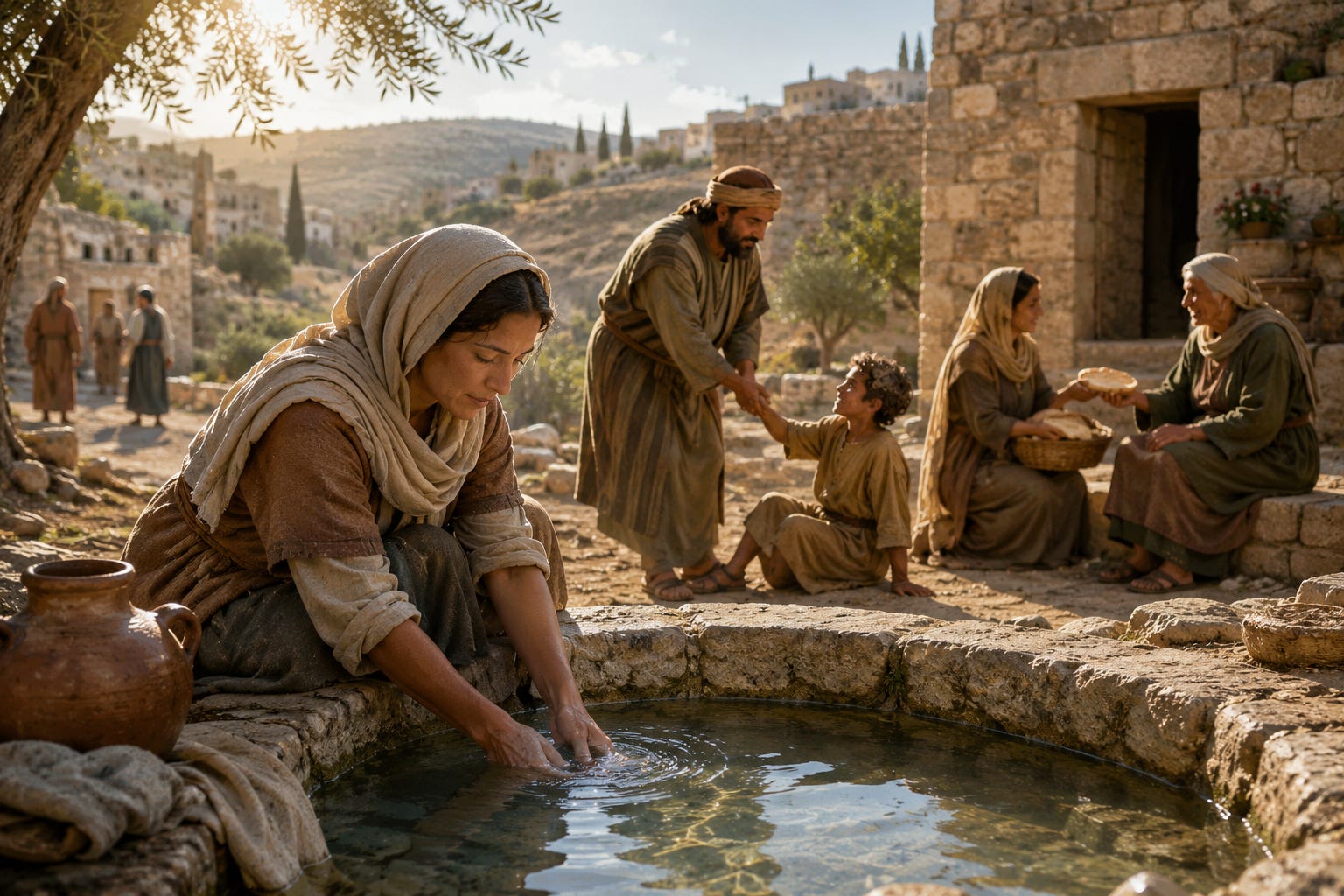
We are to clean ourselves back to a pure and innocent state, depart from all evil works that are seen or are done in the presence of the Lord (that would all of them), be taught those things that are in His favor, search for justice and what is right, be honest and rebuke those who are oppressors, avenge and govern those who are orphans, and strive with those who are widowed. The AI image shows a woman cleaning her hands, a man working with a child who is likely an orphan, and another woman consoling an older woman who is likely a widow.
Precept Austin has a good, succinct summary of the actions that we can take:
Sinners are lost and in grave need to hear God’s holy word that they might walk in His holy way and will and this section of Isaiah (Isa 1:16, 17, 18, 19, 20) is God’s “GPS” (”Global Positioning Signal”) “turned on” to guide all those who are spiritual wayward and lost onto the ancient path (Jer 6:16, 18:15), the highway of holiness (Isa 35:8, 30:21, 1Pe 1:15-note) on which the redeemed (Isa 1:27, 35:9) are privileged to walk in this life and eternally in that to come.
REPENT - “Wash you, make you clean; put away the evil of your doings from before mine eyes;”
REFRAIN - “cease to do evil;”
REEVALUATE - “Learn to do well; seek judgment,”
RELIEVE - “relieve the oppressed, judge the fatherless, plead for the widow.”
A similar passage can be found in Micah:
“He has told you, O man, what is good;
And what does the Lord require of you
But to do justice, to love kindness,
And to walk humbly with your God?”
Micah 6:8 NASB1995
Siding with the oppressed and caring for those who are in desperate situations reminds me of the wise words from John Piper that he gave to answer a question on Desiring God on whether believers should give money to every panhandler and homeless person:
So I encourage all of us to do a little bit of research, a little bit of homework of what would be really most helpful to people on the street, all things considered. It’s not an easy question. And since we’re so prone towards selfishness, I think we should err on the side of being taken advantage of rather than erring on the side of shrewdly protecting our wallet and our ego.
At the last judgment — I’ve thought about this many times — I think Jesus will be much more prone to commend lavish generosity to the undeserving than he will be to commend how shrewd we were in keeping for ourselves our few dollars rather than giving them away. I just can’t imagine Jesus saying, “Wow, you were especially good at being shrewd at not being taken advantage of.” I don’t hear anything like that in Jesus’s teachings.
So, let’s know our own hearts, let’s confess the sin of selfishness, let’s pray for the compassion of Jesus and the far-seeing wisdom of Jesus, and let’s do our homework, a little bit of research to find out how our lives as a whole can bring blessing into people’s lives, especially eternal blessing.

The second part of this passage is so compelling! God invites us to come together with Him and reason together. Our sins, which are crimson/scarlet in color, will become like snow (see the pure snow in the image above) or wool through His forgiveness (a hint at the coming Jesus). We will eat the best of the land if we obey; if we rebel, we will be devoured by the sword.
Let’s do a word study on let us reason together:
This comes from the Hebrew verb (Strong’s definition) and has the following Biblical usages:
יָכַח yâkach, yaw-kahh'; a primitive root; to be right (i.e. correct); reciprocal, to argue; causatively, to decide, justify or convict:—appoint, argue, chasten, convince, correct(-ion), daysman, dispute, judge, maintain, plead, reason (together), rebuke, reprove(-r), surely, in any wise. [H3198].
to prove, decide, judge, rebuke, reprove, correct, be right
(Hiphil)
to decide, judge
to adjudge, appoint
to show to be right, prove
to convince, convict
to reprove, chide
to correct, rebuke
(Hophal) to be chastened
(Niphal) to reason, reason together
(Hithp) to argue
Christianity (and belief in God in general) is regarded by atheists as unreasonable because faith in an unseen Supreme Being is outside an empirical or scientific solution. I recall seeing many articles to that effect from secular humanist organizations when I was wandering in the wilderness. Here is a definition of reason from a philosophical standpoint from Wikipedia:
Reason is the capacity to consciously apply logic by drawing valid conclusions from new or existing information, with the aim of seeking truth.[1] It is associated with activities considered characteristic of humans, including philosophy, religion, science, language, and mathematics, and is generally considered a distinguishing ability possessed by humans.[2][3] The term "reason" is sometimes used to refer to rationality,[4] although the latter is more about its application.
Interestingly, using reason was a major part of the development of early Christianity, according to the same article in Wikipedia. Now that I have come to real faith, for me the only reasonable conclusion is that there is a Creator God and He is the God of the Bible and our redeemer. It is THE truth, not my special truth.
I like this commentary from Enduring Word on this passage (there are some wonderful Charles Spurgeon comments that David Guzik found):
b. “Come now, let us reason together,” says the LORD: The Lord GOD invites His people to come reason with Him. What He offers us isn’t just offered because He is greater than us and has the right to dictate whatever terms please Him. God’s direction for us is reasonable. It is smart. It is the best way to live.
i. It is madness to reject and resist a God of infinite wisdom, infinite love, infinite grace, and infinite power. True reason will drive any honest man to the humblest adoration and submission towards God.
ii. The angels surrounding the throne of God are covered with eyes, which speaks of their great ability to perceive and know (Revelation 4:6-8). These are perhaps the most intelligent, rational beings God ever created, and they spend every moment of their existence lost in total praise, total adoration, and total surrender to God. This is where the highest reason will drive us.
iii. It is just plain reasonable to follow God. Have you ever once heard of an old Christian, on their deathbed, gathering their children and friends around, and saying: “Now friends, watch out for that Christianity! I’ve followed Jesus my whole life and I’m so sorry I did! What a waste that was!” What nonsense! Quite the contrary, we find that Christians on their deathbed are trusting and loving God more than ever. It’s just plain reasonable.
c. Though your sins are like scarlet, they shall be as white as snow; though they are red like crimson, they shall be as wool: The LORD offered a repentant, humbled Judah true and complete cleansing from sin. Their condition of sin could be transformed from deeply stained to become completely white.
i. In this passage, Isaiah says nothing about how this cleansing comes. But we know that it comes because Jesus took upon Himself our stain of sin, and God judged sin perfectly and completely in Jesus, so we can be accounted white as snow and as white as wool.
ii. There is tremendous hope in God’s forgiveness! We really can be clean from the stain of sin. Our good works can’t clean the stain. Our best intentions or promises can’t clean the stain. Our suffering or pain can’t clean the stain. Time can’t clean the stain. Death can’t clean the stain. Only the work of Jesus can make us white as snow! We really can have a break with the past, and a new beginning in Jesus Christ. The power of sin, the shame of sin, the guilt of sin, the domination of sin, the terror of sin, and the pain of sin can all be taken away in Jesus.
iii. “The Lord does not deny the truth of what the sinner has confessed, but he says to him, ‘Though your sins be as scarlet, I meet you on that ground. You need not try to diminish the extent of your sin, or seek to make it appear to be less than it really is. No; whatever you say it is, it is all that, and probably far more. Your deepest sense of your sinfulness does not come up to the truth concerning your real condition; certainly, you do not exaggerate in the least. Your sins are scarlet, and crimson; it seems as though you have put on the imperial robe of sin, and made yourself a monarch of the realm of evil.’ That is how a man’s guilt appears before the searching eye of God.” (Spurgeon)
iv. Spurgeon described people deeply stained by sin: “A wicked old wretch who has taken his degrees in Satan’s college, has become a Master of Belial, a prince and chief of sinners – a Goliath amongst the Philistines – yet, to such a man, is this word sent today. Your hands are bloody with the souls of the young, you have kept a hellhouse; you have grit up public entertainments which have debauched and depraved the young; you have gold in your pocket to-day, which you have earned by the blood of souls; you have the fool’s pence, and the drunkard’s shillings, which have really come into your hands from the hearts of poor women, you have heard the cries of the starving children, and you have tempted their husbands to take the drink, and ruined their bodies and their souls. You have kept a place where the entertainment was so low, so grovelling, that you awoke the slumbering passions of evil in the minds of either young or old, and so you shall sink to hell with the blood of others on your head, as well as your own damnation, not with one millstone about your neck, but with many.” All this may be true of you; yet God can forgive your sins and you can be made white as snow.
d. Come now: When we consider the greatness of God’s cleansing and pardon, it is all the more reason for us to come now. God wants the separation between you and He to be gone now. He doesn’t want you to continue in your destructive path another moment. He wants the best for us now.
i. “Come now, no season can be better. If ye tardy till you’re better, ye will never come at all. Come now; you may never have another warning; the heart may never be so tender as it is to-day. Come now; no other eyes may ever weep over you; no other heart may ever agonise for your salvation. Come now, now, now, for tomorrow you may never know in this world. Death may have sealed your fate, and the once filthy may remain filthy still. Come now; for to-morrow thy heart may become harder than stone, and God may give thee up. Come now; it is God’s time; to-morrow is the devil’s time. ‘To-day if ye will hear his voice harden not your hearts, as in the provocation, when your fathers tempted me and proved me in the wilderness and saw my works.’ Come now. Why delay to be happy? Would you put off your wedding-day? Will you postpone the hour when you are pardoned and delivered? Come now: the bowels of Jehovah yearn for you. The eye of your father sees you afar off, and he runs to meet you. Come now; the church is praying for you; these are revival times; ministers are more in earnest.” (Spurgeon)
e. If you are willing and obedient, you shall eat the good of the land; but if you refuse and rebel, you shall be devoured by the sword: Here God offered Judah a choice. They could find hope in the midst of their chastisement, relief from empty religious ritual, and cleansing from their sin. But they had to surrender their heart before God, and not refuse and rebel. Instead, they had to be willing and obedient.
i. No one perfectly matches either phrase, but which phrase better describes your life? Is it willing and obedient or refuse and rebel? There is a consequence for either course: eat of the good of the land or be devoured by the sword. No wonder the LORD said, “Come now, let us reason together!”
A few takeaways:
It IS truly madness to reject a sovereign God. During my stint in the wilderness, I had a still, small voice in my head ALL THE TIME telling me that I was wrong. Let me assure you, that voice will lead to either madness or repentance.
We could be the worst sinner in the world (I love the Spurgeon example, like something out of Charles Dickens), yet we can be made as pure as driven snow or bright wool through His grace and mercy.
There is an urgency to the Lord telling us to come and reason with Him. He wants us to come NOW, not tomorrow, not on our deathbed. As Spurgeon puts it, tomorrow is the devil’s time.
Are we willing and obedient? Or are we refusing His invitation and are we rebels?
Wow - a lot to unpack and we’re still in the first chapter of Isaiah. My next devotional examines Isaiah 1:21-23 - The unjust leaders of Judah.
Heaven on Wheels Daily Prayer:
Dear Lord - Thank You for making me see that my empirical, scientific approach to life was unreasonable. The only thing that makes sense in our lives is to look to You for the answers. Amen.
Citations and Credits:
Scripture quotations taken from the (NASB®) New American Standard Bible®, Copyright © 1960, 1971, 1977, 1995 by The Lockman Foundation. Used by permission. All rights reserved. www.Lockman.org.
The Blue Letter Bible lexicon was accessed on 7/23/2026 to do many word studies for this passage in Isaiah.
“Isaiah 1 (NASB95) - The vision of Isaiah the.” Blue Letter Bible. Web. 23 Jul, 2026. <https://www.blueletterbible.org/nasb95/isa/1/1/s_680018>.
Precept Austin was accessed on 07/23/2026 to review commentary for Isaiah 1:16-20.
John Piper is founder and teacher of desiringGod.org and chancellor of Bethlehem College and Seminary. For more than thirty years, he served as pastor of Bethlehem Baptist Church, Minneapolis. He is author of more than fifty books, and his sermons, articles, books, and more are available free of charge at desiringGod.org. By John Piper. © Desiring God Foundation. Source: desiringGod.org
Commentary from Enduring Word is used with written permission and without any alteration. ©1996-present The Enduring Word Bible Commentary by David Guzik – enduringword.com. At the link referenced, the bibliography used by David Guzik can be accessed.