


“Where will you be stricken again,
As you continue in your rebellion?
The whole head is sick
And the whole heart is faint.
From the sole of the foot even to the head
There is nothing sound in it,
Only bruises, welts and raw wounds,
Not pressed out or bandaged,
Nor softened with oil.
Your land is desolate,
Your cities are burned with fire,
Your fields—strangers are devouring them in your presence;
It is desolation, as overthrown by strangers.
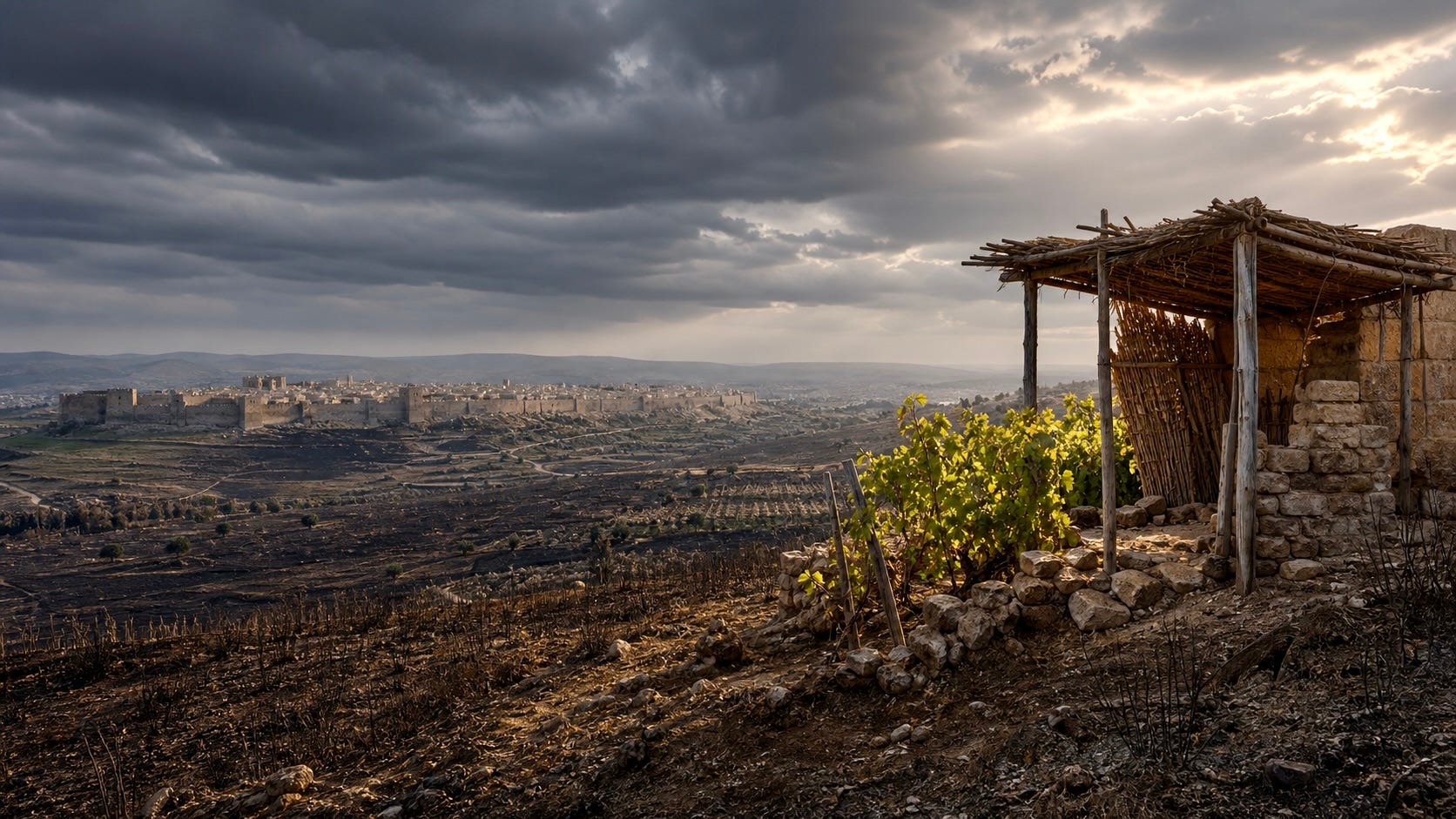
The daughter of Zion is left like a shelter in a vineyard,
Like a watchman’s hut in a cucumber field, like a besieged city.
Unless the Lord of hosts
Had left us a few survivors,
We would be like Sodom,
We would be like Gomorrah.”
Isaiah 1:5-9 NASB1995
The desperate state of Judah and its people is described in this next passage in Isaiah 1. They are stricken, over and over again, and are sick and wounded from head to toe. Their lands are desolate, their cities are burned with fire, and strangers are devouring their fields. Yet they refuse to give up their sin and stubbornly choose to live in this wretched state. The AI image at the top is described by ChatGPT in this way:
A sweeping photorealistic landscape of ancient Judah after invasion, viewed across rugged limestone hills and a broad agricultural valley. Scorched fields, abandoned vineyards, and a partially ruined ancient walled city appear in the distance, with faint smoke rising beneath a somber storm-filled sky. In the foreground stands a small, weathered vineyard watchman’s shelter, isolated and fragile like a hut left in an empty field. Near it, one small cluster of living green vines catches a narrow shaft of warm dawn light, symbolizing the remnant preserved by God. Historically authentic ancient Near Eastern setting, solemn and contemplative rather than cinematic or violent, no people, no modern objects, natural colors, highly detailed photorealism, landscape orientation, 16:9 composition, generous quiet space on the left for devotional text.
First, let’s look at commentary from Enduring Word on these verses:
a. Why should you be stricken again? Despite their sin, God did not wish evil upon Judah. Instead, He longed for them to repent and to make it easy on themselves. God had chastised Judah, and they did not respond. They would continue to be stricken as long as they rebelled.
b. Sick…the whole heart faints…. no soundness…wounds and bruises and putrefying sores: Because of their rebellion against God, Judah was in a bad place. This is where their disobedience and lack of submission brought them.
c. Your country is desolate, your cities burned with fire; strangers devour your land in your presence: During the reign of Ahaz, the kingdom of Judah was attacked and pillaged by Israel, Syria, Edom, the Philistines, and Assyria (2 Chronicles 28). It was written of this period, For the LORD brought Judah low because of Ahaz king of Israel, for he had encouraged moral decline in Judah and had been continually unfaithful to the LORD (2 Chronicles 28:19).
i. For all this, Judah would not repent. Their sin brought them great trouble, but they still preferred their sin, with all of its trouble, than submitting to the LORD God. In fact, 2 Chronicles 28:22 says, Now in the time of his distress King Ahaz became increasingly unfaithful to the LORD.
d. Unless the LORD of hosts had left to us a very small remnant, we would have become like Sodom, we would have been made like Gomorrah: As bad as Judah’s state was because of their sin, it could have been worse. It was only by the mercy of God that they survived at all. Sodom and Gomorrah were both totally destroyed, with not even a very small remnant to carry on. Even in the midst of judgment, God showed His mercy to Judah.
God’s mercy is never-ending. He loves the people of Judah, even while they are under judgment.

Let’s look more at the story of King Ahaz from 2 Chronicles, one of the many kings of Judah that did not walk with the Lord:
“For the Lord humbled Judah because of Ahaz king of Israel, for he had brought about a lack of restraint in Judah and was very unfaithful to the Lord. So Tilgath-pilneser king of Assyria came against him and afflicted him instead of strengthening him. Although Ahaz took a portion out of the house of the Lord and out of the palace of the king and of the princes, and gave it to the king of Assyria, it did not help him.
Now in the time of his distress this same King Ahaz became yet more unfaithful to the Lord. For he sacrificed to the gods of Damascus which had defeated him, and said, “Because the gods of the kings of Aram helped them, I will sacrifice to them that they may help me.” But they became the downfall of him and all Israel. Moreover, when Ahaz gathered together the utensils of the house of God, he cut the utensils of the house of God in pieces; and he closed the doors of the house of the Lord and made altars for himself in every corner of Jerusalem. In every city of Judah he made high places to burn incense to other gods, and provoked the Lord, the God of his fathers, to anger. Now the rest of his acts and all his ways, from first to last, behold, they are written in the Book of the Kings of Judah and Israel.”
2 Chronicles 28:19-26 NASB1995
I don’t know about you, but I certainly have had difficulty keeping track of all of the kings of Judah and Israel that are documented in 1 and 2 Kings and 1 and 2 Chronicles after the reigns of Saul, David and Solomon over the unified kingdom. I confess - when reading those books in previous Bible in One Year plans, my eyes would glaze over. It is truly a sign from the Lord that I will now be forced to pay attention to this remarkable history as I wade through Isaiah.
Most of these kings were bad (especially those in Israel) and it is a constant battle of attrition for the people who just love doing “what was right in their eyes”, not realizing that their woes are due to their rebellion against God. We will run into Ahaz again later in the book of Isaiah; Ahaz reigned from 732–716 B.C., according to Wikipedia. Ahaz was succeeded by one of the most righteous kings of Judah, Hezekiah (there’s much more to come about him, too).
So what does the phrase “daughter of Zion” mean? Here’s a good answer from Gotquestions.org:
The “daughter of Zion” is mentioned several times in the Old Testament, usually in prophecy and once in poetry. “Zion” meant Jerusalem and, later, Israel as the people of God. “Daughter of Zion,” then, does not refer to a specific person. It’s a metaphor for Israel and the loving, caring, patient relationship God has with His chosen people.
As a representation of the people of Israel, the daughter of Zion is described in several different situations:
2 Kings 19:21: A people confident in the deliverance of their God. When Assyria threatened Jerusalem, King Hezekiah went to the Lord. In response, God sent Isaiah to reassure Hezekiah that Jerusalem would not fall to Assyria, and God considered the threatening insult to “the virgin daughter of Zion” as a personal affront to Himself.
Isaiah 1:8: A hut, abandoned after judgment came to an evil family. Here, Isaiah compares the rebellion of Judah to a sick body in a devastated land. The daughter of Zion is left as a lone remnant—a shelter hidden in the vineyard or a hut in a cucumber field that barely escaped destruction.
Jeremiah 4:31: A woman in labor, helpless before attackers. The steadfastness of Hezekiah was rare in Judah—most kings encouraged rebellion against God instead of loyalty to God. Jeremiah warns that if the nation does not turn away from evil, God will punish them severely. And the people will be helpless against it—as helpless as a woman in labor.
Isaiah 62:11: A people awaiting salvation. After the punishment of exile, God promises restoration to Israel. He will rejoice over His chosen people again. And in verse 11, He promises the daughter of Zion, “Lo, your salvation comes; behold His reward is with Him, and His recompense before Him.”
Micah 4:13: A bull that threshes his enemies. In verse 10, God warns that the daughter of Zion will suffer as much as a woman in labor. But in verse 13, He promises vengeance. The weak, powerless woman will become a bull with horns of iron and hoofs of bronze that will crush its enemies.
Zechariah 9:9: A land awaiting its king. This prophecy promises Israel’s enemies will be destroyed, but also speaks about a more permanent solution to the problem of sin. “Rejoice greatly, O daughter of Zion! Should in triumph, O daughter of Jerusalem! Behold, your king is coming to you; he is just and endowed with salvation, humble, and mounted on a donkey, even on a colt, the foal of a donkey.” Despite the consistent rebellion of the daughter of Zion against her Father, He promises to restore her and present her with a Deliverer-King in the form of Jesus.
It all ties together, doesn’t it? There will be much more about the remnant of the chosen people of Israel/Judah and the promised Messiah.
I’ll end this with some brilliant commentary by R.C. Sproul, as quoted in Precept Austin, on how important it is to take counsel in the full word of God:
What if a preacher today talked like this in a congregation of Christians? “Hellfire and brimstone” preaching has just about disappeared. Yet Isaiah was one of the most educated men of his time. He was a member of the nobility, traveling in the highest circles of Israel. There is some evidence that he was of the royal house, though this inference is contested by some scholars. When Isaiah spoke his fiery words he was not a crazy preacher standing on a street corner with a sign. His words carried weight. We can learn from Isaiah that there is indeed a time and a place for wise, educated preachers to talk straight to their congregations about sin.
Isaiah called them “Sodom and Gomorrah (Isa 1:10).” He told them that God was sick and tired of their religious activities, their sacrifices and festivals, because they were ignoring true social justice (Isa 1:11, 12, 13, 14, 15). He advised them to start defending the good, seeking justice, reproving the ruthless, defending the orphan, and pleading for the widow. He did not tell them to take the easy way, to set up a political bureaucracy to do these things. Rather, he told them that each of them needed to stand up publicly and be counted on the side of justice for the oppressed.
God’s invitation is issued in Isa 1:18, “Come now, let us reason together.” God told the people who had been indicted that, if they would repent, their sins would be washed away, and they would eat the best of the land. He also told them that, if they continued to rebel, it was they who would be eaten—by the sword. With such options, what was clearly reasonable was heartfelt repentance.
What Isaiah delivered was part of the “whole counsel of God,” the rest of the story we often prefer not to hear. There are times when pastors must speak the whole counsel. Does your church stifle or intimidate your pastor, perhaps unintentionally, so that some subjects about sin are off-limits from the pulpit? Give him the freedom to speak all of God’s Word to you. (Sproul, R. Vol. 3: Before the face of God: Book three: Ligonier Ministries)
In my next devotional, Isaiah 1:10-15, we learn that the Lord has had enough of worthless offerings and sacrifices.
Heaven on Wheels Daily Prayer:
Dear Lord - I can see now that a study of Isaiah will force this miserable sinner (me) to deep dive into the whole counsel and word of God. Nothing is a coincidence. Amen.
Citations and Credits:
Scripture quotations taken from the (NASB®) New American Standard Bible®, Copyright © 1960, 1971, 1977, 1995 by The Lockman Foundation. Used by permission. All rights reserved. www.Lockman.org.
Precept Austin was accessed on 07/19/2026 to review commentary for Isaiah 1:5-9.
Gotquestions.org was accessed on 07/19/2026 to answer the question, What does the Bible mean when it refers to a “Daughter of Zion”? © COPYRIGHT 2002-2026 GOT QUESTIONS MINISTRIES. ALL RIGHTS RESERVED.
Commentary from Enduring Word is used with written permission and without any alteration. ©1996-present The Enduring Word Bible Commentary by David Guzik – enduringword.com.