


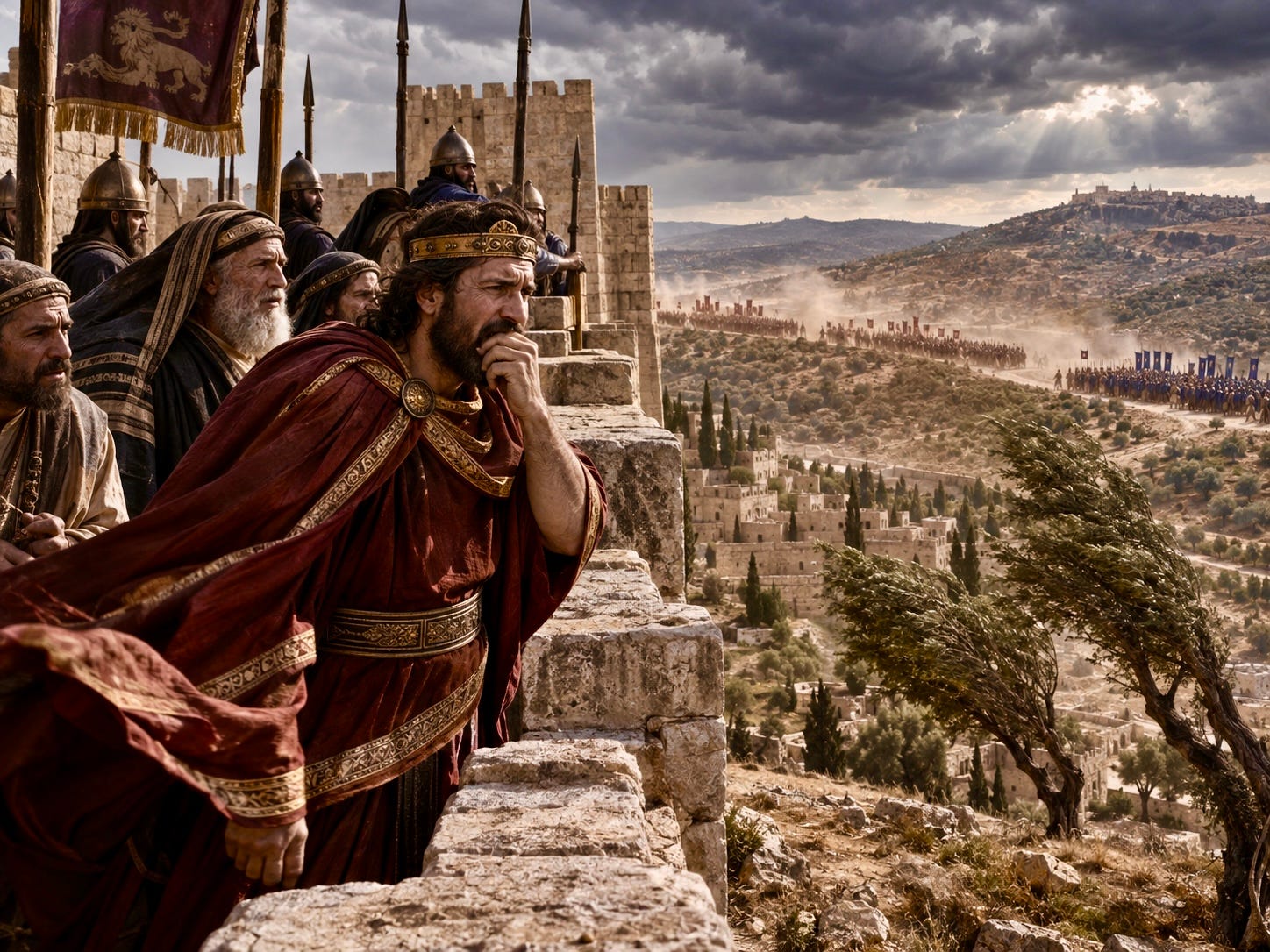
“Now it came about in the days of Ahaz, the son of Jotham, the son of Uzziah, king of Judah, that Rezin the king of Aram and Pekah the son of Remaliah, king of Israel, went up to Jerusalem to wage war against it, but could not conquer it. When it was reported to the house of David, saying, “The Arameans have camped in Ephraim,” his heart and the hearts of his people shook as the trees of the forest shake with the wind.”
Isaiah 7:1-2 NASB1995
Isaiah 7 begins with details that help establish the chronology of events for the coming prophecies. This story is described in more detail in 2 Chronicles (it is also the subject of 2 Kings 16, but I thought I would only share one reference):
“Ahaz was twenty years old when he became king, and he reigned sixteen years in Jerusalem; and he did not do right in the sight of the Lord as David his father had done. But he walked in the ways of the kings of Israel; he also made molten images for the Baals. Moreover, he burned incense in the valley of Ben-hinnom and burned his sons in fire, according to the abominations of the nations whom the Lord had driven out before the sons of Israel. He sacrificed and burned incense on the high places, on the hills and under every green tree.
Wherefore, the Lord his God delivered him into the hand of the king of Aram; and they defeated him and carried away from him a great number of captives and brought them to Damascus. And he was also delivered into the hand of the king of Israel, who inflicted him with heavy casualties. For Pekah the son of Remaliah slew in Judah 120,000 in one day, all valiant men, because they had forsaken the Lord God of their fathers. And Zichri, a mighty man of Ephraim, slew Maaseiah the king’s son and Azrikam the ruler of the house and Elkanah the second to the king.
The sons of Israel carried away captive of their brethren 200,000 women, sons and daughters; and they took also a great deal of spoil from them, and brought the spoil to Samaria. But a prophet of the Lord was there, whose name was Oded; and he went out to meet the army which came to Samaria and said to them, “Behold, because the Lord, the God of your fathers, was angry with Judah, He has delivered them into your hand, and you have slain them in a rage which has even reached heaven. Now you are proposing to subjugate for yourselves the people of Judah and Jerusalem for male and female slaves. Surely, do you not have transgressions of your own against the Lord your God? Now therefore, listen to me and return the captives whom you captured from your brothers, for the burning anger of the Lord is against you.” Then some of the heads of the sons of Ephraim—Azariah the son of Johanan, Berechiah the son of Meshillemoth, Jehizkiah the son of Shallum, and Amasa the son of Hadlai—arose against those who were coming from the battle, and said to them, “You must not bring the captives in here, for you are proposing to bring upon us guilt against the Lord adding to our sins and our guilt; for our guilt is great so that His burning anger is against Israel.” So the armed men left the captives and the spoil before the officers and all the assembly. Then the men who were designated by name arose, took the captives, and they clothed all their naked ones from the spoil; and they gave them clothes and sandals, fed them and gave them drink, anointed them with oil, led all their feeble ones on donkeys, and brought them to Jericho, the city of palm trees, to their brothers; then they returned to Samaria.
At that time King Ahaz sent to the kings of Assyria for help. For again the Edomites had come and attacked Judah and carried away captives. The Philistines also had invaded the cities of the lowland and of the Negev of Judah, and had taken Beth-shemesh, Aijalon, Gederoth, and Soco with its villages, Timnah with its villages, and Gimzo with its villages, and they settled there. For the Lord humbled Judah because of Ahaz king of Israel, for he had brought about a lack of restraint in Judah and was very unfaithful to the Lord. So Tilgath-pilneser king of Assyria came against him and afflicted him instead of strengthening him. Although Ahaz took a portion out of the house of the Lord and out of the palace of the king and of the princes, and gave it to the king of Assyria, it did not help him.
Now in the time of his distress this same King Ahaz became yet more unfaithful to the Lord. For he sacrificed to the gods of Damascus which had defeated him, and said, “Because the gods of the kings of Aram helped them, I will sacrifice to them that they may help me.” But they became the downfall of him and all Israel. Moreover, when Ahaz gathered together the utensils of the house of God, he cut the utensils of the house of God in pieces; and he closed the doors of the house of the Lord and made altars for himself in every corner of Jerusalem. In every city of Judah he made high places to burn incense to other gods, and provoked the Lord, the God of his fathers, to anger. Now the rest of his acts and all his ways, from first to last, behold, they are written in the Book of the Kings of Judah and Israel. So Ahaz slept with his fathers, and they buried him in the city, in Jerusalem, for they did not bring him into the tombs of the kings of Israel; and Hezekiah his son reigned in his place.”
2 Chronicles 28:1-27 NASB1995
I found these two graphics on Precept Austin to be useful:
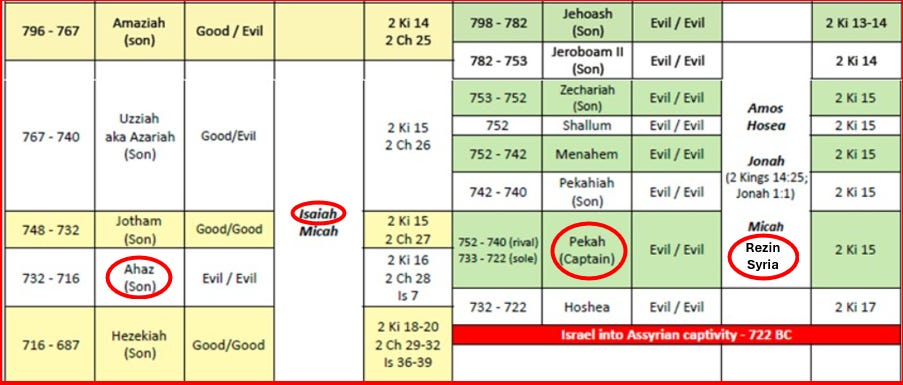
This table (a close-up of a larger table) shows a timeline of these kings (the dates on the left are years BC). On the left are the kings of Judah; the kings of Israel are on the right. The third column indicates the king’s posture towards obedience to God. Some started good and ended up evil, some were good throughout their reigns, and all of the kings of Israel were evil at the beginning and the end.
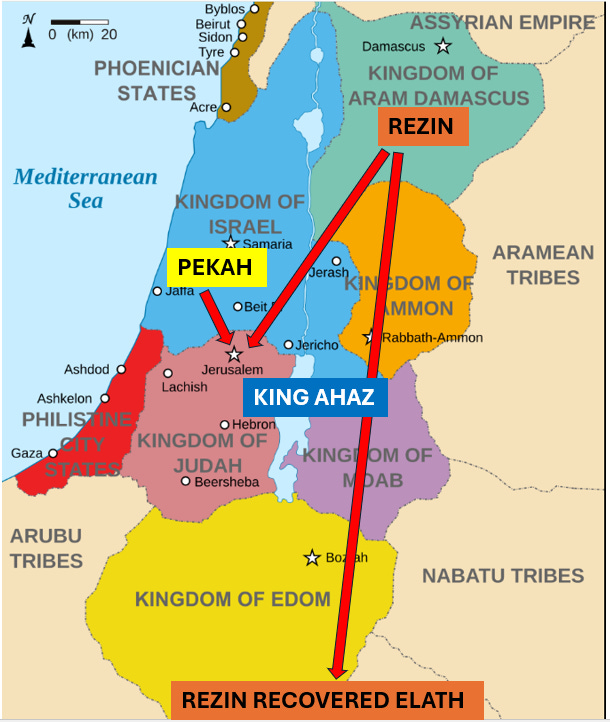
This map shows the lands in play in Isaiah 7/2 Kings 16/2 Chronicles 28.
It is worth noting that Ahaz was the son of a king that did what was right in God’s eyes (Jotham) and his son (Hezekiah) also did what was right, from the beginning to the end. Why did Ahaz go so wrong? He doubled down on “wrong” throughout his life and reign. In 2 Chronicles 28, we see that Ahaz “burned his sons in fire, according to the abomination of nations”. This is a sacrifice to Moloch (also known as Molech or Molek). Enduring Word describes this horror in its commentary for 2 Chronicles:
d. And burned his children in the fire: This describes Ahaz’s participation in the worship of Molech. The pagan god (or, demon, more accurately) Molech was worshipped by heating a metal statue representing the god until it was red hot, then placing a living infant on the outstretched hands of the statue, while beating drums drowned out the screams of the child until it burned to death.
i. In Leviticus 20:1-5, God pronounced the death sentence against all who worshipped Molech, saying: I will set My face against that man, and will cut him off from his people, because he has given some of his descendants to Molech, to defile My sanctuary and profane My holy name (Leviticus 20:3).
ii. Sadly, even a man as great as Solomon at least sanctioned the worship of Molech and built a temple to this idol (1 Kings 11:7). One of the great crimes of the northern tribes of Israel was their worship of Molech, leading to the Assyrian captivity (2 Kings 17:17). King Manasseh of Judah gave his son to Molech (2 Kings 21:6). Up to the days of King Josiah of Judah, Molech worship continued, until he destroyed a place of worship to that idol (2 Kings 23:10).
iii. “The ‘Valley of (the son of) Hinnom’ descended eastward below the southern edge of the city of Jerusalem; and it became noted as the scene of Judah’s most revolting pagan practices (2 Chronicles 33:6). It was later defiled by King Josiah and converted into a place of refuse for the city (2 Kings 23:10); thus the perpetual fires of ‘Gehenna’ became descriptive of hell itself (Mark 9:43).” (Payne)
e. According to the abominations of the nations whom the LORD had cast out before the children of Israel: The Canaanite nations that occupied Canaan before the time of Joshua also practiced this terrible form of human and child sacrifice. God would bring judgment upon Judah for their continued practice of these sins.
i. This reminds us that the war against the Canaanites in the Book of Joshua – as terrible and complete as it was – was not a racial war. God’s judgment did not come upon the Canaanites through the armies of Israel because of their race, but because of their sin. If Israel insisted on walking in the same sins, God would bring similar judgment upon them.
It seems that child sacrifice has been with humans for thousands of years. It was done in this era of the Old Testament to appease a false and malevolent god. It was done by the Aztecs to get favorable conditions from a weather god. Children were a favorite target during the Holocaust to prevent future generations of Jews and other targeted ethnic groups from growing larger (over 1.5 million children were killed by the Third Reich).
Today, millions of the unborn are targeted because they are an inconvenience or they might have some birth defect. The nation of Iceland brags that it has essentially eliminated Down Syndrome by strongly encouraging/enforcing abortion if pre-natal tests point to this genetic condition. I’m so glad (sarcasm) that no one in that country has to suffer having someone like this in their lives: Our Huddy Buddy (you can also follow Huddy Buddy on Facebook). Sadly, in our searches to find new pets we have discovered that people are very amenable to adopting cats and dogs that have birth defects like blindness, cerebellar hypoplasia (wobbly cat syndrome), and other conditions that many are unwilling to tolerate in an unborn human being. Also, sadly, the acceptance of post-birth child sacrifice to appease alleged mental illness is also now appealing to many.
This seems like a good place for a great prophet to step up and bring God’s word to Ahaz! God will not suffer these idolatries and sin.
My next devotional examines Isaiah 7:3-9 - Isaiah and his son are directed by God to meet with Ahaz.
Heaven on Wheels Daily Prayer:
Dear Lord - Thank You for the history lesson. I usually had my eyes glaze over (forgive me) when slogging through 1 and 2 Kings and 1 and 2 Chronicles in my annual Bible readings. Now, by studying Isaiah almost verse for verse, the history is clearly laid in front of me to comprehend it better! Amen.
Citations and Credits:
Scripture quotations taken from the (NASB®) New American Standard Bible®, Copyright © 1960, 1971, 1977, 1995 by The Lockman Foundation. Used by permission. All rights reserved. www.Lockman.org.
Precept Austin was accessed on 09/19/2026 to review commentary for Isaiah 7:1-2.
Commentary from Enduring Word is used with written permission and without any alteration. ©1996-present The Enduring Word Bible Commentary by David Guzik – enduringword.com. At the link referenced, the bibliography used by David Guzik can be accessed.