


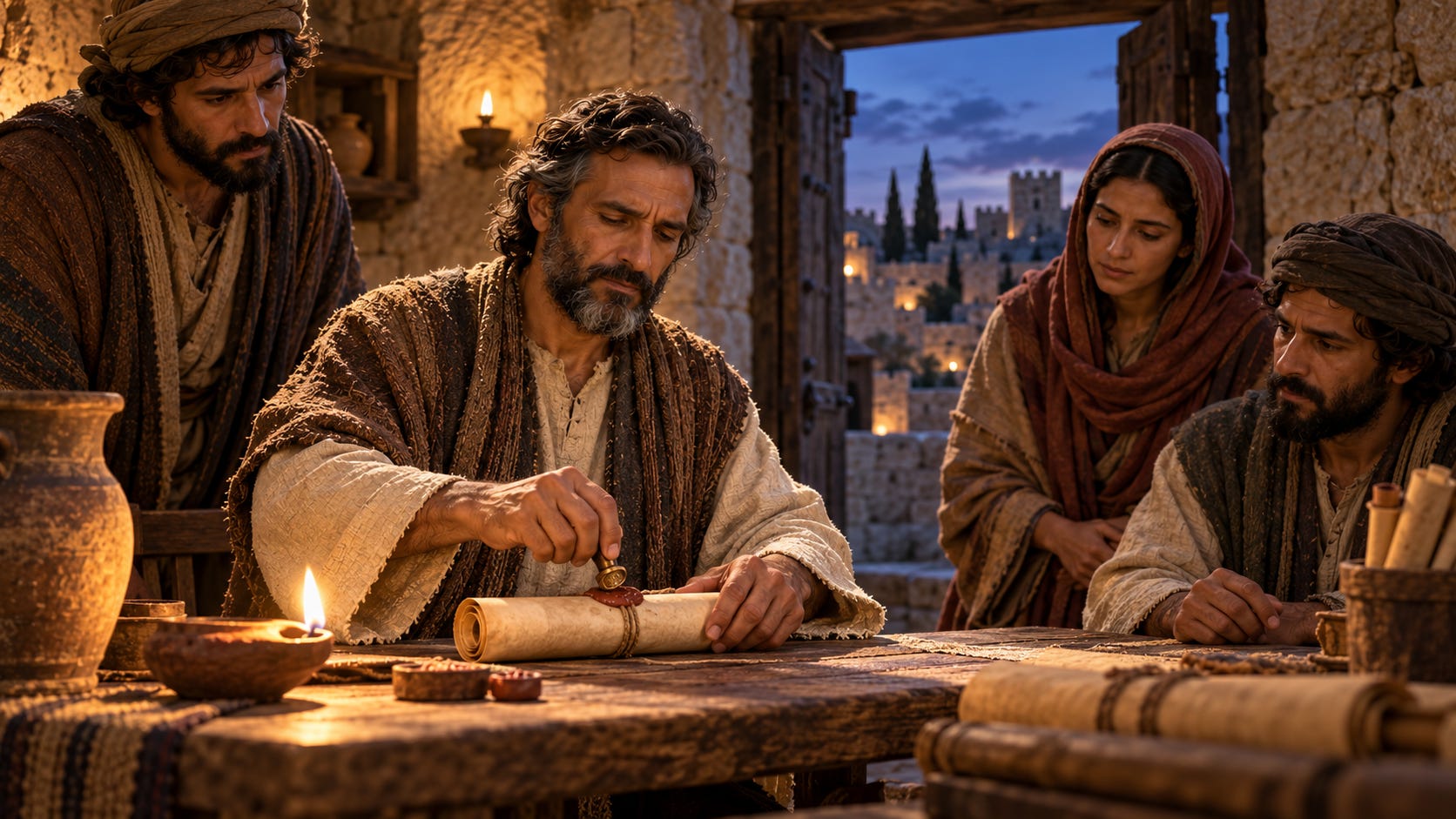
“Bind up the testimony, seal the law among my disciples. And I will wait for the Lord who is hiding His face from the house of Jacob; I will even look eagerly for Him. Behold, I and the children whom the Lord has given me are for signs and wonders in Israel from the Lord of hosts, who dwells on Mount Zion.”
Isaiah 8:16-18 NASB1995
The first verse of this passage is considered by many scholars to be difficult to interpret. It is still the voice of the Lord. Here is a possible interpretation from Barnes Notes on the Bible as quoted on BibleHub:
Bind up - This expression is one that is applicable to a volume, or roll of writing. Thus far the prophet seems to have had the roll opened, which is mentioned in Isaiah 8:1. Now the prophecy is complete, and he directs to bind it up, or close it. Perhaps, also, it is implied that it would be useless any further to address a rebellious and headstrong people. He had delivered his message, but they disregarded it.
The testimony - The message; especially that of which Uriah and Zechariah had been called to bear witness, Isaiah 8:2. Any message from God is, however, sometimes called a testimony, as being that to which a prophet bears witness; Psalm 19:7; 2 Kings 11:12; Deuteronomy 4:45; Deuteronomy 6:17, Deuteronomy 6:20; 1 Kings 2:3; Nehemiah 9:34.
Seal - Books were made in the form of rolls, and were often sealed when completed - as we seal a letter. The mode of sealing them was not by wax only, but by uniting them by any adhesive matter, as paste, or glue. Wax in warm climates would be generally rendered useless by the heat. The meaning here is, to secure, to close up - perhaps by passing a cord or string around the volume, and making it secure, denoting that it was finished; see Daniel 8:26; Daniel 12:4.
The law - The communication or command which he had delivered, and which, being given by inspiration, had now the force of law.
Among my disciples - Most of the Jewish commentators suppose that the volume, when completed by a prophet, was given for safe keeping to his disciples, or to some employed to preserve it securely. The word disciples means those who are taught, and here means those who were taught by the prophet; perhaps the pious and holy part of the people who would listen to his instructions. The Chaldee translates this verse, ‘O prophet, preserve the testimony, lest ye testify to those who will not obey; seal and hide the law, because they will not learn it.’
Now Isaiah speaks about waiting for the Lord. He waits eagerly. He and his children and the names they were given are for signs and wonders from the Lord of Hosts, who dwells in Zion. Many have speculated that there is a missing verse between verse 16 and 17, but there is no proof of that omission although the transition is quite abrupt. I think that Enduring Word has good commentary on this passage:
a. And I will wait on the LORD: Waiting on the LORD is not passive inactivity. It means to wait on the LORD as a waiter would wait on a table. It means to be totally attentive to the LORD, focused on His every move, and responsive to His every desire. At times it means inactivity, but even that is an “active inactivity,” where we stand before the LORD, totally focused on Him, waiting for what He wants next.
i. At the time Isaiah spoke, the leaders and the people of Judah were waiting on the armies of Israel and Syria, because they were under attack. As they heard of the danger from the Assyrians, they would be tempted to put their focus on them. But their focus was on these armies, not on the LORD. Isaiah says, “Battle against Syria and Israel by setting your focus on the LORD. Prepare for the coming attack from Assyria by waiting on the LORD instead of your enemies.”
b. Bind up the testimony, seal the law among my disciples: Waiting on the LORD is connected with His word. We can wait on the LORD by waiting on His word.
c. Here am I and the children whom the LORD has given me! We are for signs and wonders in Israel: Isaiah had been called to prophesy, and to use his children in his prophetic messages (Isaiah 7:3, 8:3). So, he declared, Here am I and the children whom the LORD has given me! It is as if he is said, “Look at us! We are the message!”
i. The name Maher-Shalal-Hash-Baz means, “Speed to the spoil, hurry to the plunder.” This spoke of the coming attack on Syria, Israel, and Judah by Assyria. The name Shear-Jashub means, “A Remnant Shall Return.” This spoke of the restoration God would eventually bring. The name Isaiah means, “Salvation is of the LORD.” This spoke of the attitude and hope Judah needed to have.
ii. We are also the children of God, and we are His message. Hebrews 2:11-13 quotes this passage to communicate this truth: For both He who sanctifies and those who are being sanctified are all of one, for which reason He is not ashamed to call them brethren, saying…. “Here am I and the children whom God has given Me.” Just as much as Isaiah’s children were living witnesses of the truth of God’s word, so are we as God’s children.
I like that analogy that waiting on the Lord is like being a properly attentive waiter. There’s a fine line between perfect service (truly waiting on the customer) and overly intrusive or lackadaisical service. We have found restaurants that we enjoyed that we would never go back to because the wait person came over every two-three minutes asking if everything was acceptable. In contrast, we have also been in restaurants that had great food and had servers that disappeared for long stretches of time when we needed attention.

As those who “wait” upon the Lord, we should always keep our eyes focused on Him. There will be times of inactivity! There are many people today watching the “tea leaves”, so to speak, documenting news events and anticipating the second coming of Jesus. There are huge on-line groups dedicated to this watchful activity; they are like the worst intrusive waiters who are hovering over every bite that you take waiting for a sign. Even the Son doesn’t know the date and time! All we can do is be properly attentive to Him in our waking moments and stay focused on His Word and the work of the Holy Spirit. End Times anxiety and obsession do nothing for His kingdom right now.
Let’s look at that passage in Hebrews that is referenced in the commentary.
“For it was fitting for Him, for whom are all things, and through whom are all things, in bringing many sons to glory, to perfect the author of their salvation through sufferings. For both He who sanctifies and those who are sanctified are all from one Father; for which reason He is not ashamed to call them brethren, saying,
“I WILL PROCLAIM YOUR NAME TO MY BRETHREN,
IN THE MIDST OF THE CONGREGATION I WILL SING YOUR PRAISE.”
And again, “I WILL PUT MY TRUST IN HIM.”
And again, “BEHOLD, I AND THE CHILDREN WHO GOD HAS GIVEN ME.””
Hebrews 2:10-13 NASB1995
As long-time readers may recall, I recently did a study of Hebrews (it was VERY challenging). Here’s a link to the devotional centered around this passage in Hebrews 2:
https://www.heavenonwheels.org/p/hebrews-i-will-proclaim-your-name
My next devotional examines Isaiah 8:19-22 - We should consult God and not the occult.
Heaven on Wheels Daily Prayer:
Dear Lord - How can I serve You today? Please help me to always be focused on You, even when it seems like there is quiet and inactivity. I will put my trust in You. Amen.
Citations and Credits:
Scripture quotations taken from the (NASB®) New American Standard Bible®, Copyright © 1960, 1971, 1977, 1995 by The Lockman Foundation. Used by permission. All rights reserved. www.Lockman.org.
Precept Austin was accessed on 10/05/2026to review commentary for Isaiah 8:16-18.
Biblehub.org was accessed on 10/05/2026 to review commentary for Isaiah 8:16-18.
Commentary from Enduring Word is used with written permission and without any alteration. ©1996-present The Enduring Word Bible Commentary by David Guzik – enduringword.com. At the link referenced, the bibliography used by David Guzik can be accessed.