


“He has come against Aiath,
He has passed through Migron;
At Michmash he deposited his baggage.
They have gone through the pass, saying,
“Geba will be our lodging place.”
Ramah is terrified, and Gibeah of Saul has fled away.
Cry aloud with your voice, O daughter of Gallim!
Pay attention, Laishah and wretched Anathoth!
Madmenah has fled.
The inhabitants of Gebim have sought refuge.
Yet today he will halt at Nob;
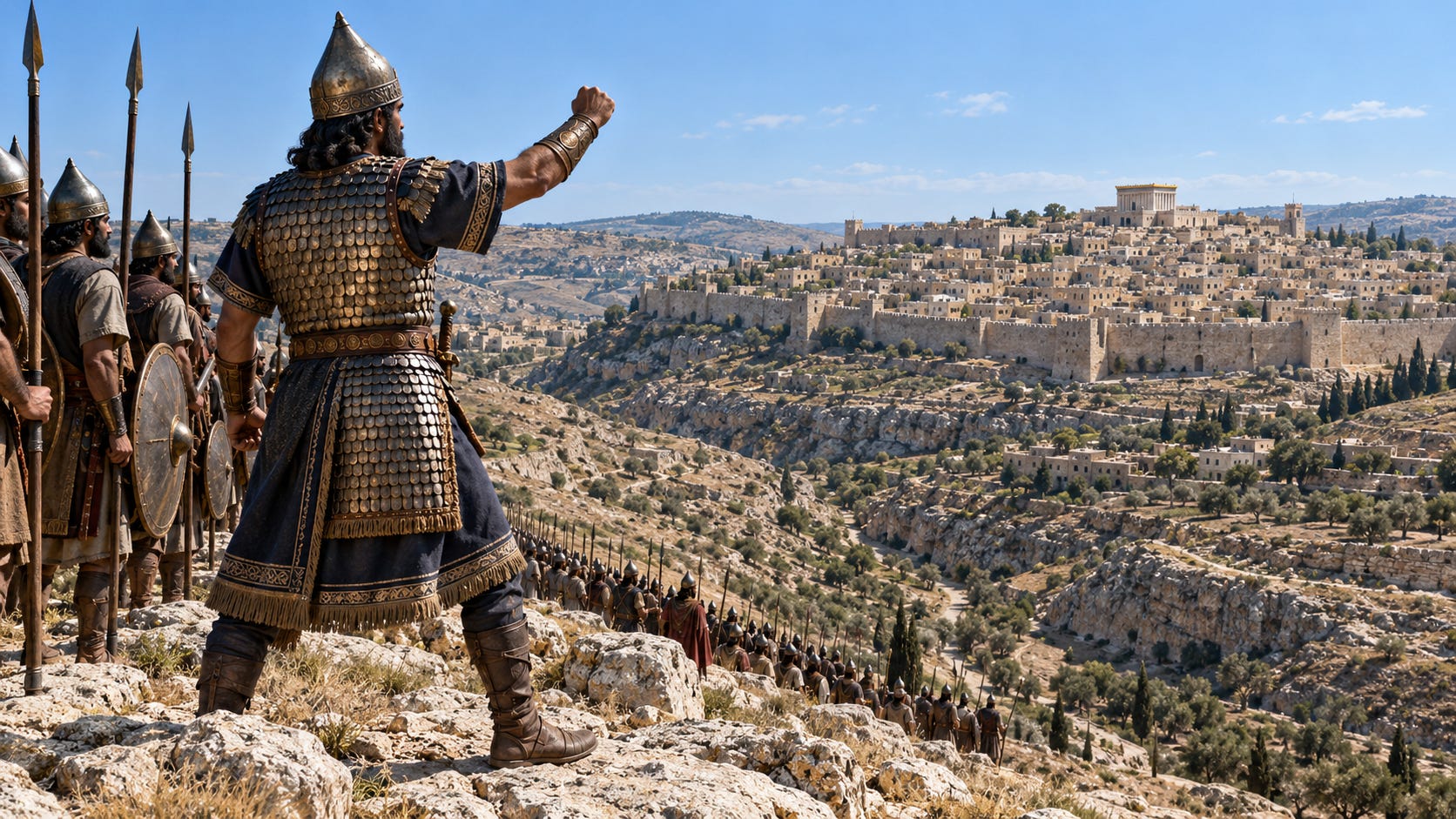
He shakes his fist at the mountain of the daughter of Zion, the hill of Jerusalem.
Behold, the Lord, the God of hosts, will lop off the boughs with a terrible crash;
Those also who are tall in stature will be cut down
And those who are lofty will be abased.
He will cut down the thickets of the forest with an iron axe,
And Lebanon will fall by the Mighty One.”
Isaiah 10:28-34 NASB1995
This final passage in Isaiah 10 describes the march of the Assyrians through various small towns in Judah, finally being halted at the town of Nob, just outside Jerusalem. At this NET Bible website, there is a map showing most of the towns in this passage; they are located in the hill country between the Dead Sea and Jerusalem. I would post the map itself, but the NET Bible website disallows reposting of their copyrighted material on another website so you can go to the link and see it.
Although Judah and Jerusalem are spared the worst of the Assyrian invasion because of a miracle from God, this litany of townships shows that there was, indeed, a reign of terror by the mighty empire as they marched through that region. Here’s the commentary from Enduring Word:
a. He has come to Aiath: Because of the word of comfort and encouragement in the previous section, Judah might think that God wouldn’t send judgment among them at all. This section, with the specific mention of many cities of Judah, is meant to show that God will indeed allow the invasion of the Assyrians, even though He will restore after the attack.
b. Aiath…Migron…Michmash…. Geba…. Nob: The listing of cities flows from the north to the south, describing the course of the Assyrian invasion. Nob is right on the outskirts of Jerusalem. This is as far as the army of the Assyrians came against Judah. They were stopped here when the LORD killed 185,000 Assyrian soldiers in one night.
i. “With a deft poetic touch, Isaiah told how the enemy moved through twelve different locations, coming ever closer to the capital.” (Wolf)
…
a. Those of high stature will be hewn down: The LORD promises that His judgment will extend even against those of high stature. A mighty forest seems invincible and seems as if it will stand forever, but the LORD can cut it down. Even so, the LORD will cut down the proud and those of high stature among Judah. All that will be left in a once-mighty forest will be stumps.
b. And Lebanon will fall by the Mighty One: The forests of Lebanon were known for their large, mighty cedar trees. God will judge the proud among Judah – and all the nations for that matter – and leave a once mighty forest of those of high stature as if they were just stumps. The bigger they are, the harder they fall down.
i. Bultema on both soul and body: “Calvin warned against inferring from this that the soul is not immortal. What is meant, according to this keen expositor, is that the soul of this tyrant will have to pay for his wicked deeds on earth after the destruction of His body.”
Other commentators believe the reference to the those of high stature being cut down is more in reference to the Assyrian army. Apparently, though, the comparison to Lebanon is often made to the people of Israel. David Guzik believe that this is a picture of all nations, including Judah, who will have the proud and mighty cut down.

The next passages coming up in Isaiah 11 are another Messianic prophecy describing the Millennial reign of Christ, so this leads several scholars to describe this prophecy as a dual fulfillment, with the “Assyrian” also representing the Antichrist in a prophecy yet to be fulfilled. According to Precept Austin, this is in Revelation 19:
“And I saw heaven opened, and behold, a white horse, and He who sat on it is called Faithful and True, and in righteousness He judges and wages war. His eyes are a flame of fire, and on His head are many diadems; and He has a name written on Him which no one knows except Himself. He is clothed with a robe dipped in blood, and His name is called The Word of God. And the armies which are in heaven, clothed in fine linen, white and clean, were following Him on white horses. From His mouth comes a sharp sword, so that with it He may strike down the nations, and He will rule them with a rod of iron; and He treads the wine press of the fierce wrath of God, the Almighty. And on His robe and on His thigh He has a name written, “KING OF KINGS, AND Lord OF LORDS.”
Then I saw an angel standing in the sun, and he cried out with a loud voice, saying to all the birds which fly in midheaven, “Come, assemble for the great supper of God, so that you may eat the flesh of kings and the flesh of commanders and the flesh of mighty men and the flesh of horses and of those who sit on them and the flesh of all men, both free men and slaves, and small and great.”
And I saw the beast and the kings of the earth and their armies assembled to make war against Him who sat on the horse and against His army.
And the beast was seized, and with him the false prophet who performed the signs in his presence, by which he deceived those who had received the mark of the beast and those who worshiped his image; these two were thrown alive into the lake of fire which burns with brimstone. And the rest were killed with the sword which came from the mouth of Him who sat on the horse, and all the birds were filled with their flesh.”
Revelation 19:11-21 NASB1995
If you dip your toes into the well of Biblical prophecy, I guess it is inevitable that we carefully wade a few feet into the eschatology of the Book of Revelation. This passage is a different Jesus, one who is “Faithful and True and in righteousness He judges and wages war”. Let’s look at one more commentary from Enduring Word on what this means:
c. In righteousness He judges and makes war: Jesus comes as a judge and a general to make war. The world that rejected Him before rejects Him again, but this time Jesus judges those who reject Him.
i. “The world likes a complacent, reasonable religion, and so it is always ready to revere some pale Galilean image of Jesus, some meager anemic Messiah, and to give Him a moderate rational homage.” (Torrance)
ii. “Any view of God which eliminates judgment and his hatred of sin in the interest of an emasculated doctrine of sentimental affection finds no support in the strong and virile realism of the Apocalypse.” (Mounce)
iii. This is a Jesus we can’t control. Here we see Jesus as someone who demands not only our attention, but also our submission.
iv. It’s good for us to remember that this dramatic display of judgment comes only at the end of a long time of grace, patience, and mercy. This is no “rush to judgment.” Jesus has amply displayed His nature of mercy, forgiveness and grace to this fallen world. He comes now to judge a world hardened and totally given over to their rebellion against Him.
v. “All of these passages point to the sad conclusion that in the day of judgment it is too late for men to expect the mercy of God. There is nothing more inflexible than divine judgment where grace has been spurned. The scene of awful judgment which comes from this background is in flat contradiction of the modern point of view that God is dominated entirely by His attribute of love.” (Walvoord)
vi. Remember that He does it all in righteousness. “The wars which he wages are from no principle of ambition, lust of power, or extension of conquest and dominion; they are righteous in their principle and in their object. And this is perhaps what no earthly potentate could ever say.” (Clarke)
vii. “Jesus is the only king who always wars in this fashion. There have been brilliant exceptions to the general rule, but war is usually as deceitful as it is bloody, and the words of diplomatists are a mass of lies. It seems impossible that men should deliberate about peace and war without straightway forgetting the meaning of words and the bonds of honesty: War still seems to be a piece of business in which truth would be out of place; it is a matter so accursed that falsehood is there most at home, and righteousness quits the plain. But as for our King, it is in righteousness that he doth judge and make war. Christ’s kingdom needs no deception: the plainest speech and the clearest truth – these are the weapons of our warfare.” (Spurgeon)
Sennacherib (or Sargon) can stand and shake his fist at Jerusalem, but the Antichrist will be destroyed. Although we don’t know when Jesus shall return (and I have advised others to be prepared but not obsessed with trying to read the “tea leaves”), there will be no more hope for God’s mercy when that day happens. However, the Lord is still granting that mercy today.
My next devotional will be a summary of the first ten chapters of Isaiah. I decided to do these periodic summaries so that there will not be one at the end that is longer than “War and Peace”. This will be followed by a devotional on Isaiah 11:1-2, A shoot will spring from the root of Jesse and shall have the Spirit of the Lord upon Him.
Heaven on Wheels Daily Prayer:
Dear Lord - Thank you for the insights I have received so far in this study of Isaiah. All of scripture is woven together and I should not be afraid of the book of Revelation! I am in gratitude for Your guidance. Amen.
Citations and Credits:
Scripture quotations taken from the (NASB®) New American Standard Bible®, Copyright © 1960, 1971, 1977, 1995 by The Lockman Foundation. Used by permission. All rights reserved. www.Lockman.org.
Precept Austin was accessed on 10/31/2026 to review commentary for Isaiah 10:28-34.
Biblehub.org was accessed on 10/31/2026 to review commentary for Isaiah 10:28-24.
Commentary from Enduring Word is used with written permission and without any alteration. ©1996-present The Enduring Word Bible Commentary by David Guzik – enduringword.com. At the link referenced, the bibliography used by David Guzik can be accessed.