


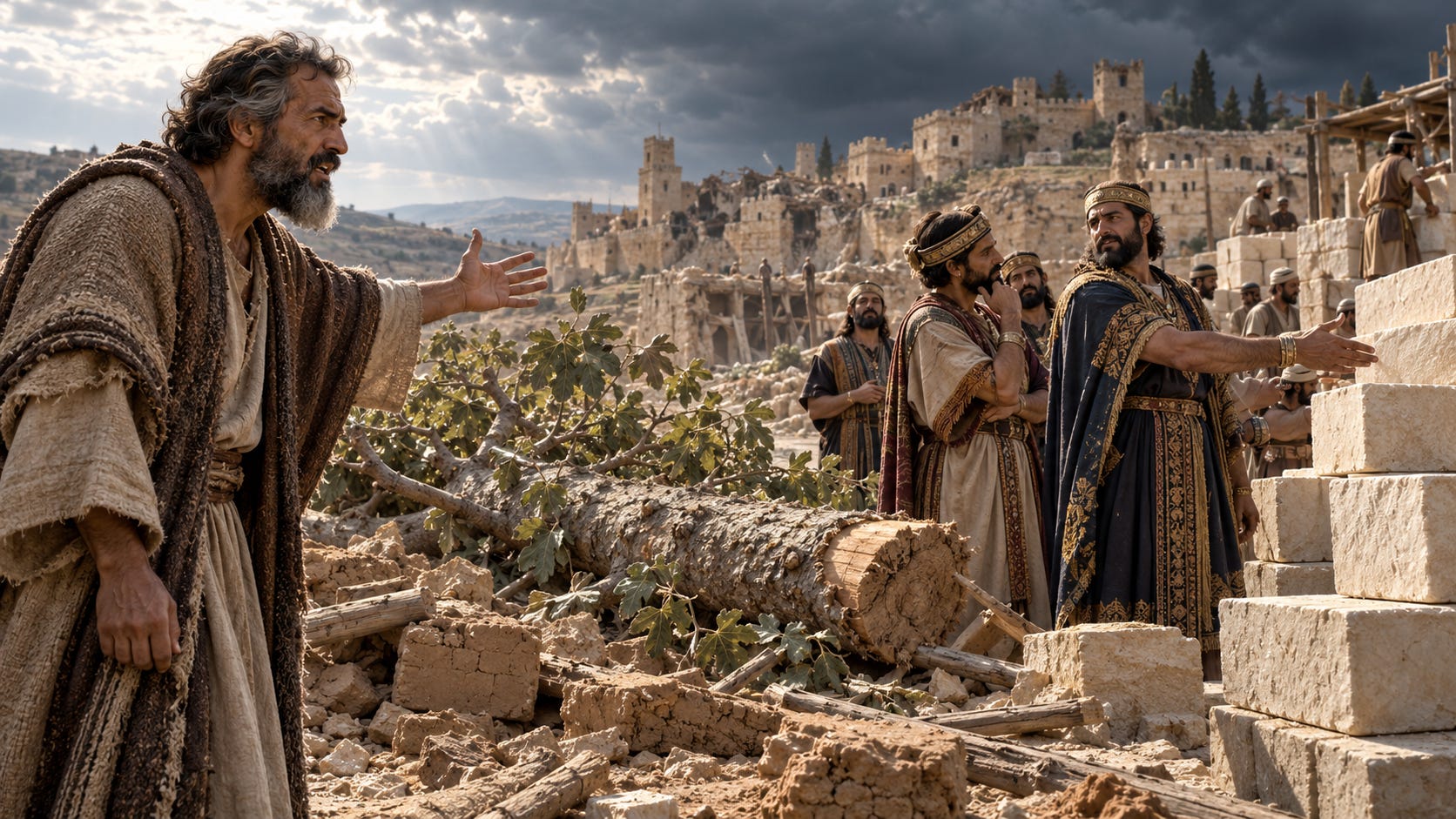
“The Lord sends a message against Jacob,
And it falls on Israel.
And all the people know it,
That is, Ephraim and the inhabitants of Samaria,
Asserting in pride and in arrogance of heart:
“The bricks have fallen down,
But we will rebuild with smooth stones;
The sycamores have been cut down,
But we will replace them with cedars.”
Therefore the Lord raises against them adversaries from Rezin
And spurs their enemies on,
The Arameans on the east and the Philistines on the west;
And they devour Israel with gaping jaws.
In spite of all this, His anger does not turn away
And His hand is still stretched out.”
Isaiah 9:8-12 NASB1995
Well, now we have a complete and abrupt change of tone following the magnificent prophecy of the Messiah in verses 6 and 7. The rest of Isaiah 9 and the first four verses of Isaiah 10 are considered to be part of a four-part poem, known colloquially as the “Speech of the Outstretched Hand”, as each stanza ends with the words:
In spite of all this, His anger does not turn away
And His hand is still stretched out.”
The words are apparently directed more towards Israel (the northern ten tribes) than Judah, although there is applicability to both regions. According to Precept Austin, this first stanza addresses the sins of pride and arrogance. I think the commentary from Enduring Word is quite good:
a. The LORD sent a word against Jacob, and it has fallen on Israel: The idea is that the LORD brought a word against all His people (against Jacob) and the word has scored a “direct hit” against the Northern Kingdom of Israel.
b. Ephraim and the inhabitant of Samaria: The tribe of Ephraim was the largest and most influential tribe in the Northern Kingdom of Israel. So, often the LORD refers to the Kingdom of Israel by the name Ephraim. Samaria was the capital of the Northern Kingdom of Israel. There isn’t any doubt whom this prophecy is directed to.
c. Who say in pride and arrogance of heart: “The bricks have fallen down, but we will rebuild with hewn stones; the sycamores are cut down, but we will replace them with cedars”: In their pride, the leaders and the people of the Northern Kingdom of Israel said, “Who cares if God judges us? Whatever is torn down, we will rebuild with something better. We have nothing to fear from what God can bring against us.”
i. “Instead of humbling themselves before the face of God on account of the many calamities that had already descended on them, they still entertained a lighthearted optimism regarding the future. This optimism manifested itself in the slogans that were current in that day and apparently on everybody’s lips.” (Bultema)
ii. “What a brief but deeply psychological picture this is of an unfaithful generation that keeps dreaming of better times to come and lightheartedly ignores the severe judgments of God.” (Bultema)
d. Therefore the LORD shall set up the adversaries: Because they believed they would be able to weather the storm of attack and then rebuild, God would send successive waves of enemies against Israel (The Syrians before and the Philistines behind). The destruction of Israel would be complete, and their proud promise to rebuild would be unfulfilled.
e. For all this, His anger is not turned away, but His hand is stretched out still: For the first time, the chorus is said. The judgment against Israel’s pride was not enough. There was still sin to judge, and God wasn’t ready to stop His work of judgment.
i. Calvin could say of his day, more than 300 years ago: “How many are the distresses with which Europe has been afflicted for thirty or forty years? How many are the chastisements by which she has been called to repentance? And yet it does not appear that those numerous chastisements have done any good. On the contrary, luxury increases every day, lawless passions are inflamed, and men go on in crimes and profligacy more shamelessly than ever. In short, those very calamities appear to have been so many excitements to luxury and splendour. What then should we expect but to be bruised with heavier blows?”
The people of Israel are essentially saying “who cares if God judges us? We can do better on our own”. This strange optimism that rejects God is driven by arrogance and pride. The observations that John Calvin made over 300 years ago sound like they could be laid on top of our time, yet multiplied exponentially. In Calvin’s time, almost all the people were still attuned to the word of God. That’s certainly not true in our current time.
Here are some key results from various surveys looking at non-religious, atheist, agnostic or the nebulous category “none” across the globe (this was found on a site called WorldData; not all attributes have been brought over); my reasons for sharing this will be explained after the data:
Total Nones (2024 Pew RLS) - 28% of US adults — largest single group in the US
“Nones” growth: 2007 → 2024 - From 16% to 28% — near-doubling over 17 years
Gallup “No religion” growth - From 2% in 1948 to 22% in 2023 — Gallup long-term data
All generations: US Christian share - 62% of all US adults — down from 78% in 2007 — Pew
Gen Z attending church regularly - Only 15% of Gen Z attend church regularly — Pew (2021)
Atheists’ political lean - 69% identify as Democrat or lean Democratic — Pew 2014 survey
Raised religious but left - 71% of currently unaffiliated Americans were raised in a formal religious tradition — American Survey Center
Religious switching: Christianity’s net - For every 6 who leave Christianity, only 1 joins — Pew 2023–24 RLS
Global religiously unaffiliated growth - From 1.6 billion to 1.9 billion (2010–2020, +17%) — Pew global study, June 2025
Atheists’ education level - Atheists and agnostics have more education than religiously affiliated Americans — Pew

There are some very troubling trends observed from these data. One positive thing I’ve heard is that there are more Gen Z members finding Jesus since the poll data in 2021. It’s also fascinating to note the political and education components of the non-religious, which should not surprise anyone. When a certain political party booed the suggestion to mention God as the agent of our rights in the party platform at the 2012 national convention, their preferences became known publicly. Those preferences have led to an embrace of many highly disturbing cultural trends (abortion on demand, transgenderism, open borders, etc.). It follows that old saying: The first effect of not believing in God is that you will believe in anything. They obviously don’t fear a God they don’t believe in. It is a sobering thought to know that nearly 2 billion people worldwide are “nones”; this is most likely due to mass media secular influences and not ignorance of religion.
I watched a video recently that echoes what Romans 1 says about unbelief. You know this is true: Many non-believing people don’t get upset if you say you are Buddhist or “spiritual” or “worship” nature or even if you are Hindu or Muslim. They DO get upset and angry if you espouse traditional Christian beliefs. Mentioning Christianity is a trigger that reveals foolish hearts that are indeed darkened and suppress the truth. Here is the passage from Romans 1:
“For the wrath of God is revealed from heaven against all ungodliness and unrighteousness of men who suppress the truth in unrighteousness, because that which is known about God is evident within them; for God made it evident to them. For since the creation of the world His invisible attributes, His eternal power and divine nature, have been clearly seen, being understood through what has been made, so that they are without excuse. For even though they knew God, they did not honor Him as God or give thanks, but they became futile in their speculations, and their foolish heart was darkened. Professing to be wise, they became fools, and exchanged the glory of the incorruptible God for an image in the form of corruptible man and of birds and four-footed animals and crawling creatures.”
Romans 1:18-23 NASB1995
When I went on the secular humanist wilderness journey for quite a few years in my earlier adulthood, I was very arrogant and prideful. I went from being a person who was actively involved at my church growing up to someone who sneered at those low-IQ mouth-breathers who still believed in a living God who is loving but also judging. We humans can do pretty much everything without having to worship some God! (That might have been my motto). My return to faith pretty much zapped that arrogance and hopefully killed it. The people of Israel and Judah are driven by their own arrogance that leads to an “optimism” that they can make things better without God. I want to repeat this commentary that was referred to by David Guzik:
“What a brief but deeply psychological picture this is of an unfaithful generation that keeps dreaming of better times to come and lightheartedly ignores the severe judgments of God.” (Harry Bultema)
My next devotional examines Isaiah 9:13-17 - God’s anger against the leadership
Heaven on Wheels Daily Prayer:
Dear Lord - I pray for a revival in this nation and around the world and for a return to faith for those who have departed. You gave us free will, but our freedom is only found under Your judgment and mercy. Amen.
Citations and Credits:
Scripture quotations taken from the (NASB®) New American Standard Bible®, Copyright © 1960, 1971, 1977, 1995 by The Lockman Foundation. Used by permission. All rights reserved. www.Lockman.org.
Precept Austin was accessed on 10/15/2026 to review commentary for Isaiah 9:8-12.
Biblehub.org was accessed on 10/15/2026 to review commentary for Isaiah 9:8-12
Commentary from Enduring Word is used with written permission and without any alteration. ©1996-present The Enduring Word Bible Commentary by David Guzik – enduringword.com. At the link referenced, the bibliography used by David Guzik can be accessed.
The survey data at the link references these surveys on religious preferences:
Source: Pew Research Center — 2023–24 Religious Landscape Study (published February 26, 2025); Pew Research Center — Religion Holds Steady in America (December 2025); Pew Research Center — Religious Nones in America (January 2024); PRRI — 2023 Census of American Religion; Gallup — How Religious Are Americans? (2023–2025 data); Wikipedia — Atheism in the United States; Wikipedia — Irreligion in the United States; American Survey Center — Generation Z and the Future of Faith (2025); Dallas Express citing Gallup International (November 2025); NPR (January 2024); CBS News (January 2024)