


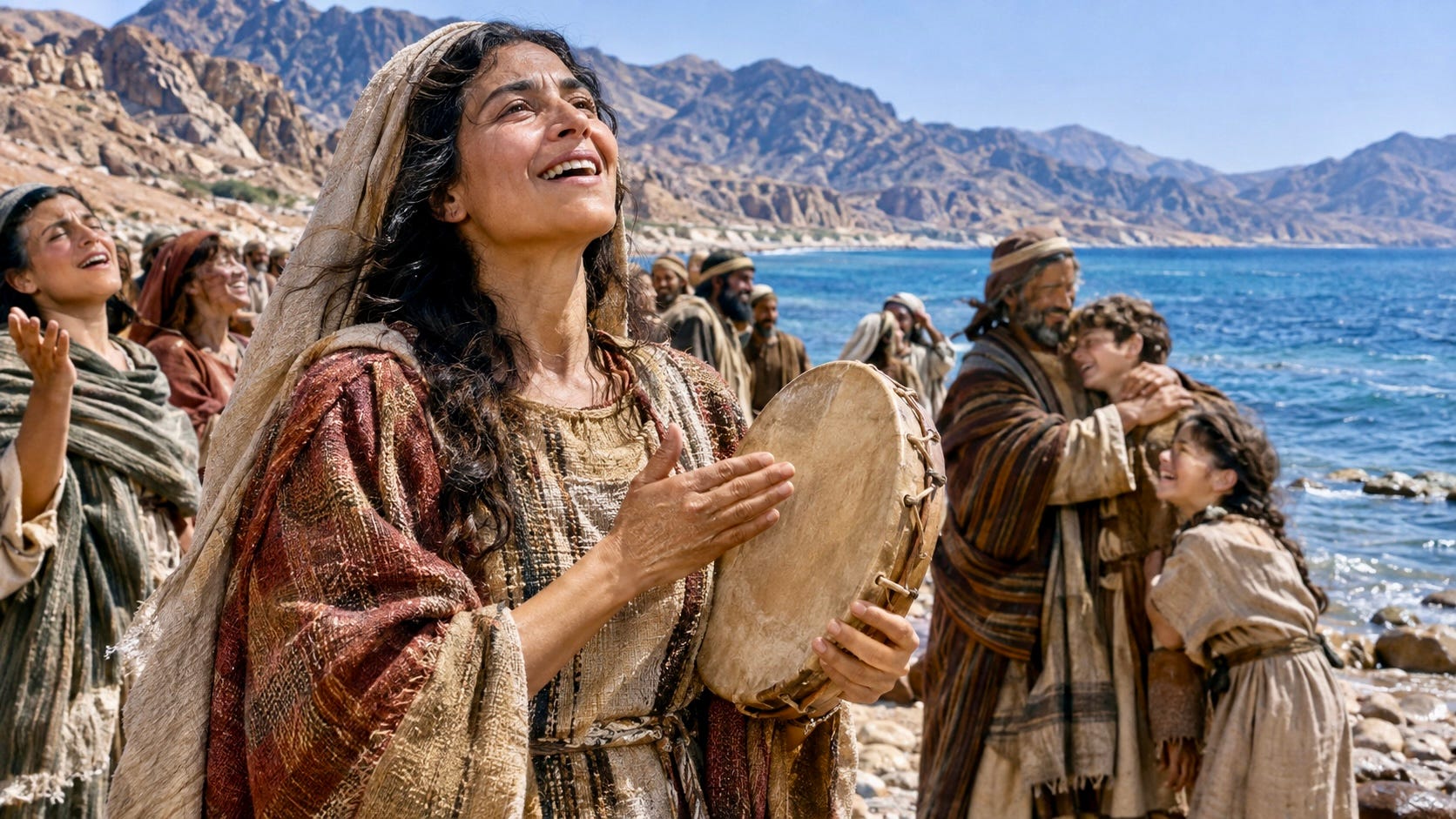
“Behold, God is my salvation,
I will trust and not be afraid;
For the Lord God is my strength and song,
And He has become my salvation.”
Therefore you will joyously draw water
From the springs of salvation.”
Isaiah 12:2-3 NASB1995
In my last devotional, I noted that I would be doing this one on verse 2 of Isaiah 12 but I decided to include verse 3 as well. This beautiful passage focuses on the eternal fact that God IS our salvation. We can’t do it ourselves and we can rest on Him.
Enduring Word has good commentary for these two verses:
a. Behold: The worshipper wants others to see what he says is true. He is excited about what God has done in his life and invites all to behold the work of the LORD.
b. God is my salvation: This is salvation. To say God is my salvation is also to say, “I am not my salvation. My good works, my good intentions, my good thoughts do not save me. God is my salvation.”
i. Many don’t ever feel the need for salvation. Instead, they think their lives are fine, and come to God for a little help when they feel they need it. But they never see themselves as drowning men in need of rescue or see themselves as hell-destined sinners in need of salvation.
ii. The worshipper is so immersed in this idea that he repeats it in the same verse: God is my salvation…He also has become my salvation.
c. I will trust and not be afraid: This peace and security comes from knowing that God is my salvation. When we are our own salvation, it is hard to trust and not be afraid in ourselves. But when God is our salvation, we can trust and not be afraid.
i. Paul repeated the same idea in Romans 5:1: Therefore, having been justified by faith, we have peace with God through our Lord Jesus Christ. The place of peace and trust and “no fear” comes only from seeing our salvation in God, and not in ourselves.
d. I will trust and not be afraid: This is a confident statement reflecting the will of the worshipper. He is deciding to trust and not be afraid. There are feelings of trust, but that is different than the decision to trust. We can say to our will, “I will trust and not be afraid.”
i. “Hearken, O unbeliever, you have said, ‘I cannot believe,’ but it would be more honest if you had said, ‘I will not believe.’ The mischief lies there. Your unbelief is your fault, not your misfortune. It is a disease, but it is also a crime: it is a terrible source of misery to you, but it is justly so, for it is an atrocious offense against the God of truth. (Spurgeon)
ii. “The talk about trying to believe is a mere pretense. But whether pretense or no, let me remind you that there is no text in the Bible which says, ‘Try and believe,’ but it says ‘Believe in the Lord Jesus Christ.’ He is the Son of God, he has proved it by his miracles, he died to save sinners, therefore trust him; he deserves implicit trust and child-like confidence. Will you refuse him these? Then you have maligned his character and given him the lie.” (Spurgeon)
e. For YAH, the LORD, is my strength and song: The LORD is not only the worshipper’s salvation, He is also his strength and song. Some find it easier to consider the LORD their salvation in a distant “bye-and-bye” sense than to take Him today as their strength and song.
i. When the LORD is our strength, it means that He is our resource, He is our refuge. We look to Him for our needs and are never unsatisfied. “Nor is he here called a part or an aid of our strength, but our complete strength; for we are strong, so far as he supplies us with strength.” (Calvin)
ii. When the LORD is our song, it means that He is our joy, He is our happiness. We find our purpose and life in Him, and He never disappoints.
iii. “The word Yah read here is probably a mistake; and arose originally from the custom of the Jewish scribes, who, when they found a line too short for the word, wrote as many letters as filled it, and then began the next line with the whole word.” (Clarke)
…
a. You will draw water from the wells of salvation: Jesus promised us whoever drinks of the water that I shall give him will never thirst. But the water that I shall give him will become in him a fountain of water springing up into everlasting life. (John 4:14) We can come to Jesus and draw water from the wells of salvation.
i. When we remember the semi-arid climate of Israel, we see what a beautiful picture the wells of salvation paint. When water is rare, a well is life. A reliable source of something that is absolutely necessary (like water) is a precious gift. God’s gift of salvation is just that precious.
ii. The LORD’s resource is not limited. There is not one well of salvation. There are many wells of salvation. This doesn’t mean that there are many ways to be saved. All of the wells draw from the same reservoir of salvation, Jesus Christ. But many wells can bring water from the same water table.
b. You will draw water: This means there is something for us to do. God doesn’t meet our needs as we sit in passive inactivity. We must reach out and draw what He has provided. At the same time, it is His water, His well, His rope, and His bucket that we draw with.
c. Therefore with joy: Because it is all of the LORD, we draw from the wells of salvation with joy. There should be no somber faces at the LORD’s well of salvation. We draw water with joy.
i. “Joy is the just man’s portion, and Christ is the never-failing fountain whence by a lively faith he may infallibly fetch it.” (Trapp)
ii. “Be of good courage, you very, very timid ones, and alter your tone. Try to put a ‘Selah’ into your life, as David often did in his Psalms. Frequently, he put in a ‘Selah,’ and then he changed the key directly. In like manner, change the key of your singing; you are a great deal too low. Let the harp-strings be screwed up a bit, and let us have no more of these flat, mournful notes. Give us some other key, please, and begin to say, with the prophet Isaiah, ‘O Lord, I will praise thee: though thou wast angry with me, thine anger is turned away, and thou comfortedst me. Behold, God is my salvation, I will trust, and not be afraid.’” (Spurgeon)
A few key takeaways:
Enduring Word uses the NKJV translation so there are some differences in how this passage is written. For example, the use of the strange word “Yah”, which the NASB translates more directly into the Lord God.
There are some great Spurgeon comments in this, especially the one that says that the Bible doesn’t ask us to try and believe. We are to believe, period.
Unbelievers are described as suffering from a disease that is their own fault and it is, in Spurgeon’s words, a criminal act against the almighty God.
The Lord is our resource, the well of salvation. This well will never go dry for those who believe.
It is up to us to draw from the well of salvation and use it for our hope and joy.
According to Precept Austin this passage is the first usage of the term Yeshuah (my salvation or savior) in the book of Isaiah. There’s a long passage at Precept Austin describing the many times this term is used in the OT.
Let’s do a word study from the Blue Letter Bible lexicon:
The Strong’s definition of H3444 is: יְשׁוּעָה yᵉshûwʻâh, yesh-oo’-aw; feminine passive participle of H3467; something saved, i.e. (abstractly) deliverance; hence, aid, victory, prosperity:—deliverance, health, help(-ing), salvation, save, saving (health), welfare. The Biblical usages are:
salvation, deliverance
welfare, prosperity
deliverance
salvation (by God)
victory
The living waters from our salvation and savior are addressed by Jesus in John 4:
“So He *came to a city of Samaria called Sychar, near the parcel of ground that Jacob gave to his son Joseph; and Jacob’s well was there. So Jesus, being wearied from His journey, was sitting thus by the well. It was about the sixth hour.
There *came a woman of Samaria to draw water. Jesus *said to her, “Give Me a drink.” For His disciples had gone away into the city to buy food. Therefore the Samaritan woman *said to Him, “How is it that You, being a Jew, ask me for a drink since I am a Samaritan woman?” (For Jews have no dealings with Samaritans.) Jesus answered and said to her, “If you knew the gift of God, and who it is who says to you, ‘Give Me a drink,’ you would have asked Him, and He would have given you living water.” She *said to Him, “Sir, You have nothing to draw with and the well is deep; where then do You get that living water? You are not greater than our father Jacob, are You, who gave us the well, and drank of it himself and his sons and his cattle?” Jesus answered and said to her, “Everyone who drinks of this water will thirst again; but whoever drinks of the water that I will give him shall never thirst; but the water that I will give him will become in him a well of water springing up to eternal life.””
John 4:5-14 NASB1995
He is our hope in a dry land! This well of water leads to eternal life!
My next devotional examines Isaiah 12:4-6 - Exalt God among the peoples,
Heaven on Wheels Daily Prayer:
Dear Lord - I can rejoice in all circumstances when drawing from Your salvation and Your living waters! Amen.
Citations and Credits:
Scripture quotations taken from the (NASB®) New American Standard Bible®, Copyright © 1960, 1971, 1977, 1995 by The Lockman Foundation. Used by permission. All rights reserved. www.Lockman.org.
Precept Austin was accessed on 11/16/2026 to review commentary for Isaiah 12:2-3
Biblehub.org was accessed on 11/16/2026 to review commentary for Isaiah 12:2-3
Commentary from Enduring Word is used with written permission and without any alteration. ©1996-present The Enduring Word Bible Commentary by David Guzik – enduringword.com. At the link referenced, the bibliography used by David Guzik can be accessed.’
“H3444 - yᵊšûʿâ - Strong’s Hebrew Lexicon (NASB95).” Blue Letter Bible. Web. 16 Nov, 2026. <https://www.blueletterbible.org/lexicon/h3444/nasb95/wlc/0-1/>.