


“Hear the word of the Lord,
You rulers of Sodom;
Give ear to the instruction of our God,
You people of Gomorrah.
“What are your multiplied sacrifices to Me?”
Says the Lord.
“I have had enough of burnt offerings of rams
And the fat of fed cattle;
And I take no pleasure in the blood of bulls, lambs or goats.
When you come to appear before Me,
Who requires of you this trampling of My courts?
Bring your worthless offerings no longer,
Incense is an abomination to Me.
New moon and sabbath, the calling of assemblies—
I cannot endure iniquity and the solemn assembly.
I hate your new moon festivals and your appointed feasts,
They have become a burden to Me;
I am weary of bearing them.
So when you spread out your hands in prayer,
I will hide My eyes from you;
Yes, even though you multiply prayers,
I will not listen.
Your hands are covered with blood.”
Isaiah 1:10-15 NASB1995
These next verses in Isaiah 1 are so eye-opening and heart-wrenching. The Lord is done with the sacrifices and offerings from a people that do not mean it. He has had enough. Let’s do a quick word study to begin an understanding of these passages in Hebrew from the Blue Letter Bible:
Has had enough comes from the Hebrew verb שָׂבַע sâbaʻ, saw-bah'; or שָׂבֵעַ sâbêa (Strong’s H7646), with the following Biblical usages:
to be satisfied, be sated, be fulfilled, be surfeited
(Qal)
to be sated (with food)
to be sated, be satisfied with, be fulfilled, be filled, have one’s fill of (have desire satisfied)
to have in excess, be surfeited, be surfeited with
to be weary of (fig)
(Piel) to satisfy
(Hiphil)
to satisfy
to enrich
to sate, glut (with the undesired)
According to Biblical Hebrew:
The Qal stem is the grammatical backbone of Biblical Hebrew. It expresses unmarked, active meaning and serves as the entry point for verb parsing, lexicon usage, and morphological analysis. Mastery of Qal is essential for interpreting biblical narrative, poetry, and prophecy. From the creation of the world to the speech of prophets, the Qal stem carries the simple but profound weight of action in Israel’s sacred texts.
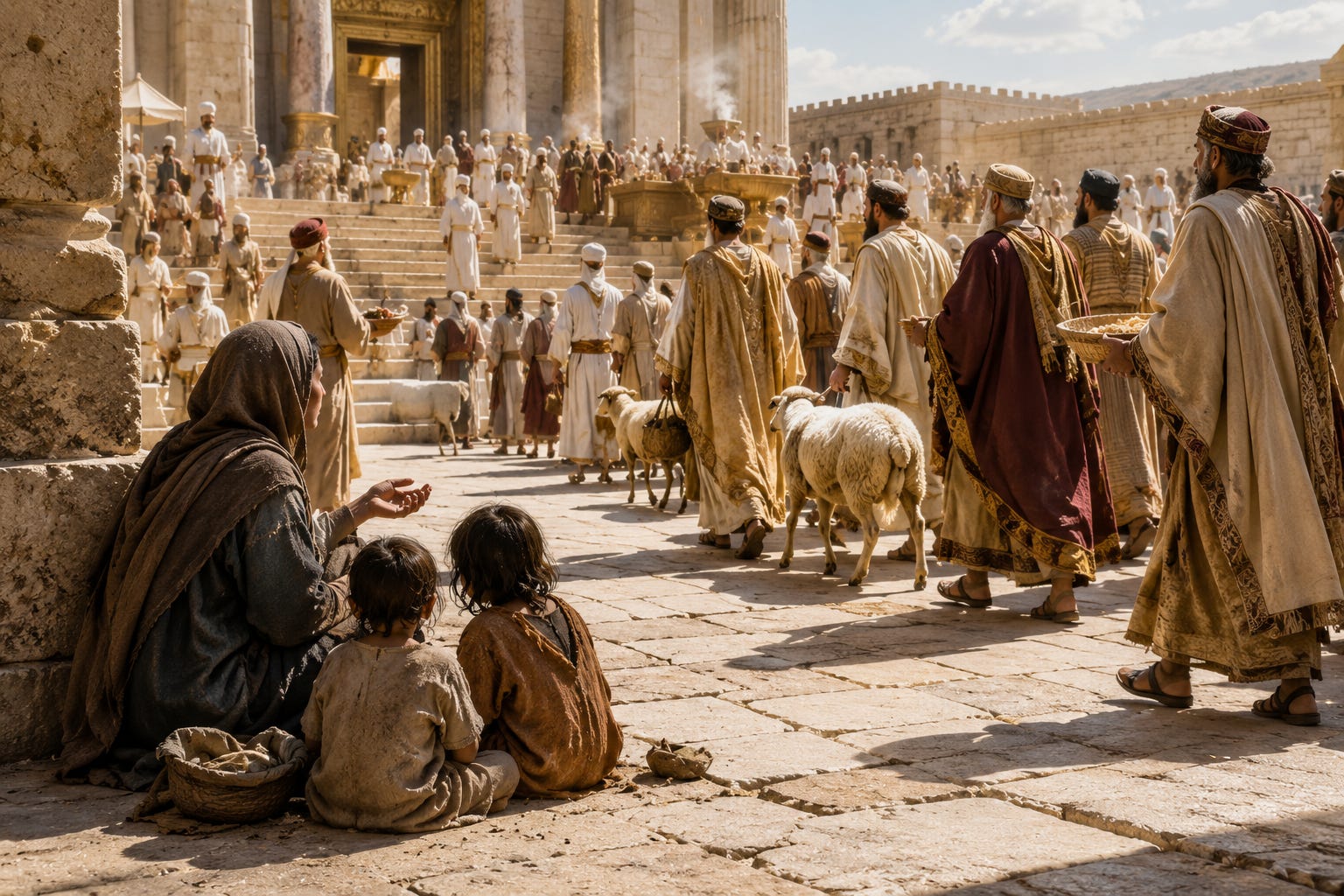
God is weary of the show that the people of Judah put on, pretending to sacrifice to Him and perform their rituals and solemn assemblies without any understanding, repentance or showing any fruit as alleged believers. The AI image is quite appropriate - a poor widow with her small children watches and begs as many well-dressed residents and rulers of Jerusalem (called “Sodom and Gomorrah” by God) bring their fatted sacrifices to the temple, completely ignoring her plight.

Apparently, the people didn’t listen very well back in the time of Isaiah, as Jesus says this to the religious leaders observing their hypocrisy:
““But woe to you, scribes and Pharisees, hypocrites, because you shut off the kingdom of heaven from people; for you do not enter in yourselves, nor do you allow those who are entering to go in. [Woe to you, scribes and Pharisees, hypocrites, because you devour widows’ houses, and for a pretense you make long prayers; therefore you will receive greater condemnation.]
“Woe to you, scribes and Pharisees, hypocrites, because you travel around on sea and land to make one proselyte; and when he becomes one, you make him twice as much a son of hell as yourselves.
“Woe to you, blind guides, who say, ‘Whoever swears by the temple, that is nothing; but whoever swears by the gold of the temple is obligated.’ You fools and blind men! Which is more important, the gold or the temple that sanctified the gold? And, ‘Whoever swears by the altar, that is nothing, but whoever swears by the offering on it, he is obligated.’ You blind men, which is more important, the offering, or the altar that sanctifies the offering? Therefore, whoever swears by the altar, swears both by the altar and by everything on it. And whoever swears by the temple, swears both by the temple and by Him who dwells within it. And whoever swears by heaven, swears both by the throne of God and by Him who sits upon it.
“Woe to you, scribes and Pharisees, hypocrites! For you tithe mint and dill and cummin, and have neglected the weightier provisions of the law: justice and mercy and faithfulness; but these are the things you should have done without neglecting the others. You blind guides, who strain out a gnat and swallow a camel!
“Woe to you, scribes and Pharisees, hypocrites! For you clean the outside of the cup and of the dish, but inside they are full of robbery and self-indulgence. You blind Pharisee, first clean the inside of the cup and of the dish, so that the outside of it may become clean also.
“Woe to you, scribes and Pharisees, hypocrites! For you are like whitewashed tombs which on the outside appear beautiful, but inside they are full of dead men’s bones and all uncleanness. So you, too, outwardly appear righteous to men, but inwardly you are full of hypocrisy and lawlessness.
“Woe to you, scribes and Pharisees, hypocrites! For you build the tombs of the prophets and adorn the monuments of the righteous, and say, ‘If we had been living in the days of our fathers, we would not have been partners with them in shedding the blood of the prophets.’ So you testify against yourselves, that you are sons of those who murdered the prophets. Fill up, then, the measure of the guilt of your fathers. You serpents, you brood of vipers, how will you escape the sentence of hell?”
Matthew 23:13-33 NASB1995
People don’t want to hear the unvarnished truth, especially from the Creator of the Universe. Obviously, not long after Jesus said these stinging words, the actions were in place to eliminate Him. The people reacted in a similar way in the time of Isaiah to silence the prophets, through murder or exile. God wants us to be in a relationship with Him all the time and in obedience. He doesn’t want us to sit in a pew at church for an hour on Sunday pretending to “commune” with Him through rote prayers and liturgies, throw a few bucks in the offering plate, and then live like the Devil himself is writing the script for our actions the rest of the week. As noted in Precept Austin, unrepentant sin stops our prayers.
Let’s look at a couple of commentaries. First, this is from Enduring Word:
a. You rulers of Sodom…you people of Gomorrah: God was obviously trying to get the attention of the leaders and people of Judah. He did this by associating them with two cities synonymous with sin and judgment.
b. To what purpose is the multitude of your sacrifices to Me? Even in the midst of their rebellion, Judah continued its religious ceremony and ritual. They continued the sacrifices, they continued the burnt offerings, they continued offering the fat of fed cattle, they continued burning incense, they continued their assemblies and their sacred meetings – and God was sick of them all.
i. See how the LORD describes His reaction to these religious rituals: I have had enough…. bring no more futile sacrifices…an abomination to Me…. I cannot endure…My soul hates…they are a trouble to Me…I am weary of bearing them.
ii. This is a sobering thought. We can offer God all kinds of religious rituals and ceremonies, all kinds of religious service, and He may hate it and consider it an abomination! Perhaps, in the midst of all their calamity (described in Isaiah 1:5-9), Judah thought the answer was in religious ceremonies, in their ancient version of “church attendance” and a few dollars in the offering. But if their heart wasn’t changed, and humbled, and surrendered to the LORD it made no difference. Without the right heart, God hated their religious ceremony and service.
iii. “When sinners are under the judgments of God they will more easily be brought to fly to their devotions than to forsake their sins and reform their lives.” (Matthew Henry)
c. When you spread out your hands: This was the posture of prayer in that ancient culture. Instead of praying with heads bowed and hands folded, they would pray with the face turned towards heaven and the hands spread out to heaven. So, when they prayed, the LORD says, “I will hide my eyes from you…I will not hear.”
i. We may be certain, that in the midst of all this religious ceremony, there were many fine prayers offered. Many eloquent, stirring, and emotional prayers were said. But they were empty, hollow, useless prayers, because God looked at Judah and said, “Your hands are full of blood.”
Warren Wiersbe has some excellent observations about the modern church as quoted in Precept Austin:
Warren Wiersbe draws out a pithy application from this section writing that… “before passing judgment on worshipers in a bygone era, perhaps we should confess the sins of the “worshiping church” today. According to researcher George Barna, 93 percent of the households in the United States contain a Bible and more than 60 percent of the people surveyed claim to be religious; but we would never know this from the way people act (cp Mt 7:23, Ezek 33:31). One Protestant church exists for every 550 adults in America, but does all this “religion” make much of a difference in our sinful society? Organized religion hasn’t affected the nation’s crime rate, the divorce rate, or the kind of “entertainment” seen in movies and on TV. The average church allocates about 5 percent of its budget for reaching others with the Gospel, but 30 percent for buildings and maintenance. At a time (Ed: Wiersbe wrote this about 1992) when the poor and the aged are pleading for help, churches in America are spending approximately 3 billion dollars a year on new construction. Where churches have life and growth, such construction may be needed; but too often the building becomes “a millstone instead of a milestone,” to quote Vance Havner. At least 62 percent of the people Barna surveyed said that the church was not relevant to today’s world and is losing its influence on society. It may be that, like the worshipers in the ancient Jewish temple, we are only going through the motions.” (See The Frog in the Kettle- George Barna) (Wiersbe, W. W. Be Comforted. An Old Testament Study. Wheaton, Ill.: Victor Books)
This was written in 1992. I think this woeful state is even more pronounced 34 years later, now that we have the many mainstream “Christian” denominations who have tossed in the towel and declared blatant sin to be acceptable, the word of God to be “troublesome and full of errors” and the church to be relevant only as a tool of narrowly-defined political social justice; it’s interesting that the unborn (created in God’s image) - as an example - never receive any of that justice but are cheerfully eliminated as inconveniences, creating many bloody hands of hypocritical apostates.
Well, I think I get Isaiah’s point as he tries to give an unvarnished message of sobering truth to the people of Judah. So what does he say next? He relays a message from God on how to make things right, by bringing reason into the picture and telling the people what they can do. My next devotional examines Isaiah 1:16-20 - Remove the evil of your deeds.
Heaven on Wheels Daily Prayer:
Dear Lord - Thank you, through the many commentaries I read, for revealing the similarities between this passage in Isaiah and the “woe” statements from Jesus in the Gospel of Matthew. Our relationship with You is not tethered to one hour in a building that calls itself a church. Amen.
Citations and Credits:
Scripture quotations taken from the (NASB®) New American Standard Bible®, Copyright © 1960, 1971, 1977, 1995 by The Lockman Foundation. Used by permission. All rights reserved. www.Lockman.org.
“H7646 - śāḇaʿ - Strong’s Hebrew Lexicon (NASB95).” Blue Letter Bible. Web. 21 Jul, 2026. <https://www.blueletterbible.org/lexicon/h7646/nasb95/wlc/0-1/>.
Precept Austin was accessed on 07/21/2026 to review commentary for Isaiah 1:10-15.
Commentary from Enduring Word is used with written permission and without any alteration. ©1996-present The Enduring Word Bible Commentary by David Guzik – enduringword.com. At the link referenced, the bibliography used by David Guzik can be accessed.
Am Grateful and thankful for your endless support may GOD bless you too in the mighty name of Jesus Christ we have prayed and Amen.