


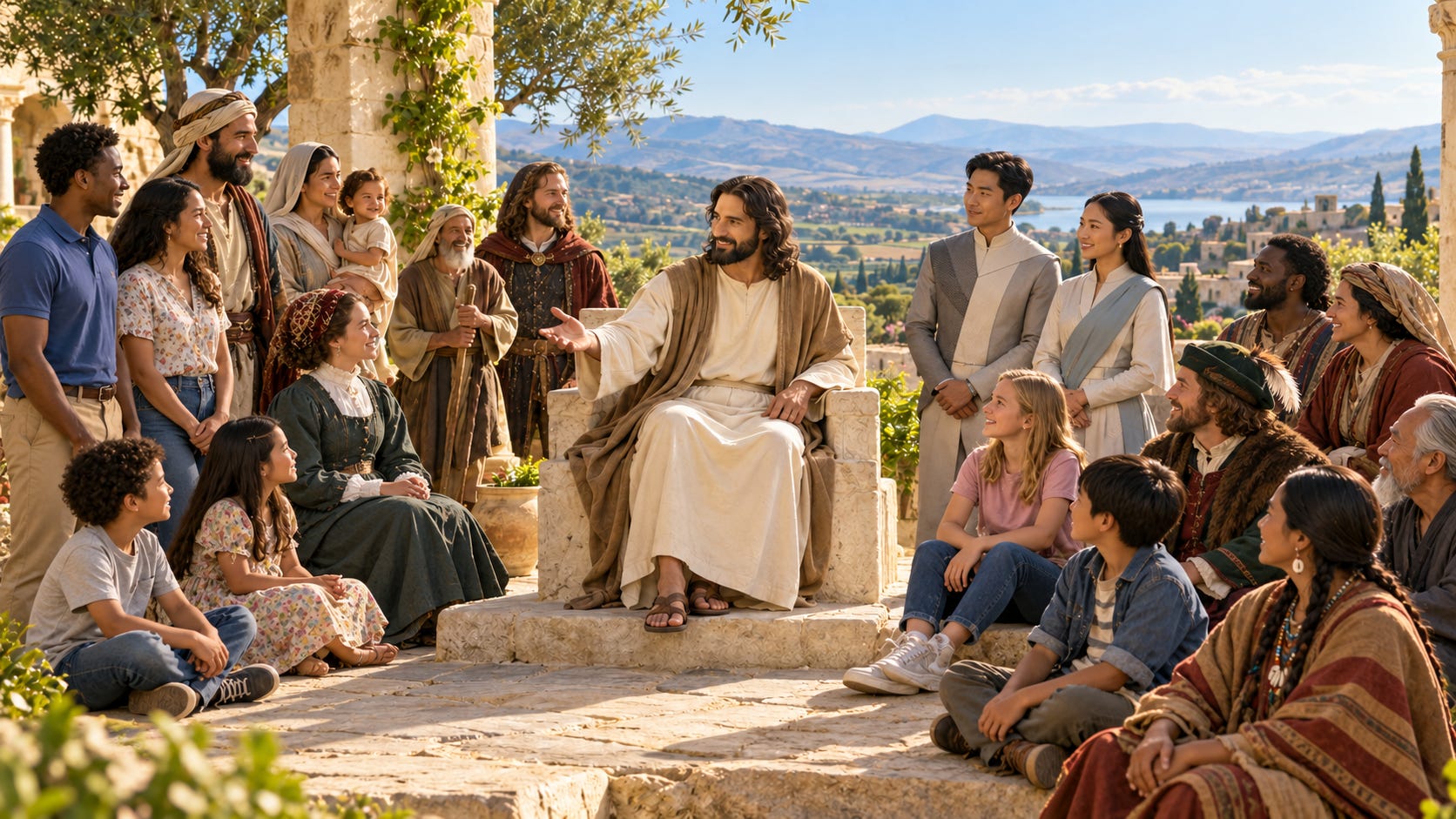
“For a child will be born to us, a son will be given to us;
And the government will rest on His shoulders;
And His name will be called Wonderful Counselor, Mighty God, Eternal Father, Prince of Peace.
There will be no end to the increase of His government or of peace,
On the throne of David and over his kingdom,
To establish it and to uphold it with justice and righteousness
From then on and forevermore.
The zeal of the Lord of hosts will accomplish this.”
Isaiah 9:6-7 NASB1995
If you’re like me, when I read the words of verse 6, I immediately conjure up the wonderful oratorio work “The Messiah” by Georg Frederich Handel in my head. He was born in Prussia and became a naturalized British citizen in 1727 and wrote this timeless work in 1741. The words from this prophecy are used in Part I, Scene 3 of the massive work, as noted in an article about “The Messiah” in Wikipedia:
Scene 3: The prophecy of Christ’s birth
Behold, a virgin shall conceive (alto)
O thou that tellest good tidings to Zion (air for alto and chorus)
For behold, darkness shall cover the earth (bass)
The people that walked in darkness have seen a great light (bass)
For unto us a child is born (duet chorus)
Now that those marvelous chords and choruses are ringing in my years, let’s dig into this part of the prophecy in Isaiah 9. By the way, if you live near a symphony orchestra that performs a sing-along Messiah (or just a regular performance) at Christmas time, go and enjoy it! If you happen to have the libretto to bring along, even better. Oh, and I especially loved the AI image for this devotional at the top. People from all ages, times and groups are gathered around an accessible throne with a loving Jesus as their centerpiece.
The best commentary about verse 6 that I read is from Enduring Word. Let’s take it a section at a time. Some readers should be warned that this exploration will be quite long (I sometimes get TL:DR messages but that’s ok):
a. For unto us a Child is born, unto us a Son is given: Most straightforwardly, Isaiah used the Hebrew literary tool of repetition to emphasize the point. The Child is born, the Son is given. At the same time, we recognize the hand of the Holy Spirit in the specific wording.
b. For unto us a Child is born: This glorious prophecy of the birth of Messiah reminds Israel that the victory-bringing Messiah would be a man. Theoretically, the Messiah could have been an angel. Or, the Messiah could have been God without humanity. But in reality, neither of those options would have qualified the Messiah to be our Savior and High Priest as Jesus is. The Child had to be born.
i. What amazing mystery! There is nothing weaker, more helpless, more dependent than a child. Theoretically, the Messiah could have come as a fully-grown man, created as an adult even as Adam was created. But for Jesus to fully identify with humanity, and to display in His life the servant nature that is in God, He made Himself of no reputation, taking the form of a bondservant, and coming in the likeness of men (Philippians 2:7).
c. Unto us a Son is given: This Child would be a man, but more than a man. He is also the eternal Son of God, the Second Person of the Godhead. Theoretically, the Messiah didn’t have to be God. He might have been a sinless angel, or merely a perfect man like Adam. But in reality, neither of those options would have qualified the Messiah to be our Savior and High Priest as Jesus is. The Son had to be given.
i. What glorious truth! We needed a perfect, infinite Being to offer a perfect, infinite atonement for our sins. We needed Immanuel, God is with us (Isaiah 7:14).
ii. The Child could be born because the humanity of Jesus had a starting point. There was a time when humanity was not added to His deity. The Son had to be given, because the Second Person of the Trinity is eternal, and existed forever as the Son, even before adding humanity to His deity.
iii. While Isaiah may have intended the repetition merely for the sake of emphasis, we rejoice in the Holy Spirit’s guidance in every word! Jesus, the Messiah, is fully God and fully man. There was a time when the eternal Son of God, the Second Person of the Holy Trinity, added humanity to His deity. He never became less God, but He added a human nature to His divine nature, and so became one person with two distinct natures, functioning together in perfect harmony.
iv. That Jesus is both God and man tells us that man really is made in the image of God (Genesis 1:26) and that perfect humanity is more compatible with deity than we imagine. It says that our problem is not our humanity, but our fallenness. To say “I’m only human” is wrong because Jesus was fully human yet perfect. It is more accurate to say, “I’m only fallen.” But remember that the humanity that Jesus added to His Divine nature was not the sinful humanity we commonly know, but the perfect humanity of Adam and Eve before the fall.
v. Jesus remains a man eternally (Acts 7:55-56, 1 Timothy 2:5). He did not relinquish His humanity on His ascension; but He is now a man in a resurrection body, as we will one day have.
vi. If Jesus were not fully man, He could not stand in the place of sinful man and be a substitute for the punishment man deserves. If He were not fully God, His sacrifice would be insufficient. If Jesus is not fully God and fully man, we are lost in sin.
This is so perfect! Let’s capture a few takeaways from this first part of the commentary:
The repetition in Isaiah and the specific words identify that the Messiah will be a man, who experiences humanity from childbirth. He is not an angel; He is not God without the humanity; He is not just a perfect man like Adam. He is also not “non-binary or transgender” as many progressive church “pastors” are now claiming.
He is the Son of the Eternal God, part of the Triune being. Humanity was added to His being because He was born. He is fully God and fully man, telling us that humanity is created in God’s image. His deity is not less for having become human.
Jesus remains a man eternally. If He were not fully man, he could not stand in the place of sinful man as a substitute for the punishment man deserves. If He were not fully God, the sacrifice would be insufficient.
This profound revelation in a few words was given to Isaiah more than 700 years before the birth of Christ.

Back to the commentary from Enduring Word:
d. And the government will be upon His shoulder: Ultimately, this will be fulfilled in the Millennium, when Jesus Christ will rule the earth as King of Kings and Lord of Lords (Revelation 20:4-6, Psalm 72, Isaiah 2:1-4, Isaiah 11, Isaiah 65:17-25, Zechariah 14:6-21).
i. This ultimate fulfillment of this promise is still waiting. But we can still see the government…upon His shoulder in many ways. Gayle Erwin writes about the government God promises, both ultimately and right now:
·What might such a government look like? First of all, it would look like its king. Politicians of this day look for what they can get from you. Jesus looks for what He can do for you.
·Leaders of this day surround themselves with servants. Jesus surrounds us with His servanthood.
·Leaders of this day use their power to build their empire. Jesus uses his power to wash our feet and make us clean and comfortable.
·Leaders of this day trade their influence for money. God so loved that he gave…
·Generals of this day need regular wars to keep their weapons and skills up to date and insure their own advancement. Jesus brings peace and rest to hearts.
·The higher the plane of importance one reaches in this world, the more inaccessible he becomes. Jesus was Emanuel, “God with us.”
·Leaders of this day are desperate to be seen and heard. Jesus sought anonymity so He could be useful.
·Obviously, Jesus is not in charge of the halls of Washington, London, Moscow, Baghdad, Paris or Berlin. So, how can we ever believe the “government will be upon His shoulders”?
·Actually, His government shows its workings in wonderful ways. Whenever I see someone who miraculously leaves a life of drugs or alcohol and is restored to his family and work, I can see that he is now governed by God.
·Whenever I see loving Christians gently caring for orphans and those rejected by family, I know I am watching people governed by God.
·Whenever I see people eagerly learning the Bible and joyously praising, I know who the governor is.
·Whenever I see people give up lucrative careers simply to go and share the Good News of Jesus, I know they are governed by God.
·When I see pastors carefully teach and lead the flock God has given them, I know they are getting signals from the great King.
·When I see people leave family to live and teach in distant lands because they love the people who have not heard, I know they are governed by God.
·So, indeed, the government is alive and working. Often silently, mostly unseen. We can be and are, by choice, governed by God. Hope and joy and peace and rest cover its subjects. Justice, mercy and grace, amazingly coexist. I like this Kingdom. The borders are open. Come on in.
I really can’t add to this. Wherever we are serving Him, we are demonstrating His government, His Kingdom. Human governments will come and go and politicians will disappear and die and then be replaced by even more glib politicians, but His Kingdom stretches on from TODAY to eternity. Serve Him!

Next part of the commentary:
f. The Messiah is Wonderful: The glory of who He is and what He has done for us should fill us with wonder. You can never really look at Jesus, really know Him, and be bored. He is Wonderful and will fill your heart and mind with amazement.
i. As well, this is a reference to the deity of Jesus. “The word ‘wonderful’ has overtones of deity” (Grogan). This is also seen in Judges 13:18.
The context of Judges 13:18 is the appearance of an angel of the Lord to Manoah and his barren wife. They become the parents of Samson. It is so important to step back from the busywork of being a believer and just sit in awe and wonder gazing at Jesus. Yes, I know we can’t see Him physically in the here and now, but we certainly know Him from His creation and His ministry and His salvation. It is wondrous!
g. The Messiah is our Counselor: Jesus is the One fit to guide our lives and should be the Christian’s immediate resource as a counselor. Jesus can help you with your problems. He may use the presence and the words of another Christian to do it, but Jesus is our Counselor.
i. How we need Jesus as our Counselor! “It was by a Counsellor that this world was ruined. Did not Satan mask himself in the serpent, and counsel the woman with exceeding craftiness, that she should take unto herself of the fruit of the tree of knowledge of good and evil, in the hope that thereby she should be as God? Was it not that evil counsel which provoked our mother to rebel against her Maker, and did it not as the effect of sin, bring death into this world with all its train of woe? Ah! beloved, it was meet that the world should have a Counsellor to restore it, if it had a Counsellor to destroy it.” (Spurgeon)
ii. Jesus is our Counselor in the sense that as God the Son, He takes counsel with the Father and the Holy Spirit for our good. The High Council of the Godhead brought forth our salvation. “Hence you read in the book of Zechariah, if you turn to the sixth chapter and the thirteenth verse, this passage – ‘The council of peace shall be between them both.’ The Son of God with his Father and the Spirit, ordained the council of peace. Thus was it arranged. The Son must suffer, he must be the substitute, must bear his people’s sins and be punished in their stead; the Father must accept the Son’s substitution and allow his people to go free, because Christ had paid their debts. The Spirit of the living God must then cleanse the people whom the blood had pardoned, and so they must be accepted before the presence of God, even the Father. That was the result of the great council.” (Spurgeon)
iii. The Great Counselor guides our lives. “Remember, there is nothing that happens in your daily life, but what was first of all devised in eternity, and counseled by Jesus Christ for your good and in your behalf, that all things might work together for your lasting benefit and profit…. Oh, how strange providence seems to you and to me! Does it not look like a zig-zag line, this way and that way, backward and forward, like the journeyings of the children of Israel in the wilderness? Ah! my brethren, but to God it is a straight line. Directly, God always goes to his object. And yet to us, he often seems to go round about…. Let us learn to leave providence in the hand of the Counsellor.” (Spurgeon)
iv. Jesus’ counsel is necessary counsel. Jesus’ counsel is faithful counsel, without any self-interest. Jesus’ counsel is hearty counsel. It isn’t detached and unemotional. Jesus’ counsel is sweet counsel. “Christian, do you know what sweet counsel is? You have gone to your Master in the day of trouble, and in the secret of your chamber you have poured out your heart before him. You have laid your case before him, with all its difficulties, as Hezekiah did Rabshakeh’s letter, and you have felt, that though Christ was not there in flesh and blood, yet he was there in spirit, and he counseled you. You felt that his was counsel that came from the very heart. But he was something better than that. There was such a sweetness coming with his counsel, such a radiance of love, such a fullness of fellowship, that you said, ‘Oh that I were in trouble every day, if I might have such sweet counsel as this!’ Christ is the Counsellor whom I desire to consult every hour, and I would that I could sit in his secret chamber all day and all night long, because to counsel with him is to have sweet counsel, hearty counsel, and wise counsel, all at the same time.” (Spurgeon)
v. “Why, you may have a friend that talks very sweetly with you, and you will say, ‘Well, he is a kind, good soul, but I really cannot trust his judgment.’ You have another friend, who has a good deal of judgment, and yet you say of him, ‘Certainly, he is a man of prudence above a great many, but I cannot find out his sympathy; I never get at his heart, if he were ever so rough and untutored, I would sooner have his heart without his prudence, than his prudence without his heart,’ But we go to Christ, and we get wisdom; we get love, we get sympathy, we get everything that can possibly be wanted in a Counsellor.” (Spurgeon)
Charles Spurgeon has such a lovely take on this word Counselor. Jesus and His counsel is necessary and faithful and hearty and sweet. No earthly counselor could ever match the wisdom, love, sympathy and guidance that we can receive from our Lord.

Continuing in this commentary:
h. The Messiah is Mighty God: He is the God of all creation and glory, the LORD who reigns in heaven, the One worthy of our worship and praise.
i. It is difficult to think of a more straightforward declaration of the deity of the Messiah. Yet some groups (such as Jehovah’s Witnesses) try to make a distinction between Mighty God and Almighty God. Scripturally, there is no distinction, because both titles are used of Jesus and Yahweh specifically (Almighty is applied to Jesus in Revelation 1:8).
ii. In Isaiah 10:21, the prophet uses the exact same phrase to refer to Yahweh: The remnant will return, the remnant of Jacob, to the Mighty God. Therefore, this is a clear statement of absolute deity
iii. “And indeed, if Christ had not been God, it would have been unlawful to glory in him; for it is written, Cursed be he that trusteth in man. (Jeremiah 17:5)” (Calvin)
iv. “We extend the right hand of fellowship to all those who love the Lord Jesus Christ in sincerity and truth; but we cannot exchange our Christian greetings with those who deny him to be ‘very God of very God.’ And the reason is sometimes asked; for say our opponents, ‘We are ready to give the right hand of fellowship to you, why don’t you do so to us?’ Our reply shall be given thus briefly: ‘You have no right to complain of us, seeing that in this matter we stand on the defensive. When you declare yourselves to believe that Christ is not the Son of God, you may not be conscious of it, but you have charged us with one of the blackest sins in the entire catalogue of crime.’ The Unitarians must, to be existent, charge the whole of us, who worship Christ, with being idolaters. Now idolatry is a sin of the most heinous character; it is not an offense against men it is true, but it is an intolerable offense against the majesty of God.” (Spurgeon)
v. “If Christ were not the Son of God, his death, so far from being a satisfaction for sin, was a death most richly and righteously deserved. The Sanhedrin before which He was tried was the recognised and authorised legislature of the country. He was brought before that Sanhedrin, charged with blasphemy, and it was upon that charge that they condemned him to die, because he made himself the Son of God.” (Spurgeon)
There are some great insights here, again most of them from Charles Spurgeon. Those who deny the fully divinity of Christ are essentially accusing Jesus of the very things (like blasphemy) that allowed the Sanhedrin to condemn Him to death. More and more mainstream (really, progressive) churches are starting to question that Jesus IS the mighty (almighty) God. Some of them even describe Him as a brown-skinned “Palestinian” rebel against the Roman oligarchy. There’s so much that is in error in that characterization that it would take another full devotional to pick it apart. He is the Son of God.
i. The Messiah is the Everlasting Father: The idea in these Hebrew words is that Jesus is the source or author of all eternity, that He is the Creator Himself. It does not mean that Jesus Himself is the Person of the Father in the Trinity.
j. The Messiah is the Prince of Peace: He is the One who makes peace, especially between God and man.
i.“Whenever, in short, it appears to us that everything is in a ruinous condition, let us recall to our remembrance that Christ is called Wonderful, because he has inconceivable methods of assisting us, and because his power is far beyond what we are able to conceive. When we need counsel, let us remember that he is the Counselor. When we need strength, let us remember that he is Mighty and Strong. When new terrors spring up suddenly every instant, and when many deaths threaten us from various quarters, let us rely on that eternity of which he is with good reason called the Father, and by the same comfort let us learn to soothe all temporal distresses. When we are inwardly tossed by various tempests, and when Satan attempts to disturb our consciences, let us remember that Christ is The Prince of Peace, and that it is easy for him quickly to allay all our uneasy feelings. Thus will these titles confirm us more and more in the faith of Christ, and fortify us against Satan and against hell itself.” (Calvin)
The best age for believers is yet to come. The Prince of Peace makes peace between God and man. I like this illustration of this time to come that was found in Precept Austin:
One evening in the dark war days of 1940 Anthony Eden (Lord Avon, as he became) and Winston Churchill were dining alone. They were sitting debating which period of history they would have preferred to live in, had the choice been theirs. Churchill favored the age of Queen Anne and Marlborough’s wars. Eden preferred that of Pitt and the struggle with Napoleon. They were both attracted by the first Elizabethan Age. After they had been talking in this fashion for awhile, Churchill concluded: “Of course, of all of them this is the greatest! This is the one in which to love!” And he meant it, … Nevertheless, as Browning said, “the best is yet to be.” Earth’s finest age lies not in the past but in the future—the Minennial Age in which Jesus Christ will personally preside over the affairs of this planet. And—wondrous thought!—every trueborn child of God will be alive on earth at that time! Prophetic Witness. vol. 6, no. 9 (Eastbourne, England: Prophetic Witness Publishing House, September 1982)
Here’s one more commentary from Enduring Word on verse 7:
a. Of the increase of His government and peace there will be no end…even forever: The reign of the Messiah will not last merely 1,000 years, though the millennium is a special aspect of His reign. There will be no end to the reign of the Messiah, and He will rule for all eternity.
i. Handel had it right in the Hallelujah chorus of Messiah: “And He shall reign forever and ever.”
b. Upon the throne of David: Jesus will rule on David’s throne and over his kingdom (that is, David’s kingdom – Israel). This is a fulfillment of God’s great covenant with David in 2 Samuel 7.
c. The zeal of the LORD of hosts will perform this: All this may sound too good to be true, but it will be done. God – the LORD of all heavenly armies – has promised to accomplish this word, and part of it has been accomplished already.
i. Jesus can be Wonderful, Counselor, Mighty God, Everlasting Father, Prince of Peace for everyone now. One day, these offices will be imposed upon the world. For now, they are real for those who receive Jesus and submit to Him.
We’ve come full circle back to Handel’s Messiah again! From the prophecy to the wonder of eternal life in His rule!
Look away from the irritations and annoyances and turmoil of this life and look to the prophecy fulfilled! I needed this today because I was in a bit of a foul mood earlier, but it is hard to stay that way with this glorious prophecy!
My next devotional examines Isaiah 9:8-12 - The first of four passages on God’s anger and judgment against Israel.
Heaven on Wheels Daily Prayer:
Dear Lord - Thank You for the wonderful descriptions of Jesus that are found in Isaiah. Thank you for inspiring Handel to write the glorious Messiah oratorio and put these passages of scripture to music. Amen.
Citations and Credits:
Scripture quotations taken from the (NASB®) New American Standard Bible®, Copyright © 1960, 1971, 1977, 1995 by The Lockman Foundation. Used by permission. All rights reserved. www.Lockman.org.
Precept Austin was accessed on 10/13/2026 to review commentary for Isaiah 9:6-7.
Biblehub.org was accessed on 10/13/2026 to review commentary for Isaiah 9:6-7
Commentary from Enduring Word is used with written permission and without any alteration. ©1996-present The Enduring Word Bible Commentary by David Guzik – enduringword.com. At the link referenced, the bibliography used by David Guzik can be accessed.