


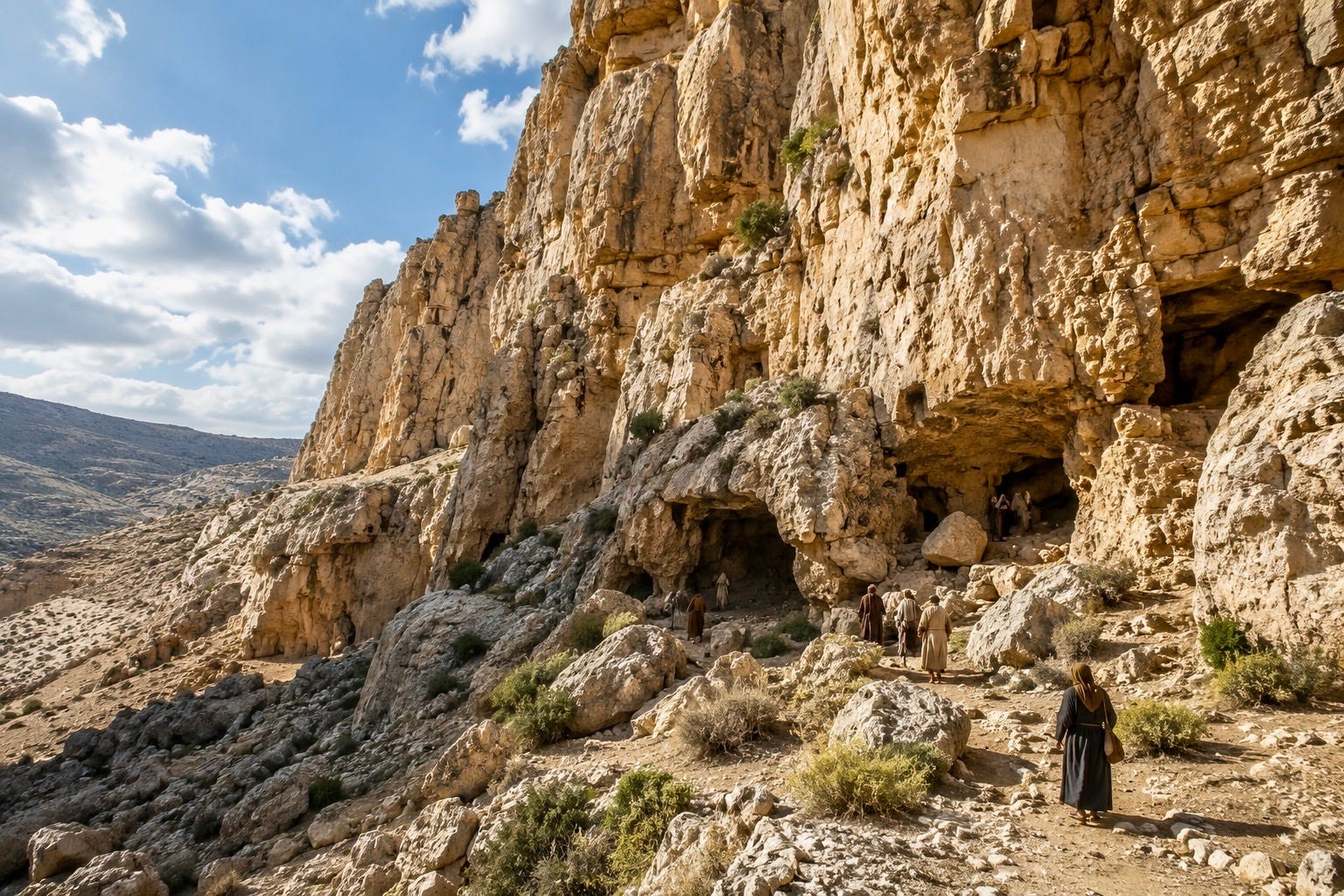
“Enter the rock and hide in the dust
From the terror of the Lord and from the splendor of His majesty.
The proud look of man will be abased
And the loftiness of man will be humbled,
And the Lord alone will be exalted in that day.
For the Lord of hosts will have a day of reckoning
Against everyone who is proud and lofty
And against everyone who is lifted up,
That he may be abased.”
Isaiah 2:10-12 NASB1995
Those who are driven by their sin are tempted to try and hide from an omnipotent, omniscient God (good luck with that). They want to hide from the terror of the Lord in the dust behind rocks and perhaps in caves, like the AI image suggests. This passage, from the commentary I read, points directly to Revelation 6, after the breaking of the sixth seal (my emphasis added in bold):
“I looked when He broke the sixth seal, and there was a great earthquake; and the sun became black as sackcloth made of hair, and the whole moon became like blood; and the stars of the sky fell to the earth, as a fig tree casts its unripe figs when shaken by a great wind. The sky was split apart like a scroll when it is rolled up, and every mountain and island were moved out of their places. Then the kings of the earth and the great men and the commanders and the rich and the strong and every slave and free man hid themselves in the caves and among the rocks of the mountains; and they *said to the mountains and to the rocks, “Fall on us and hide us from the presence of Him who sits on the throne, and from the wrath of the Lamb; for the great day of their wrath has come, and who is able to stand?””
Revelation 6:12-17 NASB1995
Everyone who is not already walking in the light wants to flee from the Lord on that day. Those who are prideful or lofty will be humbled. This commentary from Dr. Richard Mayhue (Master’s Seminary) is quoted on Precept Austin with insight into this passage in Isaiah, which is the first real reference to the Day of the Lord in that prophecy:
Isa 2:12 is the first mention of DOL in Isaiah’s prophecy. This chapter emphasizes the future establishment of God’s kingdom (Isa 2:2, 3, 4 ), the present sinful state of Israel (Isa 2:5, 6, 7, 8, 9), and the future day of reckoning (Isa 2:10, 11, 12, 13, 14, 15, 16, 17, 18, 19, 20, 21, 22 ). The prophet appears to look beyond the near to the far future in the judgment emphasis of Isa 2:10-22 , just as he had looked to the eschatological kingdom in Isa 2:1-4. There are several indicators of millennial conditions in Isa 2:1-4 (cf. Rev 20:1-6). Mt. Zion will be the world capital and all the nations will come to it (Isa 2:1, 2) in order to seek God’s word (Isa 2:3). God will judge between the nations and war will be no more (Is 2:4,5). This eschatological emphasis in Isa 2:2, 3, 4 makes it reasonable to conclude that eschatological judgment is in view in Is 2:10-22 , rather than to God’s chastisement of Judah by Assyria and Babylon.
DOL is described by Isaiah as a time of universal humiliation for all who are proud (Is 2:11, 12, 17). In contrast, the splendor of God’s majesty (Is 2:10, 19, 21 ) will be displayed and the Lord alone will be exalted in that day (Is 2:11, 17). Isaiah’s portrayals of DOL here should be interpreted as referring to that time immediately preceding the establishment of Christ’s kingdom on earth. It is a day when God’s majesty will be outwardly manifested (Is 2:10, 19, 21), and the population will be driven in terror to caves for protection (Is 2:21 , cf. Re 6:16, 17).
The timing and terminology of Is 2:21 are strikingly similar to the description of the sixth seal in Re 6:16, 17. If these passages are correlated, it can be concluded that the sixth seal is a part of DOL and occurs at the end of the Tribulation. The correlation also confirms that Isa 2:12 refers to the far future. As will be noted later, Zec 14:1 and Mal 4:5 also emphasize only the far eschatological implications of DOL.
Isaiah 13 is the next chapter to be considered. It is an oracle concerning Babylon. Is 13:1-8 deals with God’s use of Babylon as his instrument of indignation for the destruction of Israel (Is 13:5, 6 ). This reminds one of Habakkuk’s dismay that God would do such a thing (Hab 1:2, 3, 4). The DOL was near in the mind of Isaiah (Is 13:6), although it would not come for over one hundred years. It would be a day of destruction, terror, and pain (Is 13:8). There is little doubt that this refers to the near eschatological event fulfilled by Babylon from 605-586 B.C.
However, there is good reason to believe that Isa 13:9-16 speaks of DOL implications for the far future. The near emphasis returns in Isa 13:17-22 where the end of Babylon is described. That the far future is described in 13:9-16 is shown by the cosmic disturbances (Isa 13:10, 13 ; cf. Matt 24:29; Rev 6:12, 13; Joel 2:31) and the universal judgment of mankind (Isa 13:11 ; cf. 2:11, 12 ). Ladd accurately describes the interplay of the near and far views:
These two visitations, the near and the far, or, as we may for convenience call them, the historical and the eschatological, are not differentiated in time. In fact, sometimes the two blend together as though they were one day. Isaiah 13 calls the day of the visitation of Babylon the Day of the Lord. The Lord is mustering a host for battle (Isa 13:4-6), he will stir up the Medes against Babylon (Isa 13:17). Therefore, men are to “wail, for the day of the Lord is near; as destruction from the Almighty it will come!” (Isa 13:6). This historical Day of the Lord is painted against the backdrop of the eschatological Day of the Lord. The Day of the Lord will bring disaster to the earth and a disruption of the heavenly order (Isa 13:9-13). Judgment will fall both upon the world of nature and upon men (Isa 13:7) when God punishes the world for its evil and the wicked for their iniquity (Isa 13:11). Here is a picture of universal judgment. The Day of the Lord is the eschatological judgment of mankind; but the two are seen as though they were one day, one visitation of God.
WOW! I need to read this several times to understand the far-reaching implications. One thing I found throughout the threads for this passage is that the Day of the Lord and God’s wrath is directed primarily at one thing: humanity’s pride! Here are some OT references to pride, which will be cut down by the Lord in His day:
“Pour out the overflowings of your anger,
And look on everyone who is proud, and make him low.
Look on everyone who is proud, and humble him,
And tread down the wicked where they stand.
Hide them in the dust together;
Bind them in the hidden place.”
Job 40:11-13 NASB1995
“Rise up, O Judge of the earth,
Render recompense to the proud.”
Psalms 94:2 NASB1995
“The proud have hidden a trap for me, and cords;
They have spread a net by the wayside;
They have set snares for me. Selah.”
Psalms 140:5 NASB1995
“The Lord will tear down the house of the proud,
But He will establish the boundary of the widow.”
Proverbs 15:25 NASB1995
“It is better to be humble in spirit with the lowly
Than to divide the spoil with the proud.”
Proverbs 16:19 NASB1995
“We have heard of the pride of Moab—he is very proud— Of his haughtiness, his pride, his arrogance and his self-exaltation.”
Jeremiah 48:29 NASB1995
In our debased culture, we are supposed to take pride in all sorts of ludicrous things. I could make this even longer by creating a list of the ways in which human pride struts around and haughtily invites God’s judgment and wrath. Cultivating a heartfelt and true humility in the face of the Light means that we don’t have to hide in the dust and in caves but be there willing to be with Him in that consequential moment. Pride is indeed the deadliest of sins. Those who are “lofty” and proud will be abased and humbled. Isaiah tells us more about the fate of the prideful in the next passage in Isaiah 2.
My next devotional examines Isaiah 2:13-17 - When He arises, the Earth will tremble.
Heaven on Wheels Daily Prayer:
Dear Lord - Whenever I feel a touch of pride in what I have done in life, please remind me that my true path is to not hide in the dust and rocks but humbly be ready for the Day of the Lord. Amen.
Citations and Credits:
Scripture quotations taken from the (NASB®) New American Standard Bible®, Copyright © 1960, 1971, 1977, 1995 by The Lockman Foundation. Used by permission. All rights reserved. www.Lockman.org.
Precept Austin was accessed on 08/03/2026 to review commentary for Isaiah 2:10-12.
Commentary from Enduring Word is used with written permission and without any alteration. ©1996-present The Enduring Word Bible Commentary by David Guzik – enduringword.com. At the link referenced, the bibliography used by David Guzik can be accessed. Enduring Word was not used for this devotional.
Amen