


“Now it will come about that instead of sweet perfume there will be putrefaction;
Instead of a belt, a rope;
Instead of well-set hair, a plucked-out scalp;
Instead of fine clothes, a donning of sackcloth;
And branding instead of beauty.
Your men will fall by the sword
And your mighty ones in battle.
And her gates will lament and mourn,
And deserted she will sit on the ground.”
Isaiah 3:24-26 NASB1995
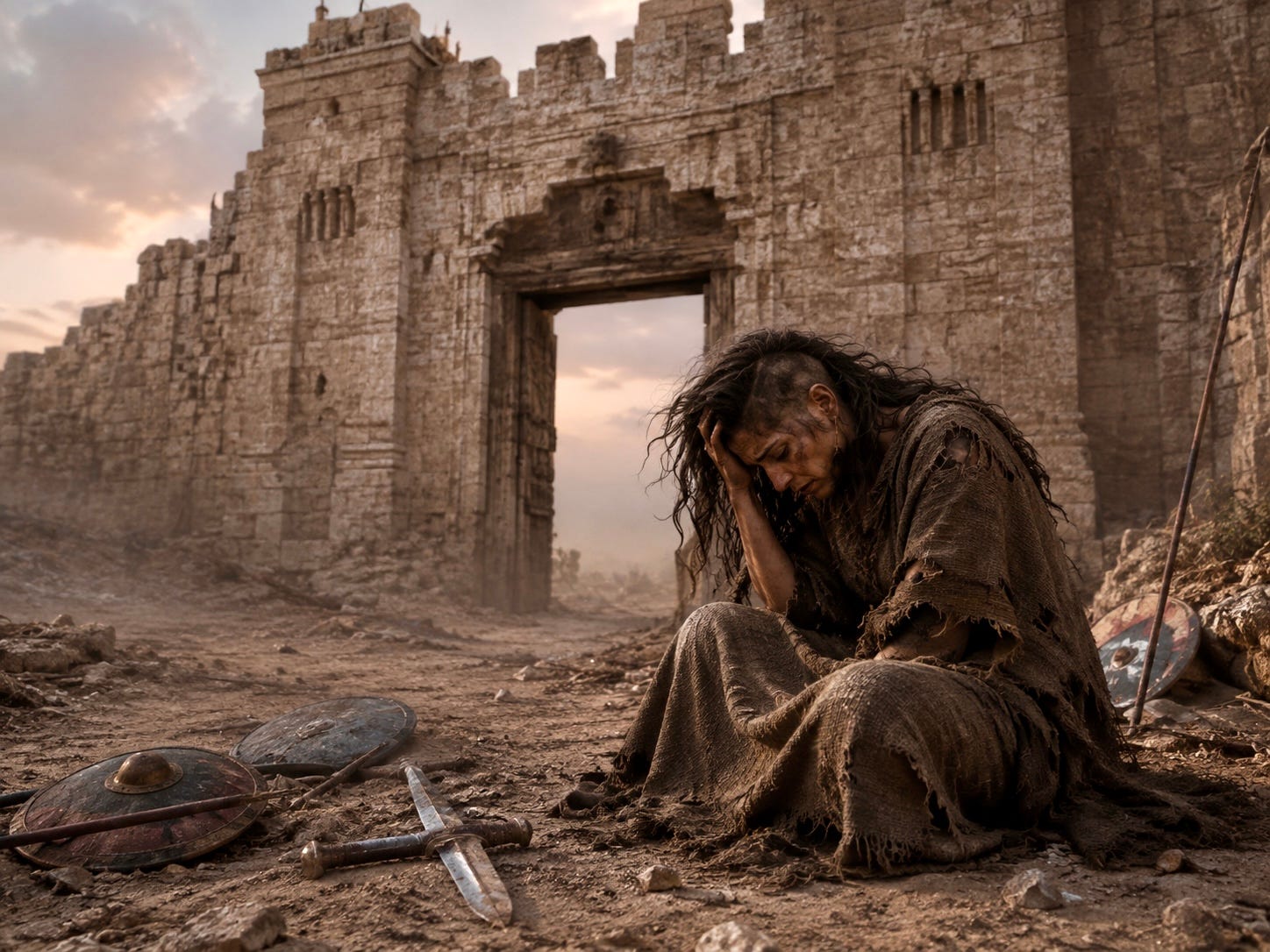
The last passage in Isaiah 3 describes the consequences of the sins of the women of Jerusalem and Judah. The AI image above says it all. There are six transformations for these women that Isaiah lists that are coming due with the prophesied captivity by Babylon:
Instead of sweet perfume there is putrefaction.
Instead of a belt, there is a rope.
Instead of well-set hair there is a plucked-out scalp.
Instead of fine clothes there is sackcloth.
Instead of beauty there is branding.
Instead of men attracted to them, these men are cut down by the sword.
Her gates will lament and mourn and she will sit on the ground, deserted. This can be both figurative, describing the city of Jerusalem itself, and also a simple direct observation of the miserable state of those women who frivolously spent their time and treasure on their appearance.
There’s not a lot of in-depth commentary on this passage. Here is what Enduring Word says:
a. Instead of…Instead of…Instead of…Instead of…instead of: The LORD will replace their finery with the marks of captivity and humiliation. They will live with the stench, the baldness, the branding and the general deprivation of captivity.
i. Do we realize how quickly God can take it all away? How much more reason to honor God with what we have, instead of indulging ourselves.
ii. “Now there cannot befall us anything worse than that we should be hardened against chastisements, and not perceive that God chastiseth us. When we labour under such stupidity, our case is almost hopeless.” (Calvin)
b. Your men shall fall by the sword, and your mighty in the war: without doubt, one reason the daughters of Zion loved all the luxury and finery was because it made them more attractive to men. They felt they could “get” men that way. But their ungodly love of luxury and finery resulted in the loss of their men.
c. She being desolate shall sit on the ground: A Roman medal, struck after Jerusalem’s fall, shows a Jewish woman being desolate, sitting under a palm tree next to a Roman soldier.
I found a reference to the prophet Ezekiel, who had a vision of the glory of the Lord departing the temple while in captivity in Babylon:
“Then I looked, and behold, in the expanse that was over the heads of the cherubim something like a sapphire stone, in appearance resembling a throne, appeared above them. And He spoke to the man clothed in linen and said, “Enter between the whirling wheels under the cherubim and fill your hands with coals of fire from between the cherubim and scatter them over the city.” And he entered in my sight.
Now the cherubim were standing on the right side of the temple when the man entered, and the cloud filled the inner court. Then the glory of the Lord went up from the cherub to the threshold of the temple, and the temple was filled with the cloud and the court was filled with the brightness of the glory of the Lord. Moreover, the sound of the wings of the cherubim was heard as far as the outer court, like the voice of God Almighty when He speaks.
It came about when He commanded the man clothed in linen, saying, “Take fire from between the whirling wheels, from between the cherubim,” he entered and stood beside a wheel. Then the cherub stretched out his hand from between the cherubim to the fire which was between the cherubim, took some and put it into the hands of the one clothed in linen, who took it and went out. The cherubim appeared to have the form of a man’s hand under their wings.
Then I looked, and behold, four wheels beside the cherubim, one wheel beside each cherub; and the appearance of the wheels was like the gleam of a Tarshish stone. As for their appearance, all four of them had the same likeness, as if one wheel were within another wheel. When they moved, they went in any of their four directions without turning as they went; but they followed in the direction which they faced, without turning as they went. Their whole body, their backs, their hands, their wings and the wheels were full of eyes all around, the wheels belonging to all four of them. The wheels were called in my hearing, the whirling wheels. And each one had four faces. The first face was the face of a cherub, the second face was the face of a man, the third the face of a lion, and the fourth the face of an eagle.
Then the cherubim rose up. They are the living beings that I saw by the river Chebar. Now when the cherubim moved, the wheels would go beside them; also when the cherubim lifted up their wings to rise from the ground, the wheels would not turn from beside them. When the cherubim stood still, the wheels would stand still; and when they rose up, the wheels would rise with them, for the spirit of the living beings was in them.
Then the glory of the Lord departed from the threshold of the temple and stood over the cherubim. When the cherubim departed, they lifted their wings and rose up from the earth in my sight with the wheels beside them; and they stood still at the entrance of the east gate of the Lord’s house, and the glory of the God of Israel hovered over them.
These are the living beings that I saw beneath the God of Israel by the river Chebar; so I knew that they were cherubim. Each one had four faces and each one four wings, and beneath their wings was the form of human hands. As for the likeness of their faces, they were the same faces whose appearance I had seen by the river Chebar. Each one went straight ahead.”
Ezekiel 10:1-22 NASB1995
Since my devotional study is on the book of Isaiah and not the equally compelling and mysterious book of the prophet Ezekiel, it should suffice to say that the people were shocked that the glory of the Lord would depart from their presence. Here is what Enduring Word says about part of this chapter of Ezekiel:
Then the glory of the LORD departed from the threshold of the temple and stood over the cherubim. And the cherubim lifted their wings and mounted up from the earth in my sight. When they went out, the wheels were beside them; and they stood at the door of the east gate of the LORD’s house, and the glory of the God of Israel was above them.
a. Then the glory of the LORD departed from the threshold of the temple and stood over the cherubim: Earlier in Ezekiel 10 the glory of the Lord was described as moving to the threshold of the temple (Ezekiel 10:4). Here it continued to move and departed from the threshold of the temple.
i. “The Jews dreamed that God could not depart from his temple; indeed, whilst it was his, and used as his, he did not, nor would he depart, but he will abandon it when profaned, and thereby made not his.” (Poole)
b. The cherubim lifted their wings and mounted up from the earth: The cherubim were something like guardians or attendants to this visible representation of the glory of God. Ezekiel noted in his vision that as the glory moved, so did the cherubim.
i. “The chariot not only serves as a vehicle to proclaim Yahweh’s glory and his sovereignty (Ezekiel 1) but also provides the means whereby he will abandon his temple, by which he declares the termination of his special relationship with Jerusalem and with his covenant people.” (Block)
c. They stood at the door of the east gate of the LORD’s house: The sense seems to be that the glory of God traveled from the holy of holies to the threshold of the temple building, then across the court of the temple, and now stood at the door of the east gate. It was moving away from the temple and about to leave the temple courts.
i. The last mention of the east in this vision goes back to Ezekiel 8:16, where 25 priestly men faced east and worshipped the sun. “But the men who faced east worshipping the sun must have looked through the vision at the gate: their eyes were so dazzled by the created ball of light that they could not see the True Light.” (Wright)
ii. It is a striking and shocking thought that the glory of God was about to leave the temple altogether. Yet, Ezekiel also will later tell us (Ezekiel 43:2-4) that it will come back. “But turn to Ezekiel 43:2-4. The glory of the Lord returned to the renovated temple. Like the dawn of a new day; like the sound of many waters, it came, it came. ‘This,’ God said, ‘is the place of My throne…and the house of Israel shall no more defile.’” (Meyer)
iii. “Note that when the Lord does finally return, He is seen coming back through the East Gate (Ezekiel 43:4).” (Wright)
d. The glory of the God of Israel was above them: Ezekiel phrased this with a bit of irony, or perhaps tragedy. The God of Israel should have His glory rest in Israel, but now that glory was about to depart.
i. “The departure of the glory signals the end of a relationship that had existed for almost four centuries. The divine king has abandoned his residence.” (Block)
To find out what happens after we see the consequences of the sins of the daughters of Zion, my next devotional examines Isaiah 4:1-6 (a short chapter in Isaiah).
Heaven on Wheels Daily Prayer:
Dear Lord - Please help me to avoid the sins of pride like those that affected the women of Judah and Jerusalem and to be humble and righteous. Amen.
Citations and Credits:
Scripture quotations taken from the (NASB®) New American Standard Bible®, Copyright © 1960, 1971, 1977, 1995 by The Lockman Foundation. Used by permission. All rights reserved. www.Lockman.org.
Precept Austin was accessed on 08/18/2026 to review commentary for Isaiah 3:24-26.
Commentary from Enduring Word is used with written permission and without any alteration. ©1996-present The Enduring Word Bible Commentary by David Guzik – enduringword.com. At the link referenced, the bibliography used by David Guzik can be accessed. Commentary was also accessed for Ezekiel 10.