


“Behold, I am going to stir up the Medes against them,
Who will not value silver or take pleasure in gold.
And their bows will mow down the young men,
They will not even have compassion on the fruit of the womb,
Nor will their eye pity children.
And Babylon, the beauty of kingdoms, the glory of the Chaldeans’ pride,
Will be as when God overthrew Sodom and Gomorrah.
It will never be inhabited or lived in from generation to generation;
Nor will the Arab pitch his tent there,
Nor will shepherds make their flocks lie down there.
But desert creatures will lie down there,
And their houses will be full of owls;
Ostriches also will live there, and shaggy goats will frolic there.
Hyenas will howl in their fortified towers
And jackals in their luxurious palaces.
Her fateful time also will soon come
And her days will not be prolonged.”
Isaiah 13:17-22 NASB1995
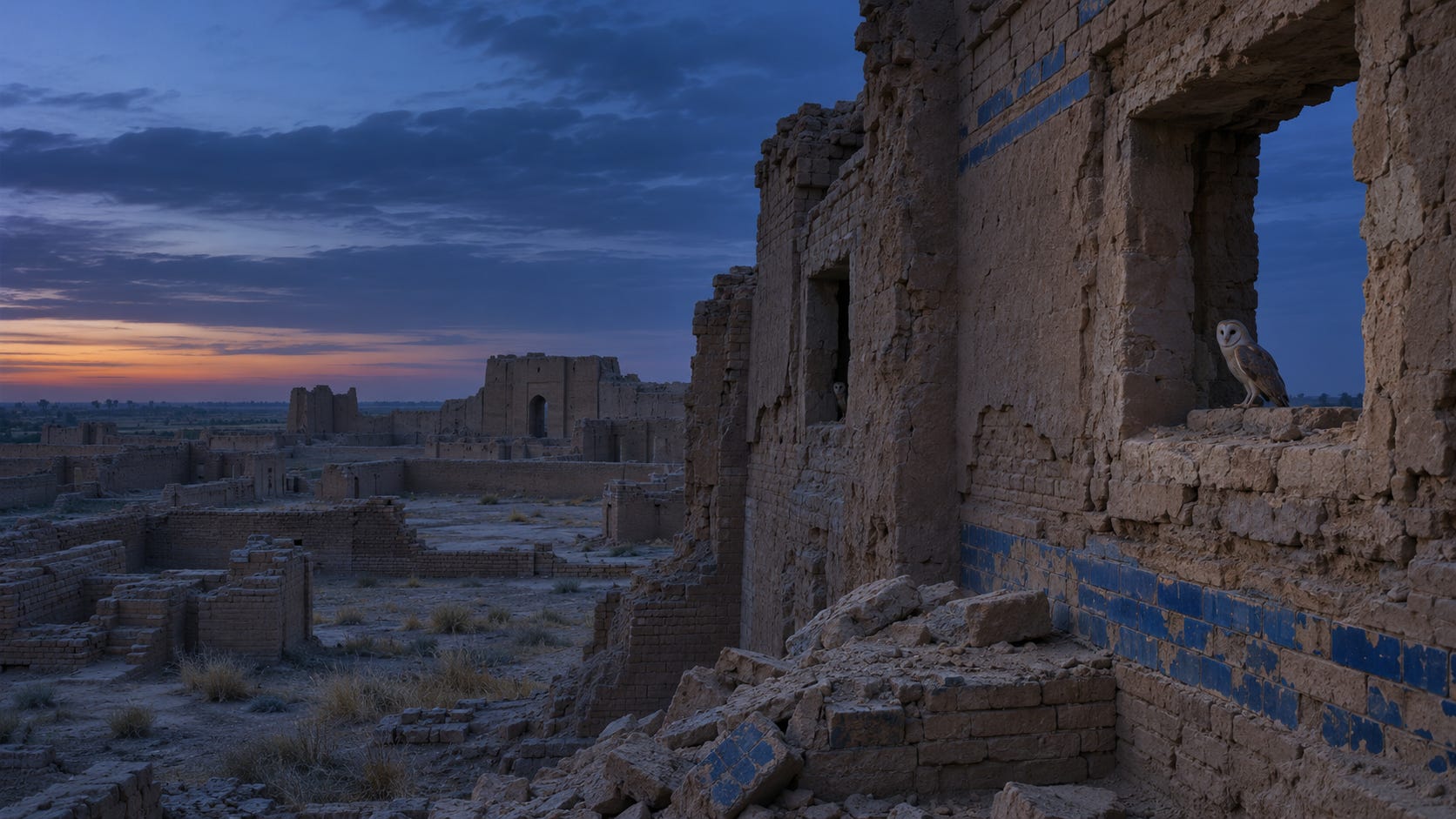
The prophecy becomes more specific in this last passage in Isaiah 13. The Medes will be stirred up to go against the Babylonian Empire. They will not have pity or compassion and this beautiful kingdom will become the haunt of animals like owls, goats, ostriches, hyenas and jackals.
Here’s a good commentary from Enduring Word:
a. I will stir up the Medes against them: If this prophecy was made decades before the Babylonian Empire defeated the Assyrian Empire and became a superpower, it was even longer before the time when the Medes came against the Babylonians, conquering them as instruments of God’s judgments.
i. It is specifically worded passages like this that drive skeptics of the Bible crazy, pushing them to regard Isaiah as written after the events prophesied. But doesn’t God know the future, and know it specifically?
ii. Will be as when God overthrew Sodom and Gomorrah: “The phrase ‘Sodom and Gomorrah’ suggests not only complete destruction but also its moral cause.” (Grogan)
b. It will never be inhabited: The ancient city of Babylon, once conquered, will never be inhabited again.
i. “When Cyrus conquered Babylon, he did not devastate the city. The walls were left standing until 518 B.C., and general desolation did not set in until the third century B.C. Babylon gradually fell into decay, and the prophecy of Isaiah was fulfilled. Babylon became completely depopulated by the time of the Muslim conquest in the seventh century A.D., and to this day it lies deserted.” (Wolf)
ii. This is also true in its ultimate fulfillment. When Jesus returns in glory and conquers the world system, He will rule the earth for 1,000 years. As He does, there will be no more “world system” in opposition to God as we know it. In this sense, the world system in opposition to God will never be inhabited again.
c. Owls…ostriches…wild goats…hyenas: The animals mentioned here are impossible to identify precisely. The picture is of the darkness and confusion surrounding the fall of Babylon.
i. “The ‘wild goats’ (v. 21) are sometimes associated with demons in goat form that are called ‘satyrs’ (Leviticus 17:7; 2 Chronicles 11:15).” (Wolf)
ii. John Calvin applied the truth of Isaiah 13 in this manner: “Whenever therefore we behold the destruction of cities, the calamities of nations, and the overturning of kingdoms, let us call those predictions to remembrance, that we may be humbled under God’s chastisements, may learn to gather wisdom from the affliction of others, and may pray for an alleviation of our own grief.”
A couple of takeaways:
This prophecy looks far into the future, after a robust Babylonian empire takes over the Assyrian empire to a time even later when they are defeated by the Medes. The accuracy of these prophecies are impossible to deny.
The desolation of Babylon is also hard to deny. Today Babylon is a collection of ruins in the southern part of Iraq. According to this commentary, this can be seen as the fulfillment of the prophecy, in that no world system will be in opposition to the Lord. However, there are still indications that this ruin of a city is not yet completely abandoned (see this Link), so this may point to an ultimate final fulfillment in the future.
As I look ahead, sadly, there is no commentary from Precept Austin on Isaiah 14 through Isaiah 34 (UPDATE before publishing: I may have found the commentary!). I really like the perspective of this resource, so this will make my task “interesting” for quite a while. Bible Hub is too “replacement theology” oriented, so we will see what happens.
My next devotional examines Isaiah 14:1-2 - The Fall of the King of Babylon.
Heaven on Wheels Daily Prayer:
Dear Lord - Please help me find additional resources to study as I enter the passages in Isaiah 14. Amen!
Citations and Credits:
Scripture quotations taken from the (NASB®) New American Standard Bible®, Copyright © 1960, 1971, 1977, 1995 by The Lockman Foundation. Used by permission. All rights reserved. www.Lockman.org.
Precept Austin was accessed on 11/27/026 to review commentary for Isaiah 13:17-22.
Biblehub.org was accessed on 11/27/2026 to review commentary for Isaiah 13:17-22.
Commentary from Enduring Word is used with written permission and without any alteration. ©1996-present The Enduring Word Bible Commentary by David Guzik – enduringword.com. At the link referenced, the bibliography used by David Guzik can be accessed.
Your daily writing is deep and very meaningful to me. Thank you so much for all that has been studied and lived to prepare it and is thus revealed through it. Soli Deo gloria