


“Is the axe to boast itself over the one who chops with it?
Is the saw to exalt itself over the one who wields it?
That would be like a club wielding those who lift it,
Or like a rod lifting him who is not wood.
Therefore the Lord, the God of hosts, will send a wasting disease among his stout warriors;
And under his glory a fire will be kindled like a burning flame.
And the light of Israel will become a fire and his Holy One a flame,
And it will burn and devour his thorns and his briars in a single day.
And He will destroy the glory of his forest and of his fruitful garden, both soul and body,
And it will be as when a sick man wastes away.
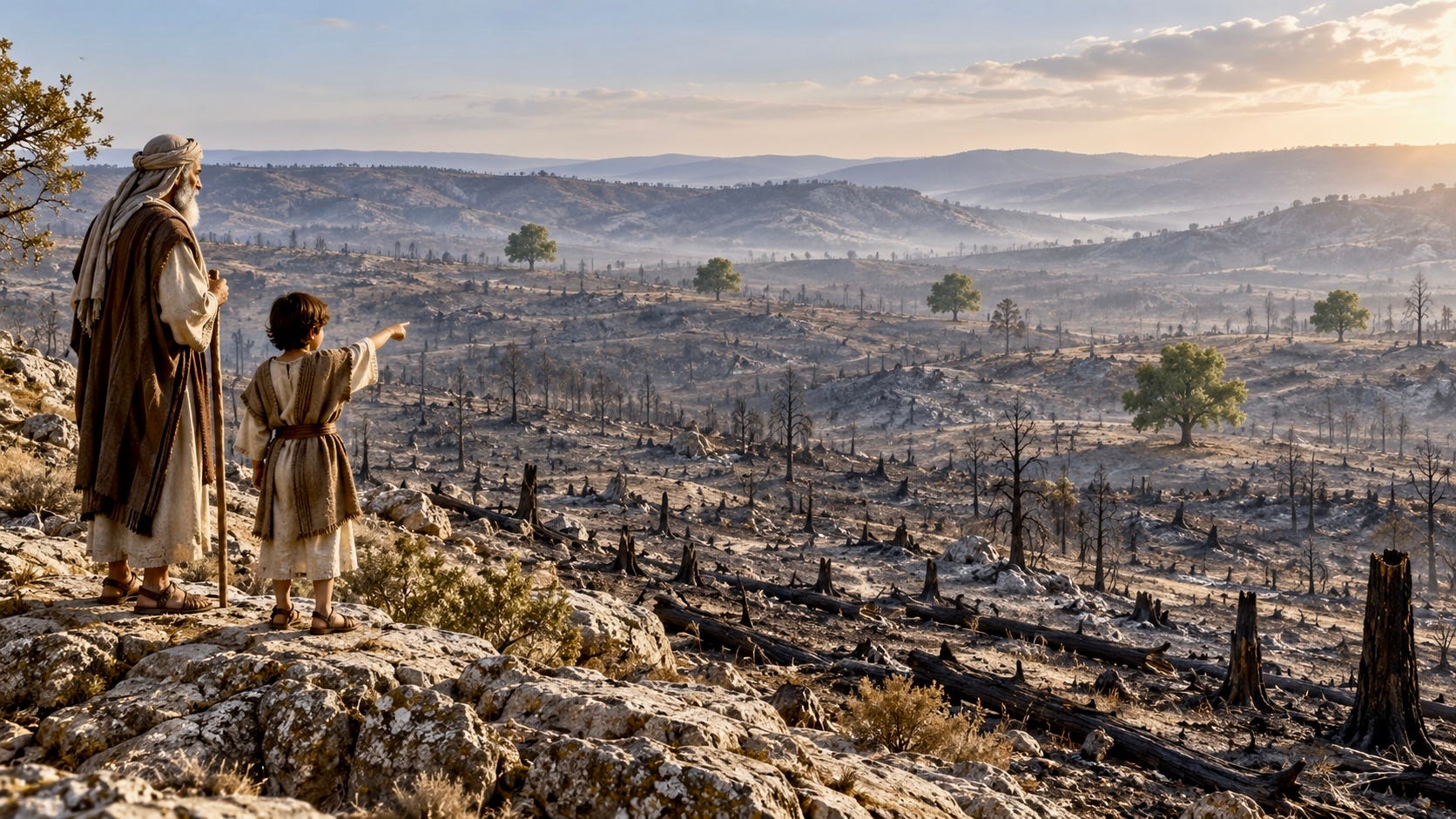
And the rest of the trees of his forest will be so small in number
That a child could write them down.”
Isaiah 10:15-19 NASB1995
The Lord continues to speak through Isaiah with words of warning to Assyria. He is using them in His plans to chastise Israel and Judah, but they should not think that they are in control. Let’s look at the commentary from Enduring Word on this passage:
a. Shall the ax boast itself against him who chops with it? The LORD uses the pictures of an ax, a saw, a rod, and a staff to make the point that the instrument should never take credit for what the worker does with the instrument. The scalpel can’t take credit for what the surgeon does; the strength and the skill are in the user, not in the instrument.
i. If it is easy for an unknowing instrument of God to become proud, it is also easy for a willing instrument of God to become proud. Jesus said we should have a different attitude: So likewise you, when you have done all those things which you are commanded, say, “We are unprofitable servants. We have done what was our duty to do.” (Luke 17:10) As wonderful as it is to be an instrument in the hand of God, the instrument deserves no special glory.
b. Therefore the Lord…will send leanness among his fat ones: Assyria sat “fat and sassy” at the time, but God would send leanness to them. His judgment will be like the burning of a fire among them, and it will consume the glory of his forest and of his fruitful field. The Lord will leave Assyria just a shadow of its former self.
i. Bultema on both soul and body: “Calvin warned against inferring from this that the soul is not immortal. What is meant, according to this keen expositor, is that the soul of this tyrant will have to pay for his wicked deeds on earth after the destruction of His body.”
I believe the cautionary tale is to be wary of church leaders and pastors who become so proud of their ability to deliver a message or lead the church effectively that they think their own skills are what should be credited for their success. The instrument in the hands of the Lord should never take credit for what the user (God) does with them. I’ve known more than one pastor who seemed to preen and bask in the glow of applause and compliments after they delivered a particularly good sermon. The same cautionary principle could apply to someone like me, a rank amateur, who is trying to deep dive into scripture to gain further illumination and discernment. I admit to liking the “likes” on my devotionals, but I must remind myself every day that I am an unprofitable servant who is doing my duty for the Lord.
The Lord will destroy Assyria, making it just a shadow of its former self. Let’s look at a little bit of the history of Assyria. This is from Wikipedia (the links have been left intact):
Assyria[e] was a major ancient Mesopotamian civilization that existed from the 21st to the 7th century BC which conquered and administered most of West Asia from the Assyrian heartland in Upper Mesopotamia.[4] Assyria is called the first true military superpower in human history, and pioneered major inventions and advances in the first libraries and large-scale preservation and accumulation of knowledge, as well as in statecraft, centralised government, bureaucracy, warfare, military organisation, propaganda, art, and architecture.
Assyrian imperial history spans the early Bronze Age to the late Iron Age, from its beginning as small Akkadian settlement in northern Mesopotamia to its zenith and collapse as the largest empire at the time, and is typically divided into the Early Assyrian (c. 2600–2025 BC), Old Assyrian (c. 2025–1364 BC), Middle Assyrian (c. 1363–912 BC), Neo-Assyrian (911–609 BC), and post-imperial (609 BC–c. 240 AD) periods.[5][6] The Assyrian people survive to this day and continue to live and practice their culture in their ancient heartland and in the diaspora.
…
The remaining Assyrian people, who had survived and preserved their native culture in northern Mesopotamia, were among the first people to accept Christianity in the 1st century AD, traditionally having been evangelized by St. Thomas the Apostle, one of the Twelve Disciples of Jesus Christ, and by the disciples St. Addaiand St. Mari, went on to develop a unique East Syriac rite and establish the Church of the East (which would go on to spread Christianity throughout large parts of Asia). The ancient Mesopotamian religion persisted at Assur until Assur’s final sack in the 3rd century AD, and at certain other holdouts for centuries thereafter.[10] A number of religious and cultural symbols, practices, customs, artistic styles, and genres from the ancient Mesopotamian religion and culture continue to be used and repurposed in Syriac Christianity to this day, such as the star of Shamash and the Easter Monday ‘gayasa’ (a play in the Sumerian disputation genre).
The triumph of ancient Assyria can be attributed not only to its vigorous warrior-monarchs but also to its adeptness in efficiently assimilating and governing conquered territories, using inventive and advanced administrative mechanisms. The developments in warfare and governance introduced by ancient Assyria continued to be employed by subsequent empires and states for centuries.[7]Ancient Assyria also left a legacy of great cultural significance,[11] particularly through the Neo-Assyrian Empire, making a prominent impression in later Assyrian, Greco-Roman, and Hebrew literary and religious traditions.[12][13][f]
I find it fascinating that the remnant Assyrians were among the first people to accept Christianity and their customs are still used by Syriac Christians today.
Here’s a map showing the extent of the Assyrian empire during two different eras (also from Wikipedia):
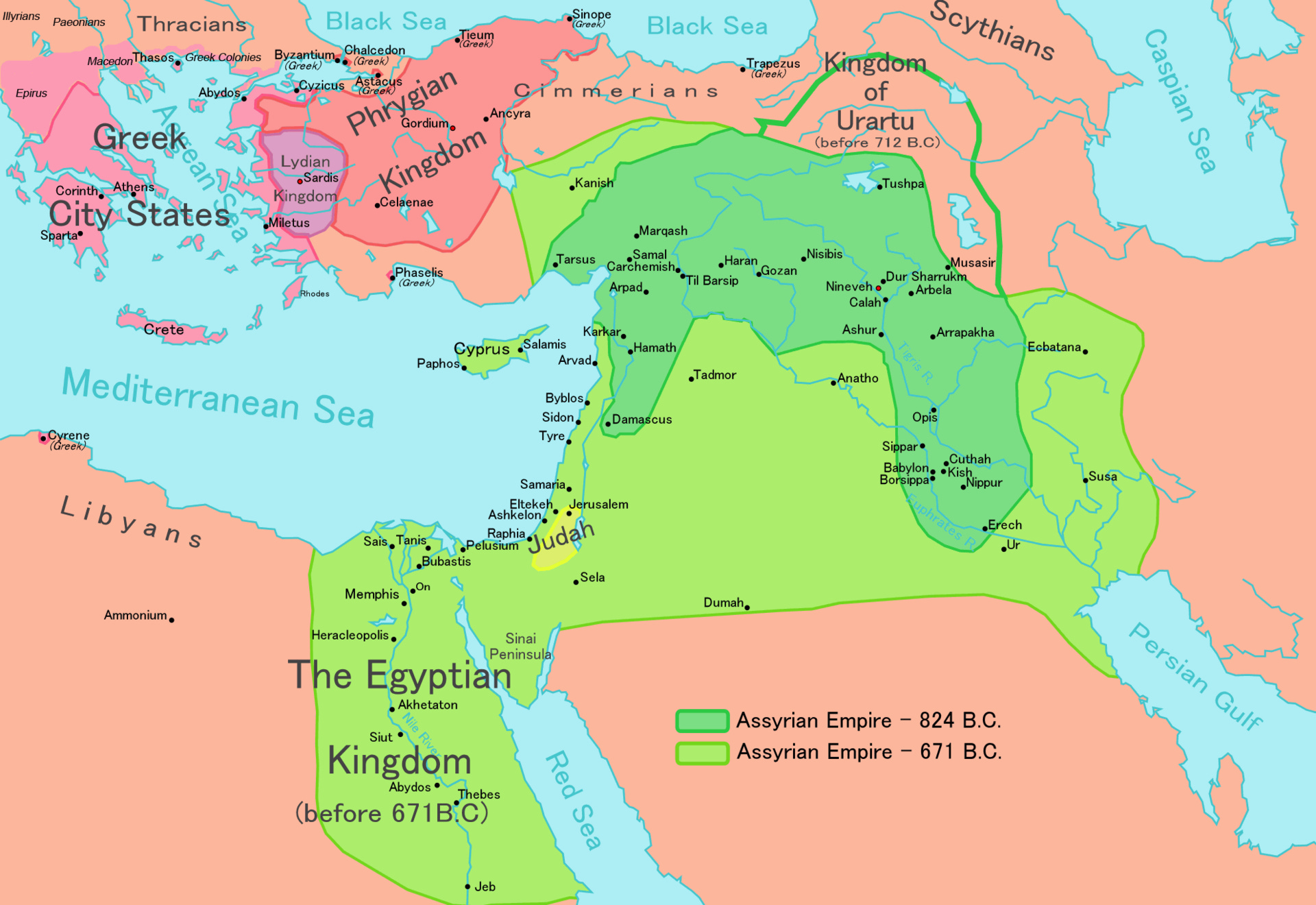
Note that by 671 B.C., the 10 northern tribes in Israel are completely absorbed by Assyria, but the tiny Judah (and Jerusalem) are not part of that empire. This map is from a completely secular source (Wikipedia), which goes out of its way to cast doubt on anything Biblical or supernatural or miraculous. But the map tells the story!!
A group known as the Biblical Foundation for Freedom has this excellent summary of the timeline (chart and text). Although we looked at this already in my introduction to Isaiah, it’s worth noting it again; that introduction was over three months ago and I’m still in Isaiah 10!
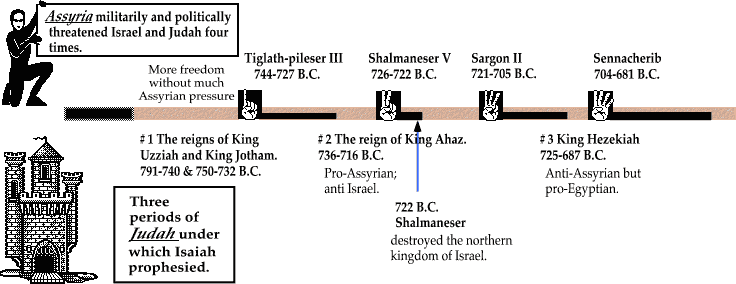
Three Periods of Judah During Isaiah’s Ministry
Uzziah (792–740 BC) and Jotham (750–732 BC): Judah flourished, but Uzziah’s arrogance and temple sin ended in leprosy, while Jotham served as co-regent for a time.
Ahaz (735–715 BC): This era was marked by decay, open idolatry, hostility from Syria and Israel, and a pro-Assyrian foreign policy.
Hezekiah (715–686 BC): He purified the temple and resisted idolatry. Some chronologies instead place his reign at 725–697 BC; the exact calendar years remain debated.
Assyria’s Four Major Pressures on Israel and Judah
Tiglath-pileser III (744–727 BC): Ahaz responded to the threat from Israel and Syria by sending tribute to Assyria.
Shalmaneser V (726–722 BC): Assyria besieged Samaria; the city fell in 722 BC (2 Kings 17:5–6).
Sargon II (721–705 BC): Judah became associated with the Ashdod revolt of 713–711 BC, though it escaped the harshest consequences.
Sennacherib (704–681 BC): Assyria devastated Judah’s towns and fortresses before Jerusalem was miraculously delivered (2 Kings 19:18–19).
So our passage today describes the miraculous delivery of Jerusalem, albeit at great loss to other parts of Judah, from the raid of Sennacherib. This event happens in one day, according to Isaiah 10. Isaiah is looking forward (prophetically) to events at a later day, as documented in Isaiah 37 and 2 Kings 19:
““Therefore, thus says the Lord concerning the king of Assyria, ‘He will not come to this city or shoot an arrow there; and he will not come before it with a shield, or throw up a siege ramp against it. By the way that he came, by the same he will return, and he will not come to this city,’ declares the Lord. ‘For I will defend this city to save it for My own sake and for My servant David’s sake.’ ”
Then the angel of the Lord went out and struck 185,000 in the camp of the Assyrians; and when men arose early in the morning, behold, all of these were dead. So Sennacherib king of Assyria departed and returned home and lived at Nineveh. It came about as he was worshiping in the house of Nisroch his god, that Adrammelech and Sharezer his sons killed him with the sword; and they escaped into the land of Ararat. And Esarhaddon his son became king in his place.”
Isaiah 37:33-38 NASB1995
“‘Therefore thus says the Lord concerning the king of Assyria, “He will not come to this city or shoot an arrow there; and he will not come before it with a shield or throw up a siege ramp against it. By the way that he came, by the same he will return, and he shall not come to this city,” ’ declares the Lord. ‘For I will defend this city to save it for My own sake and for My servant David’s sake.’ ”
Then it happened that night that the angel of the Lord went out and struck 185,000 in the camp of the Assyrians; and when men rose early in the morning, behold, all of them were dead. So Sennacherib king of Assyria departed and returned home, and lived at Nineveh. It came about as he was worshiping in the house of Nisroch his god, that Adrammelech and Sharezer killed him with the sword; and they escaped into the land of Ararat. And Esarhaddon his son became king in his place.”
2 Kings 19:32-37 NASB1995
The texts are virtually identical. The destruction of the forest by the fire of the Lord in Isaiah 10 is considered by most scholars to be metaphorical, describing the actions of the angel of the Lord against the Assyrian army (185,000 struck dead overnight). I don’t plan to skip Isaiah 37, so we will go through this again, perhaps with a different perspective after the intervening 27 chapters.
My next devotional examines Isaiah 10:20-27 - God will preserve a remnant of Israel.
Heaven on Wheels Daily Prayer:
Dear Lord - I am thankful for the guidance to go and study the historical aspects of this passage. In spite of the doubts that secularists at Wikipedia have about anything from Christianity and Scripture, the map aligns with Isaiah and 2 Kings. Help me to always be a humble instrument of Your will. Amen.
Citations and Credits:
Scripture quotations taken from the (NASB®) New American Standard Bible®, Copyright © 1960, 1971, 1977, 1995 by The Lockman Foundation. Used by permission. All rights reserved. www.Lockman.org.
Precept Austin was accessed on 10/27/2026 to review commentary for Isaiah 10:15-19.
Biblehub.org was accessed on 10/27/2026 to review commentary for Isaiah 10:15-19.
Commentary from Enduring Word is used with written permission and without any alteration. ©1996-present The Enduring Word Bible Commentary by David Guzik – enduringword.com. At the link referenced, the bibliography used by David Guzik can be accessed.
Other sources accessed for this devotional:
Wikipedia
Biblical Foundation for Freedom